FastField is a capable mobile forms platform, and I’ve spoken with teams who have used it successfully for years. But organizations tend to outgrow it as their operations mature. The forms still work, but everything around them – routing, approvals, corrective actions, and reporting – starts to strain.
In this article, I compare five FastField alternatives – Fluix, TrueContext, Fulcrum, Connecteam, and Forms On Fire – across offline reliability, reporting quality, integration depth, external user access, and pricing transparency.
For each tool, you’ll find key features, pros and cons, pricing, and real customer feedback. I work at Fluix, so it’s fair to factor that in, but I’ve made a conscious effort to represent each platform objectively.
All Picks at a Glance
| Alternative | Best For | Pros | Cons | Starting Price |
| Fluix | Inspection management | Offline, end-to-end workflows, external access included | Upfront setup investment | $29/user/mo |
| TrueContext | Field service | Deep integrations, AI-augmented workflows | From $400/mo per team; advanced features custom-priced | From $400/mo (whole team) |
| Fulcrum | GIS data collection | GPS/mapping, reliable offline, | Pricier than before; limited post-capture workflow | $43/user/mo |
| Connecteam | Team collaboration | HR + ops in one app, free tier, | Not an inspection tool; conditional forms gated to Advanced | From $29/mo (30 users) |
| Forms On Fire | Form building | Customizable, affordable, free support forever | Standard plan capped at 1,500 entries/user/mo | $20/user/mo (yearly) |
Why Look for FastField Alternatives?
FastField does basic form digitization well. But for teams running more complex field operations, a few problems tend to surface:
- No closed loop after submission. Data gets collected, but routing, corrective actions, and approvals require manual work or a plan upgrade.
- Offline sync you can’t fully trust. In low-connectivity environments, photos and timestamps don’t always make it through. For compliance teams, that’s not acceptable.
- Manual user management at scale. No bulk import from CSV or Excel. Adding 50 new seasonal inspectors means 50 manual entries.
- Reports that need finishing elsewhere. Getting data into a clean, client-ready PDF often means work outside the platform.
- Costs that grow with your operations. Workflow automation, external access, and advanced features are all add-ons or upgrades.
My Selection Framework
The above pain points translated directly into the criteria I used to evaluate every alternative here:
- Mobile-first experience – the tool should work in real field conditions.
- Offline reliability – sync behavior when returning to connectivity matters as much as offline capture.
- Workflow automation – routing, corrective actions, approvals in place.
- Reporting quality out of the box – audit-ready, without post-processing.
- Integration depth – native connections, not just Zapier chains.
- External user access and cost – no expensive add-ons for contractors.
- Transparent, scalable pricing – no hidden fees as teams grow.
- Support quality – responsive, accessible, especially during implementation.
1. Fluix: Best for Inspection Management
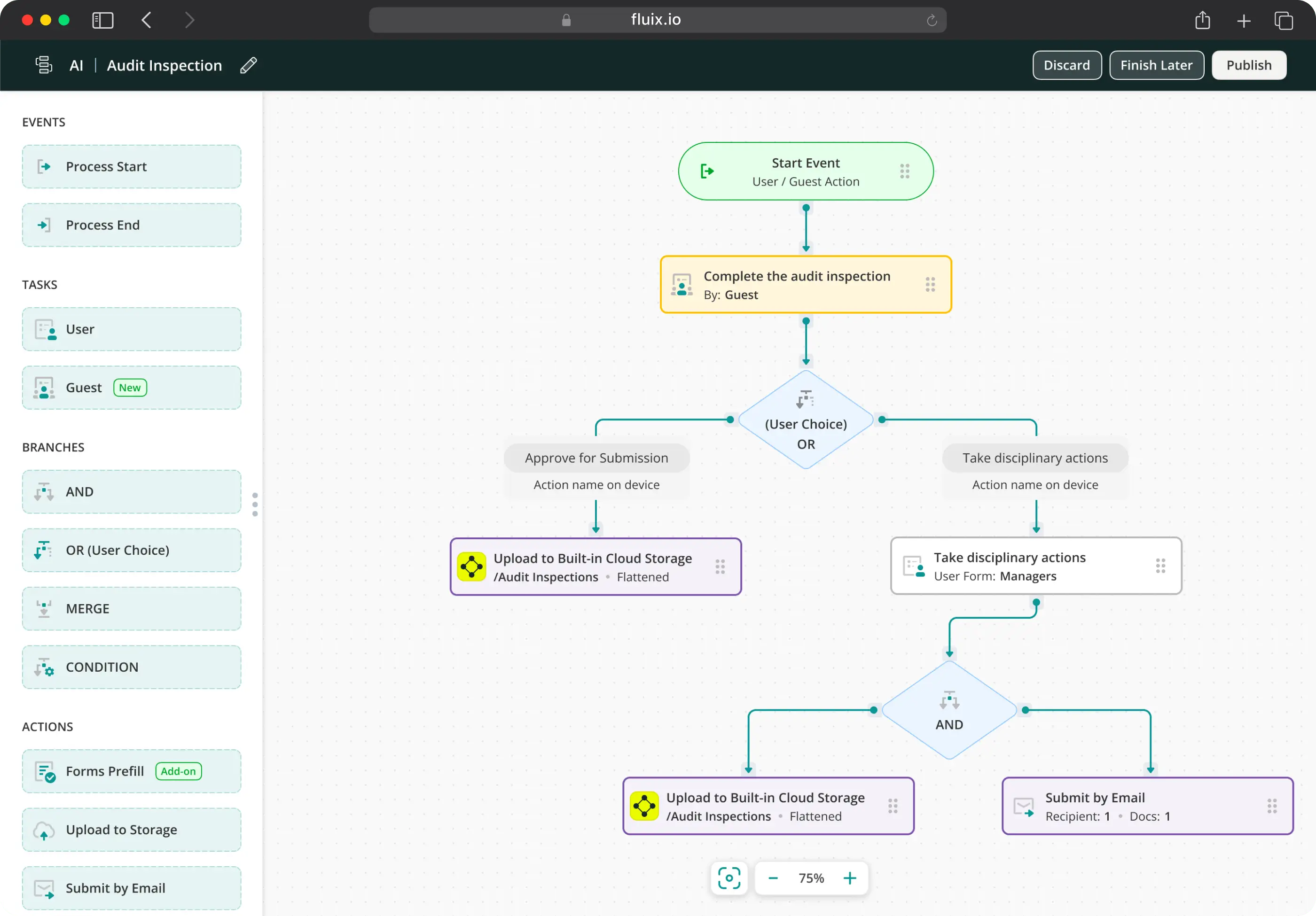
Fluix is inspection management software built for field teams who collect and manage a lot of data. While FastField stops at data capture, Fluix gets completed inspections to flow directly into corrective actions, approval chains, and audit-ready reports. Workflows are visual and flowchart-based, making it easy to see exactly how an inspection moves through review and into storage.
Fluix runs on web, iOS, and Android. It’s structured around two products: Docs, which handles document-heavy processes like sign-offs, permits, and compliance records, and Tasks, which manages checklist-based workflows and corrective action tracking. The two can work independently or together depending on how your operation is set up.
Security is enterprise-grade: SOC 2 Type II attested and ISO 27001 certified (ISMS), which I know matters for teams operating in regulated industries or submitting data to external auditors.
Teams switching from FastField most commonly cite three things: offline reliability including photos, external contractor access without add-on fees, and the quality of onboarding support.
Key Features
- Mobile checklists and inspections
- Offline mode with reliable photo sync
- Automated approvals
- Task scheduling and assignment
- Issue tracking
- Automated notifications and alerts
- Audit-ready reports and issue logs
- Charts and dashboards
Fluix Pros
- Genuine offline reliability, including photos, solving the exact sync failures that drive teams away from FastField.
- End-to-end workflow. Inspections connect directly to corrective actions, approvals, and reports without additional tools.
- External user access at no extra cost. Unlike FastField’s per-submission model, contractors participate in Fluix workflows without a separate bill.
- Dedicated implementation support. Every customer gets a Customer Success Manager and Solutions Architect from day one.
Fluix Cons
- Initial setup takes time to get right. Fluix’s workflow flexibility is genuinely powerful, but it means more upfront configuration than a simpler capture-only tool.
- Android is still catching up to iOS. The iOS experience is more feature-complete; Android users may occasionally hit limitations
- Not a CMMS. Teams needing asset management or preventive maintenance scheduling will need a separate tool
Pricing
- Crews: $29/user/month (5+ users)
- Operations: $49/user/month (15+ users) — includes external user access
- Enterprise: Custom (25+ users)
What Do Customers Say About Fluix?
4.8 — Capterra, 4.8 — G2
“The fact that you can use Fluix offline is an absolute must for us. It means that technicians can work on a boat, from their car, or from the top of a turbine.” James Bird, Maintenance Engineer, RWE Renewables
“Safety documents in Fluix allow us to do immediate sign-offs onsite. This way, auditors can look at the records in one system.” Leanne Lawrence, Administration Manager, Dyna Crane
Still Using a Forms Tool to Manage Inspections?
Fluix handles the full cycle from field capture to corrective actions, approvals, and audit-ready reports.
2. TrueContext (Previously ProntoForms): Best for Field Service
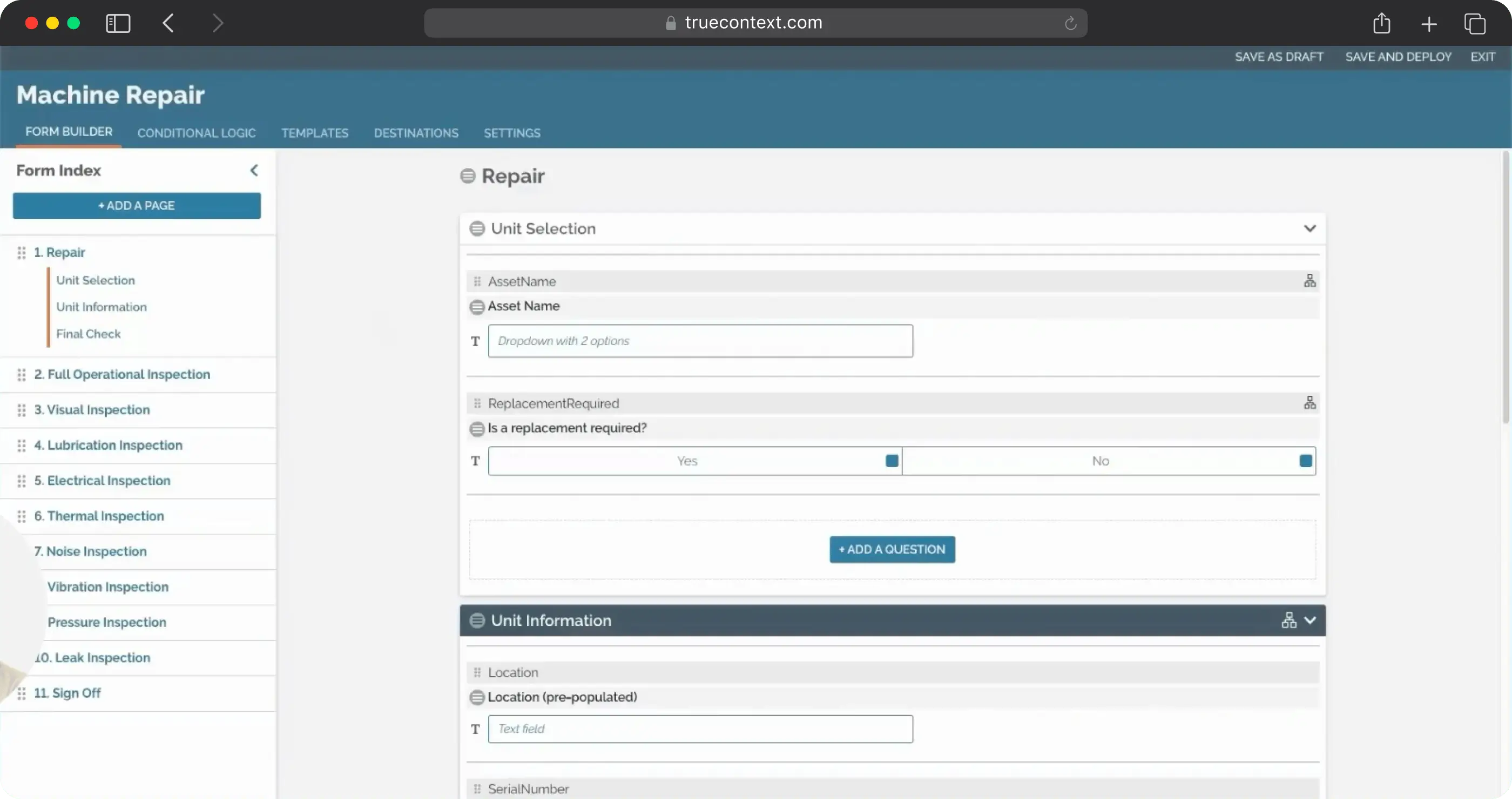
TrueContext is a field service workflow platform built around the idea of an “augmented technician.” Having AI at its core, TrueContext handles mobile data collection with sophisticated form logic, job dispatching, automated reporting, and bi-directional integration with enterprise systems. It supports iOS, Android, Windows, and macOS, and works offline across all plans.
That said, there are a few things prospective buyers should understand before getting excited. First, TrueContext’s pricing is per team, not per user. Their Digital plan starts at $400/month for your entire team, billed annually. That sounds manageable until you look at what’s actually included — multi-column layouts, advanced repeatable sections, SSO, and the ServiceNow connector all require the Intelligent or Elite tiers, both custom-priced. The headline number and the real cost of ownership diverge quickly.
Second, the Digital plan caps forms at 750 questions and 100 conditional logic rules — limits that complex inspection workflows will hit. And multiple G2 reviewers flag that reaching positive ROI takes longer than expected.
I’d recommend TrueContext to organizations with genuine enterprise integration requirements and the technical resources to implement properly, not as a straightforward swap for FastField.
Key Features
- Context-aware forms
- Guided workflows
- Job dispatching
- Native integrations
- Offline data capture
- Multi-language forms (Elite plan)
TrueContext Pros
- AI-guided workflows that surface contextual information to technicians
- Direct enterprise integrations reduce Zapier dependency for large organizations
- Strong security certifications for regulated industries
TrueContext Cons
- The $400/month entry point covers basic digitization only
- Digital plan limits (750 questions/form, 100 conditional rules) will constrain complex workflows
- G2 reviewers consistently flag slower ROI, the configuration investment is real and should be budgeted for
- Mobile interface feels dated relative to newer platforms
Pricing
- Digital: From $400/month (entire team, billed annually)
- Intelligent: Custom pricing
- Elite: Custom pricing
TrueContext does not publish per-user pricing. Requires a direct conversation with sales to understand actual costs for your team size.
What Do Customers Say About TrueContext?
4.6 – Capterra, 4.5 – G2
“This product enables us to collect various field data, feed it into our corporate EH&S and Asset Management systems, saving a lot of time and effort. The forms are easy to build and intuitive to use.” Oleksiy Golovchenko, Sr. Air Compliance Specialist, Encana
“Powerful platform once configured, but expect a few weeks before your team is fully comfortable. The ROI takes time to materialize.” G2 review, Utilities
3. Fulcrum: Best for GIS Data Collection
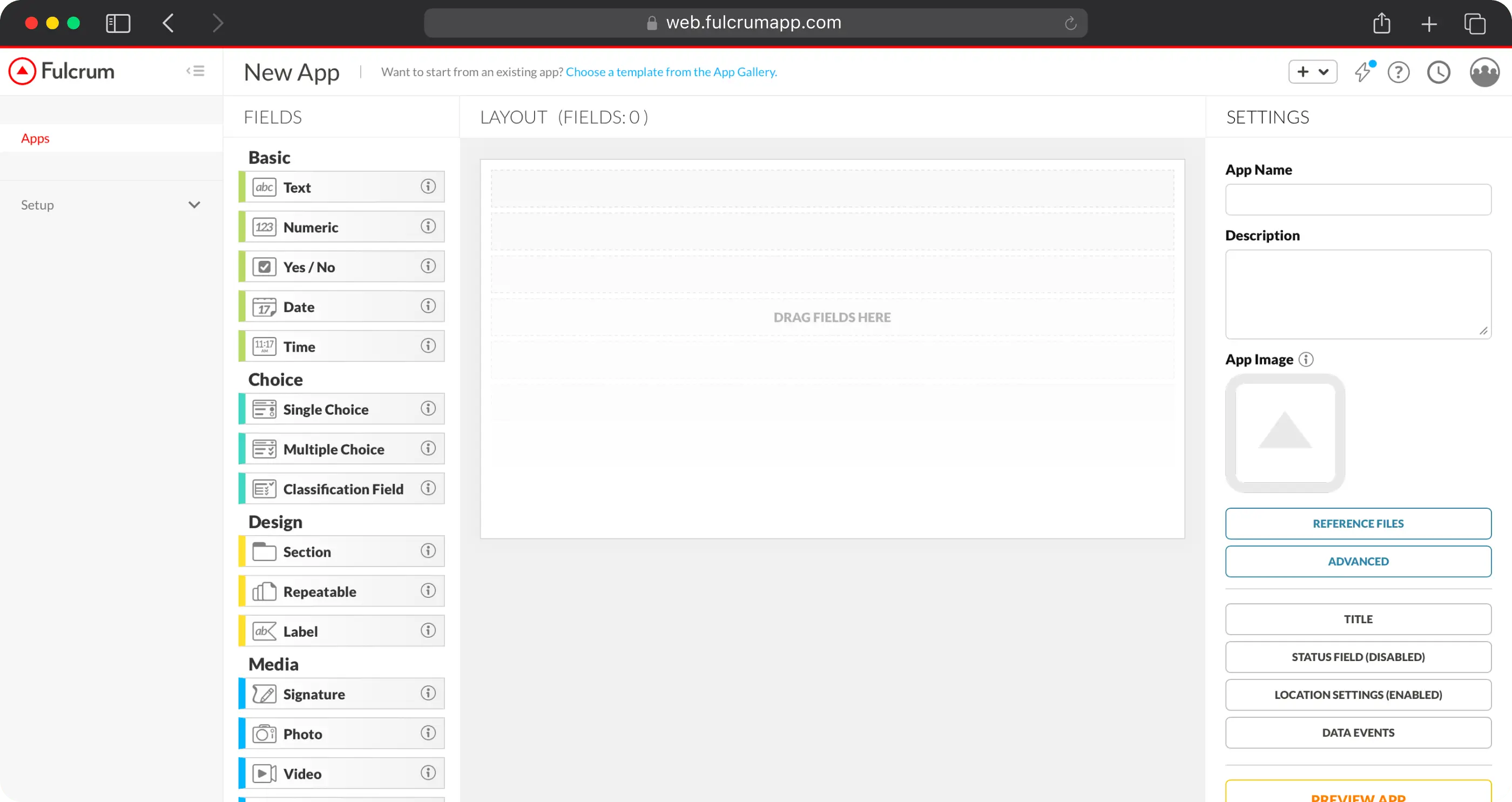
Fulcrum is purpose-built for data collection, and for teams that do environmental surveys, asset mapping, or utility inspections, its GIS capabilities are unmatched on this list. Native Esri ArcGIS integration, geocoding, GPS-stamped records, and the newly launched Insights feature that turns field data into plain-language reports and maps.
It recently acquired Wildnote, deepening its environmental and regulatory reporting capabilities, and announced a partnership with KPMG focused on utility operations. These are meaningful signals about where the platform is headed, and who it’s being built for.
Outside of GIS and environmental/utilities use cases though, the limitations are more apparent. There’s no meaningful corrective action workflow, approval routing is basic, and at $43–55/user/month it’s now notably more expensive than alternatives with broader workflow capability. If location intelligence isn’t core to your work, you’re paying for something you won’t use.
Key Features
- GPS stamping and geocoding on all records
- Native Esri ArcGIS integration (ArcGIS Enterprise on Elite plan)
- AI-powered plain-language field data analysis
- Photo and video capture with location metadata
- Offline data collection with automatic sync
- Webhooks and operational API (Elite plan)
Fulcrum Pros
- Unmatched GIS and mapping capabilities for location-sensitive fieldwork
- Insights AI feature genuinely adds value: ask plain-language questions, get maps and trend reports
- Clean form builder accessible to non-technical administrators
Fulcrum Cons
- Outside GIS and environmental use cases, the $43–55/user/month price tag is hard to justify against alternatives with deeper workflow capability
- No native corrective action workflows — there’s no closed loop after data capture
- Webhooks and API access require the Elite plan; no operational API on Professional
Pricing
- Professional: $43/user/month (billed annually)
- Elite: $55/user/month (billed annually)
- Enterprise: Contact Fulcrum (unlimited users, dedicated CSM)
What Do Customers Say About Fulcrum?
4.7 – Capterra, 4.6 – G2
“I like Fulcrum because it allows me to capture, review, edit, and transfer data seamlessly during asset inspections. I also enjoy being able to export the data and overlap it with an existing map.” G2 review
“Good data capture tool. But if you need to do anything meaningful with the data after collection – routing, approvals, follow-ups — you’ll need something else alongside it.” G2 review
4. Connecteam: Best for Frontline Workforce Management
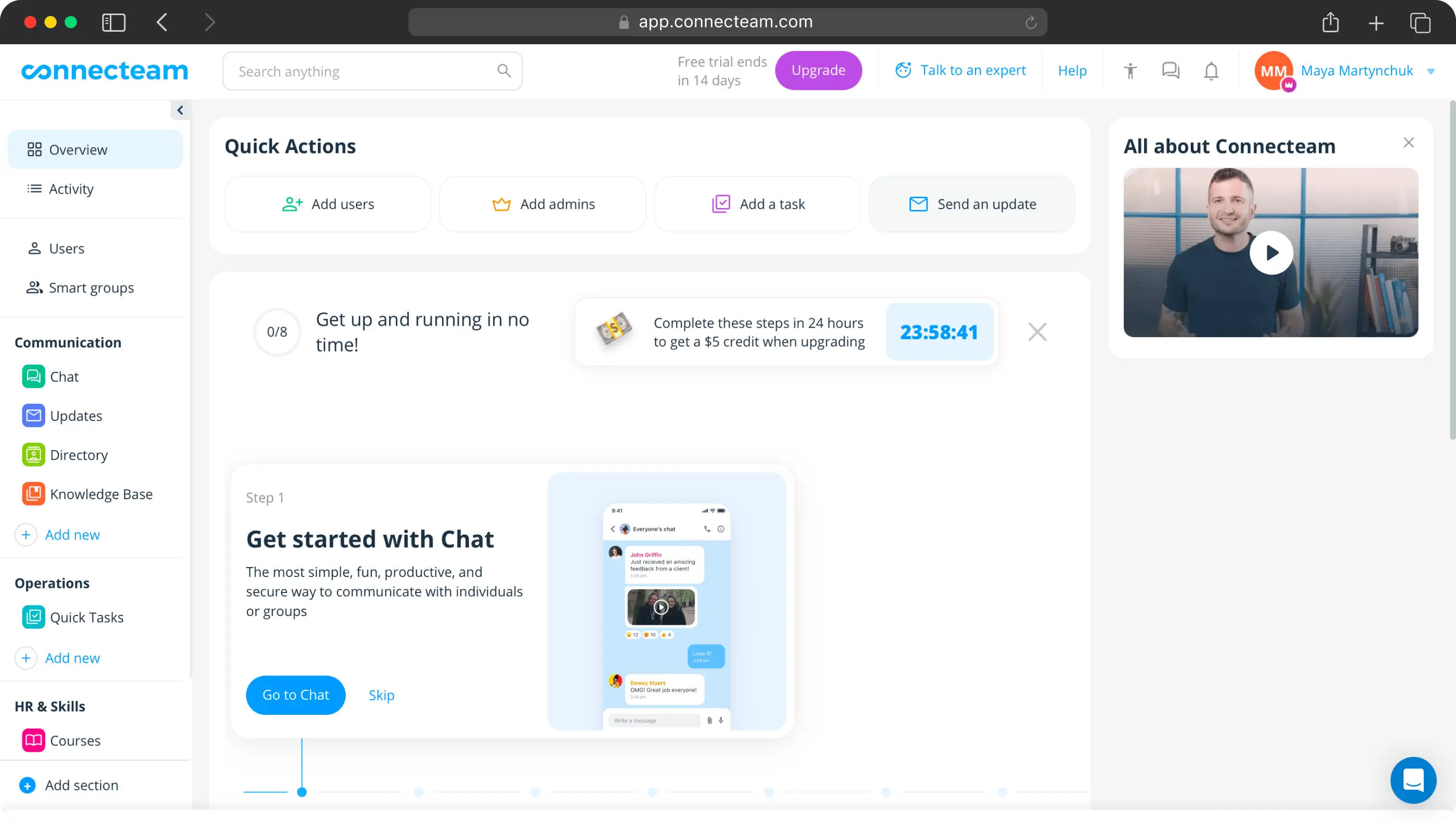
I want to be clear about what Connecteam actually is, because it’s easy to mistake it for an inspection platform. It isn’t. It’s a frontline workforce management tool used by over 80,000 companies including Hilton, Subway, Chipotle, and Burger King, and that customer list tells you a lot about what it’s built for. Time tracking, scheduling, team messaging, HR processes, training, and compliance for deskless workers in hospitality, retail, and F&B.
The overlap with FastField is limited to digital forms and checklists. And there’s a meaningful catch: conditional fields in forms are only available on the Advanced plan ($49/month) and above – on Basic, your forms are static. For teams whose primary need is inspection quality and audit documentation, Connecteam won’t solve that.
Where it does shine is support: 24/7 live chat with under 5-minute response times, which is genuinely better than what FastField or most tools on this list offer.
Key Features
- Time clock and attendance tracking with GPS geofencing
- Employee scheduling and labor forecasting
- Leave and absence management
- Team chat and broadcast messaging
- Digital forms and checklists (conditional logic on Advanced+)
- Compliance and certification tracking
- Training modules and knowledge base
- AI-powered features (Expert plan and above)
Connecteam Pros
- Genuinely broad platform, replaces multiple apps
- Flat pricing for the first 30 users makes it cost-effective for larger deskless teams
- 24/7 live support with under 5-minute response times, genuinely better than most competitors
- Free forever for teams under 10 users
Connecteam Cons
- Forms are basic and conditional logic is gated to Advanced ($49/mo). On Basic, forms are static, which significantly limits inspection use cases
- Offline capability is limited; not suitable for teams in genuinely poor connectivity environments
- Reporting is functional but not deep; custom analytics require workarounds
Pricing
(Per hub, for first 30 users, billed annually)
- Free: Up to 10 users (all hubs, full features)
- Basic: $29/month per hub
- Advanced: $49/month per hub
- Expert: $99/month per hub
- Enterprise: Custom
What Do Customers Say About Connecteam?
4.7 – Capterra, 4.6 – G2
“This all-in-one solution is perfect for large, multi-location teams.” Heather, IT Manager (201–500 employees), Capterra.
“Great for workforce management. Just don’t expect it to replace a proper inspection or audit platform.” G2 review, Retail
5. Forms On Fire: Best for Form Building
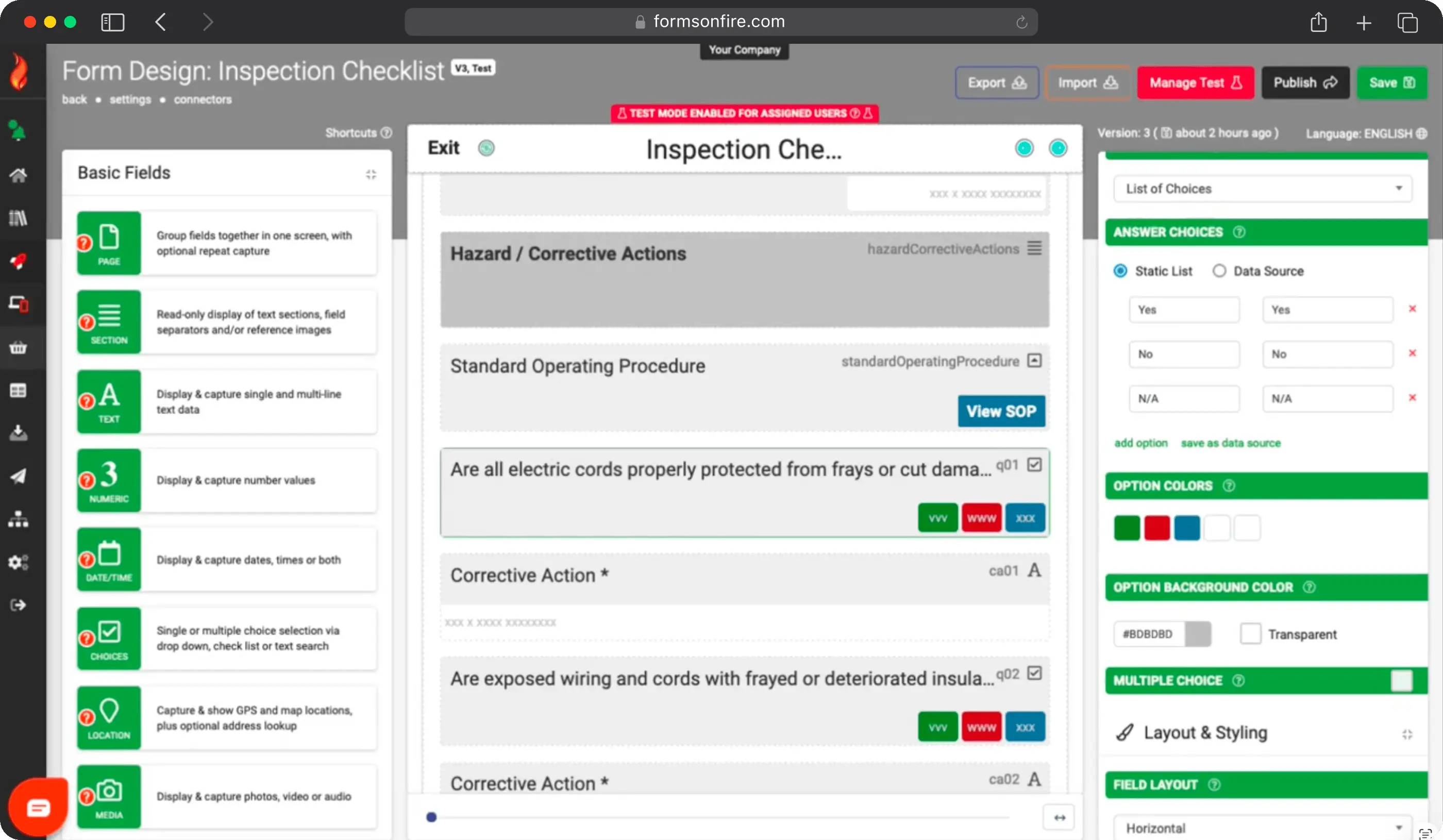
Forms On Fire is a mobile forms platform that covers the full form lifecycle: build, collect, dispatch, and integrate. The form builder is where it stands out. Beyond standard drag-and-drop, it supports Excel-style logic, conditional branching, repeatable sections, and an AI Assistant that generates forms from a voice description, typed prompt, or uploaded PDF.
For teams with existing paper forms or Word documents, the conversion process is fast. The designer also supports Excel export and import, which makes bulk editing practical for large form libraries.
On the integration side, Forms On Fire connects to 3,000+ systems via pre-built connectors and an open REST API, including SharePoint, Google Drive, Dropbox, SQL Server, Power BI, Salesforce, and ServiceNow. Workflow, dispatch, and task management are available on the Premium plan and above.
One genuine differentiator worth mentioning: support is free, forever, on all plans, no ticket queues, no upsells. For smaller teams without dedicated IT resources, that’s a meaningful commitment.
Where it’s more limited is on the workflow side of inspections. Forms On Fire handles capture and distribution well, but corrective action tracking and multi-party approval chains aren’t native capabilities, teams that need a closed loop after submission will find it falls short of platforms like Fluix or TrueContext.
Key Features
- AI Form Builder
- Drag-and-drop form designer with Excel export/import
- Photo, audio, video, GPS, barcode, NFC, and signature capture
- Workflow, task management, and dispatch (Premium plan)
- White-label / private label option
- Free support, forever
Forms On Fire Pros
- Strongest AI form builder on this list – describe by voice or upload a PDF, get a deployable mobile form in minutes
- Free support with no ticket queues — a genuine and rare commitment
- White-label option lets organizations brand the entire experience — useful for agencies and enterprises
Forms On Fire Cons
- Standard plan is capped at 1,500 entries/user/month — high-volume inspection teams will hit this ceiling and need Premium
- Workflow, dispatch, and task management require Premium ($28/user/mo yearly) — the entry-level plan is essentially form capture only
- Enterprise features (SSO, MS SQL Sync, WebForms) require 25+ users and contact for pricing
- Smaller user community than FastField or Fluix — fewer peer resources and third-party tutorials
Pricing
- Standard: $20/user/month
- Premium: $28/user/month
- Enterprise: Contact Forms On Fire (25+ users required)
What Do Customers Say About Forms On Fire?
4.5 – G2
“By working with Forms On Fire, we’ve realized more than a 1,000% return on our investment.” Misti Matteis, Founder & CEO, Sedo Laser
“Fantastic platform for easy customization and massive improvements to efficiency.” Robert Myers, Dir. of Operations, Marker Investments
How to Migrate from FastField to Your Tool of Choice
Switching platforms sounds more disruptive than it usually is, but only if you go in prepared. The teams I’ve seen struggle with migrations are almost always the ones that underestimated how much undocumented process was living inside their old tool.
The actual migration (like rebuilding forms, configuring workflows, connecting systems) is the straightforward part. The preparation is what determines whether you go live in eight weeks or eight months. So before you touch anything in your new platform, get the following in order:
- Audit your current FastField setup. Document all active forms, workflows, and integrations before touching anything.
- Export your historical data. Download existing submissions and reports while you still have access.
- Prioritize your migration order. Start with critical compliance workflows; migrate by team or location, not in one cutover.
- Define success criteria before go-live. Set measurable outcomes upfront so you can evaluate whether the switch worked.
- Assign internal ownership. At minimum: someone from IT or ops, and a field team representative.
- Run a structured pilot. Test with a small group, collect formal feedback, resolve issues before scaling.
- Don’t underestimate training time. Even intuitive platforms have a learning curve for field staff.
- Verify integrations end-to-end before switching off FastField – confirm connected systems sync correctly with the new platform
At Fluix, every migrating customer is paired with a Customer Success Manager, Solutions Architect, and support team covering integration setup, workflow configuration, and training. Most teams are live within 4 weeks, not 4 months (yes, I’ve heard of such terms).
Have questions about whether Fluix is the right fit for your team? Talk to us – we’re happy to walk through your specific setup before you commit to anything.