Near misses happen every day on job sites, construction projects, wind farms, and factory floors. Most go unreported because reporting is too slow, the form is back at the office, or the app does not work without signal.
This guide for operations managers, HSE leads, and safety supervisors in field-heavy industries like oil and gas, construction and wind energy, who need near miss reports to actually reach the right person and result in a closed corrective action.
I reviewed seven platforms based on how they perform in real field conditions: offline capability, how quickly a report can be submitted, whether findings automatically route to a corrective action, and whether the resulting record holds up under audit.
Contents:
How I Picked This List
- Market analysis. I mapped the near miss reporting software category — who the main players are, which tools appear consistently across analyst reports, G2 and Capterra category listings, and procurement shortlists from teams I have spoken with.
- Hands-on testing. I tested every tool on this list that offers a free trial or demo — walking through the near miss report submission flow, the corrective action routing, and the admin dashboard. I specifically tested offline mode: put the app in airplane mode, submitted a report with photos, reconnected, and checked whether the data came through cleanly.
- G2 and Capterra reviews. I read the actual review text, not just the scores. I looked for patterns: what do reviewers praise consistently, what do they flag as the recurring frustration after 12 months of use, and where does the gap between the sales demo and the live product show up. Pricing complaints, sync failures, and support quality issues all appear in the reviews long before they appear in the marketing.
- Reddit and LinkedIn communities. EHS managers and safety officers talk candidly in r/OccupationalSafety, r/FieldService, and LinkedIn groups for HSE professionals. What they say about near miss software in peer conversations is often more useful than any review platform.
- My own experience as a PM at Fluix. I have spent 7 years working on inspection and safety management software. I know what field teams actually struggle with during rollout and what breaks down six months in.
7 Best Near Miss Reporting Software for Field Teams
Quick Comparison
| Tool | Best for | Starting price |
|---|---|---|
| Fluix | Field teams in regulated industries | $29/user/month |
| Mitti (formerly SafetyCulture) | Broad safety management and easy start | Free / $24/user/month |
| Intelex | Multi-site teams | Quote-based |
| VelocityEHS | Large enterprises | Quote-based |
| EHS Insight | Mid-market incident and near miss management | ~$5,000/year |
| Vatix | Lone worker safety | From £199/month |
| Benchmark Gensuite | Enterprise EHS with AI-powered insights | Quote-based |
1. Fluix – Best for Field Teams in Regulated Industries
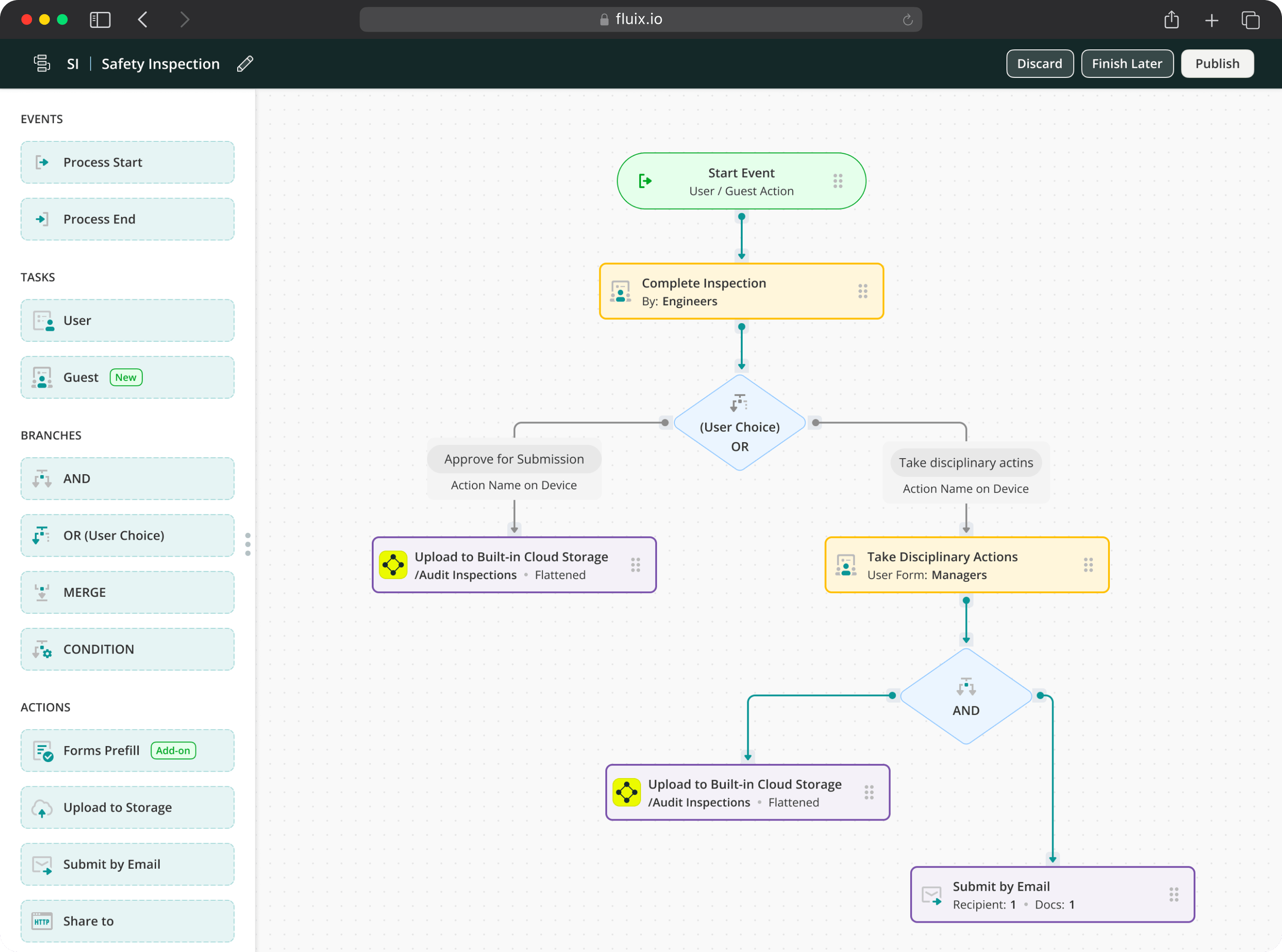
Fluix inspection management software field teams across construction, energy, oil and gas, and aviation use to capture incidents and near misses, and stay audit-ready.
Near miss reporting in Fluix is part of the full inspection and corrective action workflow. A technician submits a near miss report from mobile, including photos, GPS location, and a timestamp. That report automatically creates a corrective action assigned to a named person with a due date. A supervisor can review and push it back if something is missing before it closes. The full record is stored with an audit trail that holds up under OSHA and regulatory review.
This matters most in the environments where near misses actually happen. A crew working on a remote construction site, offshore platform, or wind turbine nacelle at 80 meters has no reliable connectivity. Fluix’s full offline mode — inspections, photo capture, e-signatures, GPS timestamps — works without signal and syncs automatically when connectivity returns.
Key features
- Full offline mode — near miss reports, photo capture, GPS, and e-signatures work without signal
- Automated corrective action routing — finding assigned to named person with due date, no manual follow-up
- Multi-step approvals — supervisor reviews before the report closes
- AI form generation — build near miss report forms from a plain-language prompt
- Field Intelligence MCP connector — query live near miss and incident data through Claude, Copilot, or ChatGPT
- Task scheduling, issue reporting, and non-conformance reporting
- Integrations: Procore, Power BI, Salesforce, HubSpot, Airtable, Claude, Copilot, ChatGPT
- ISO 27001, SOC 2 Type II, HIPAA, GDPR certified
Pricing
- Crews: $29 per user/month, 5+ users
- Operations: $49 per user/month, 15+ users
- Enterprize: Quote request, 25+ users
Ratings
4.8 — Capterra · 4.8 — G2
Logging Near Misses Is Easy for Your Field Teams with Fluix
2. Mitti (Formerly SafetyCulture) – Best for Broad Safety Management and Easy Start
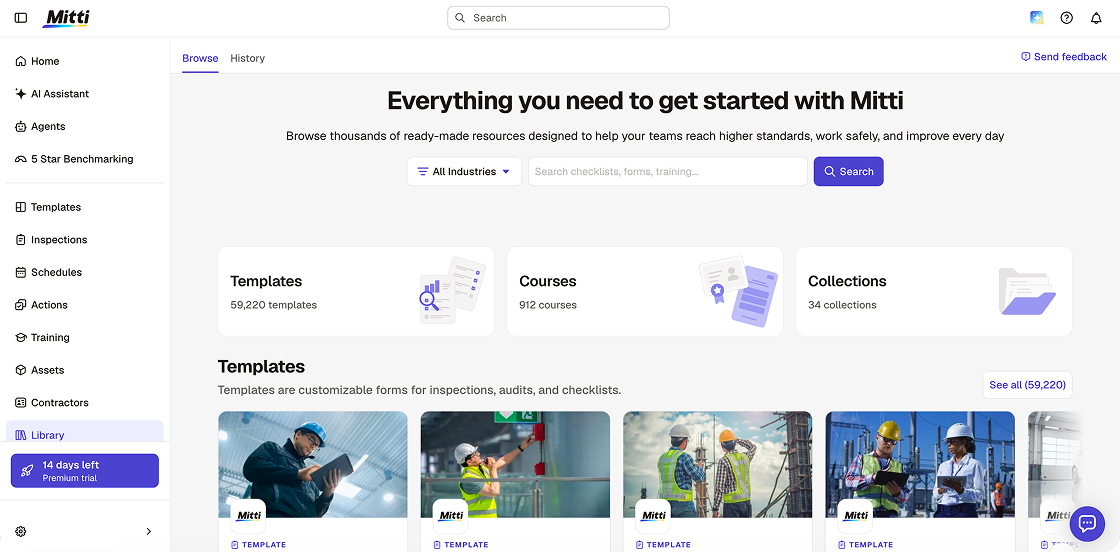
Mitti (formerly SafetyCulture, originally iAuditor) is the near miss reporting platform most teams try first. The reason for that is the template library that now exceeds 59,000 customisable options. The mobile app is genuinely excellent. The free plan for up to 10 users is functional enough to run real inspections.
Alongside the August 2026 rebrand from safetyCulture, Mitti launched a significant AI suite: AI Agents that monitor site activity and run routine tasks in the background, an AI Assistant that surfaces patterns across safety data, AI Issue Creation that converts photos and voice into structured reports automatically, and 5-Star Benchmarking that scores each site in a portfolio.
The honest limitation for regulated industries: Mitti’s task management is one-directional. Once a worker marks a near miss as actioned, it is actioned. There is no native mechanism for a senior reviewer to push it back with notes before it counts as resolved. For teams where multi-stage sign-off is a compliance requirement, this is a real gap.
Key features
- Customisable near miss and safety templates with AI template generation
- Mobile-first capture with full offline support
- Corrective action tracking and basic task management
- AI Agents and AI Assistant
- AI Issue Creation — photos and voice to structured reports
- 5-Star Benchmarking — site performance scoring across portfolio
- IoT sensor integration for real-time environmental monitoring
Pricing
- Free: $0, up to 10 users — 5 active templates, basic near miss reporting
- Lite Seat: $5/user/month
- Premium: $24/user/month (annual) / $29/user/month (monthly)
- Enterprise: Custom
Ratings
4.6 — Capterra · 4.6 — G2
Want to compare this tool? Compare alternatives to SafetyCulture.
3. Intelex – Best for Multi-Site Teams
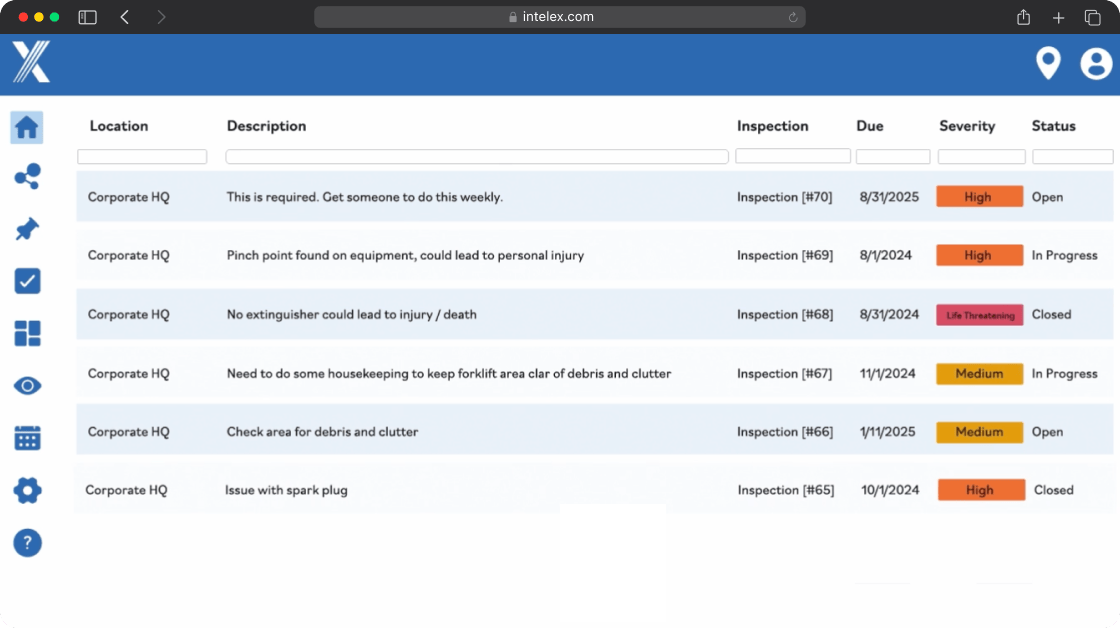
Intelex turns field near miss data into enterprise-level safety insights. The platform is used by large organisations managing multiple sites, complex regulatory frameworks, and global safety operations. Near miss reports captured in the field connect directly to incident management, corrective actions, and root cause analysis, giving safety managers a complete picture across the organisation.
The platform’s mobile-first reporting works offline, with GPS and photo capture available in the field. Integration with CRM and ERP systems means near miss data flows into the broader operational picture without manual re-entry.
Where Intelex is not the right fit: teams under 50 users who need fast deployment without IT involvement. The platform is enterprise-grade in scope and requires configuration time and dedicated admin resources.
Key features
- Mobile offline near miss and incident reporting with GPS and photo capture
- Integrated incident management and corrective action tracking
- Root cause analysis tools
- Scheduled task dispatch with real-time updates
- Role-based access control and digital signatures
- CRM and ERP integration
Pricing
Enterprise pricing based on organisational needs and scale — contact Intelex for a quote.
Ratings
4.4 — Capterra · 4.3 — G2
4. VelocityEHS – Best for Enterprise EHS Management
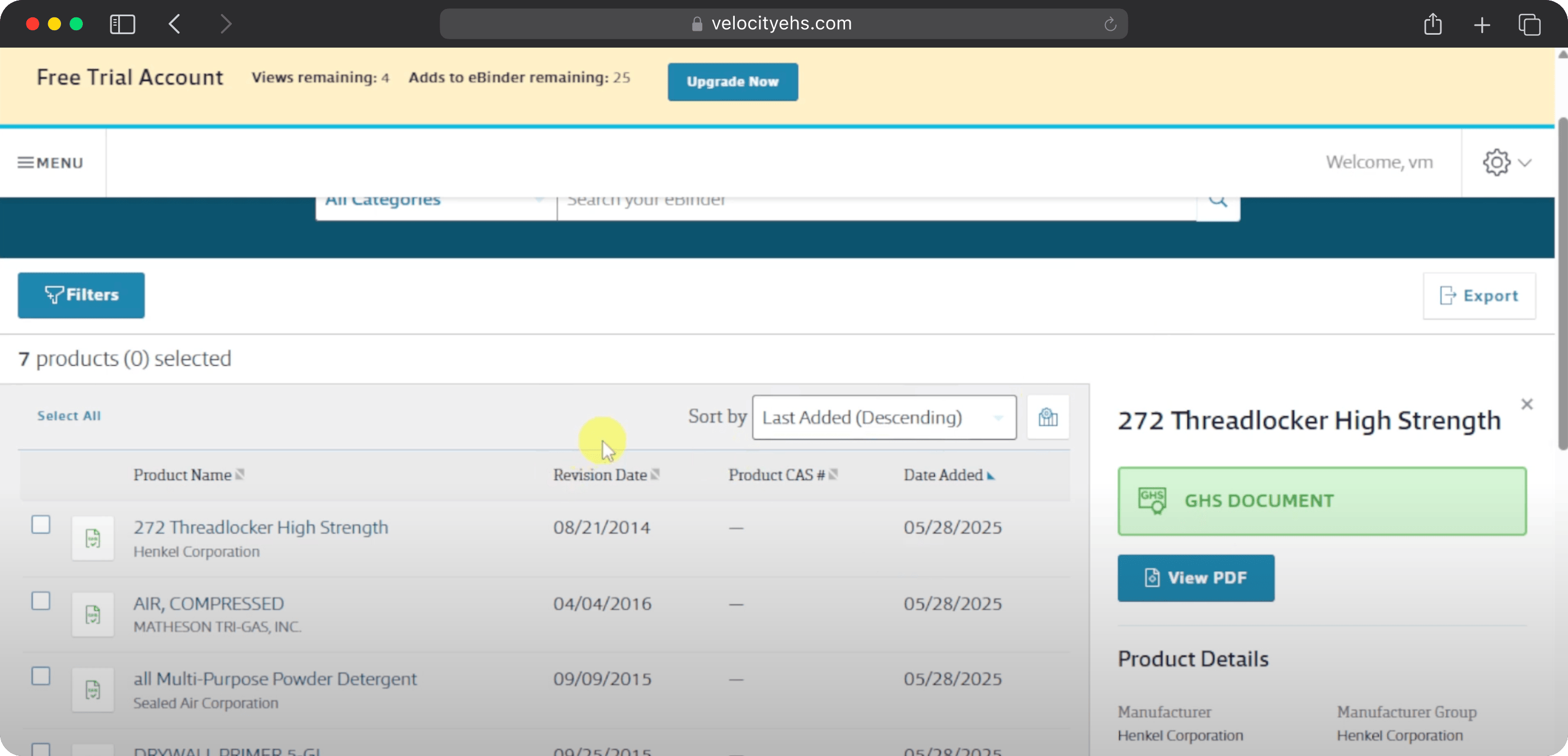
VelocityEHS is trusted by one-third of the Fortune Global 1000. For large enterprises managing complex multi-site EHS programmes — where near miss reporting is one component of a broader safety management system covering chemical management, industrial hygiene, ergonomics, and ESG — VelocityEHS is one of the most comprehensive platforms available.
In 2026, VelocityEHS gained FedRAMP authorization — relevant for government sector buyers and federal contractors. The platform also expanded its SAP integrations to 60+ connections.
Near miss reports in VelocityEHS connect to leading indicator tracking, corrective action management, and cross-site lesson sharing. Advanced analytics dashboards surface patterns before they become incidents.
Where it is not the right fit: field-first teams that need a fast, mobile-focused near miss app without the overhead of an enterprise EHS platform. The scope and cost reflect the enterprise it is built for..
Key features
- Mobile near miss and incident reporting — online and offline
- Leading indicator and performance indicator tracking
- Advanced analytics dashboards and real-time data visualisation
- Corrective action management
- Cross-site lesson sharing and root cause analysis
- FedRAMP-authorised security
- ESG tracking aligned to CDP, GRI, TCFD, CSRD
Pricing
Custom pricing based on organization needs.
Ratings
4.4 — Capterra · 4.4 — G2
5. EHS Insight – Best for Mid-Market Near Miss and Incident Management

EHS Insight is built for mid-sized organisations that need comprehensive near miss and incident management without enterprise-level complexity or cost. The platform connects near miss reports to incident management, surfacing patterns and improving resolution across safety programmes.
EHS Insight was recognised as a 2026 Leader by Capterra and Software Advice, and rated number one for usability in G2’s mid-market EHS index.
The honest limitation: some users report that large audits can time out in very low connectivity areas, and the setup requires internal EHS expertise to maximise the platform’s depth.
Key features
- Mobile near miss and incident reporting with full offline mode
- Integrated incident management and corrective action tracking
- Root cause analysis and CAPA workflows
- OSHA and TRIR reporting
- Performance and leading indicator tracking
- Advanced analytics dashboards
- Hybrid LMS for safety training
Pricing
Starting from approximately $5,000/year for the SMB solution. Enterprise pricing depends on requirements. 14-day free trial available.
Ratings
4.6 — G2
6. Vatix – Best for Lone Worker Safety
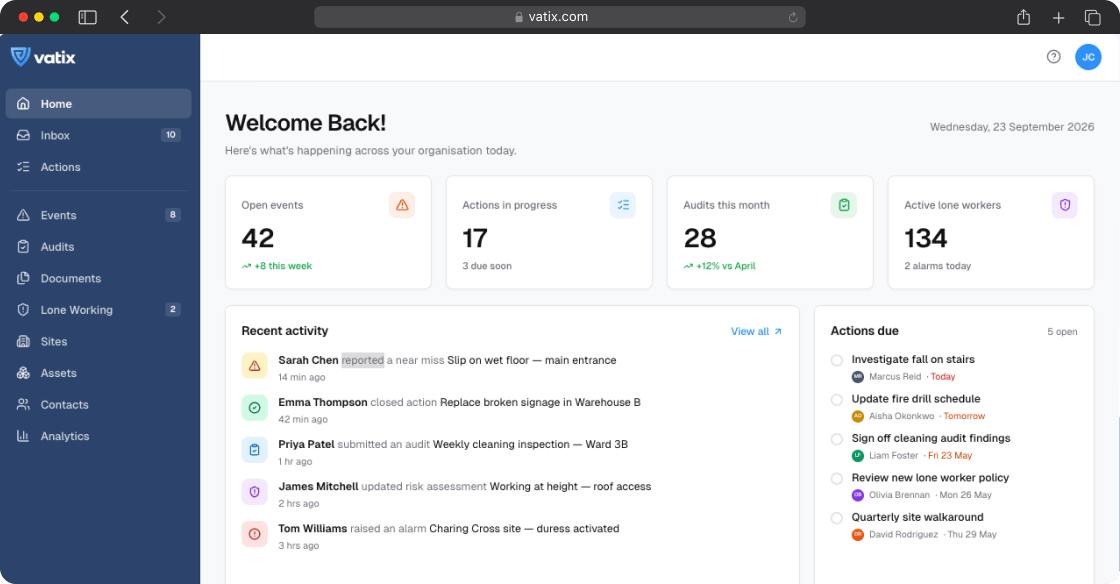
Vatix is a connected, customisable platform for managing safety, risk, and compliance. Near miss reports can be submitted through the mobile app, web, or a QR code, with anonymous and public reporting supported. Assignment rules route each report to the right people and the right follow-up workflow automatically.
What distinguishes Vatix in this list: it is the only platform with fully published, transparent pricing — a rare characteristic in this category. It also offers a dedicated workforce user tier at £2.50/person/month for frontline staff who only need to submit reports and complete assigned actions, without paying for full platform access.
Vatix is UK-based and particularly well-suited to UK and European organisations given its GBP pricing and BS 8484-accredited lone worker protection. US-based teams should confirm current USD pricing directly.
Key features
- Near miss reporting via mobile app, web, or QR code
- Automated assignment rules route reports to the right workflow
- Audits and inspections with scoring, signatures, and photo evidence
- 40+ chart types, KPI dashboards, and trend analysis
- Lone worker protection with BS 8484:2022 accreditation
- Custom fields and configurable workflows
- Live dashboards across all safety activity
Pricing
- Essentials: £199/month (5 full users included, billed annually) — additional full users £19/month
- Professional: £399/month (5 full users included, billed annually) — additional full users £29/month
- Workforce users: from £2.50/person/month — for frontline staff submitting reports and completing actions
- Enterprise: Custom
Ratings
4.5 — G2 · 4.6 — Capterra
7. Benchmark Gensuite – Enterprise EHS with AI-Powered Insights
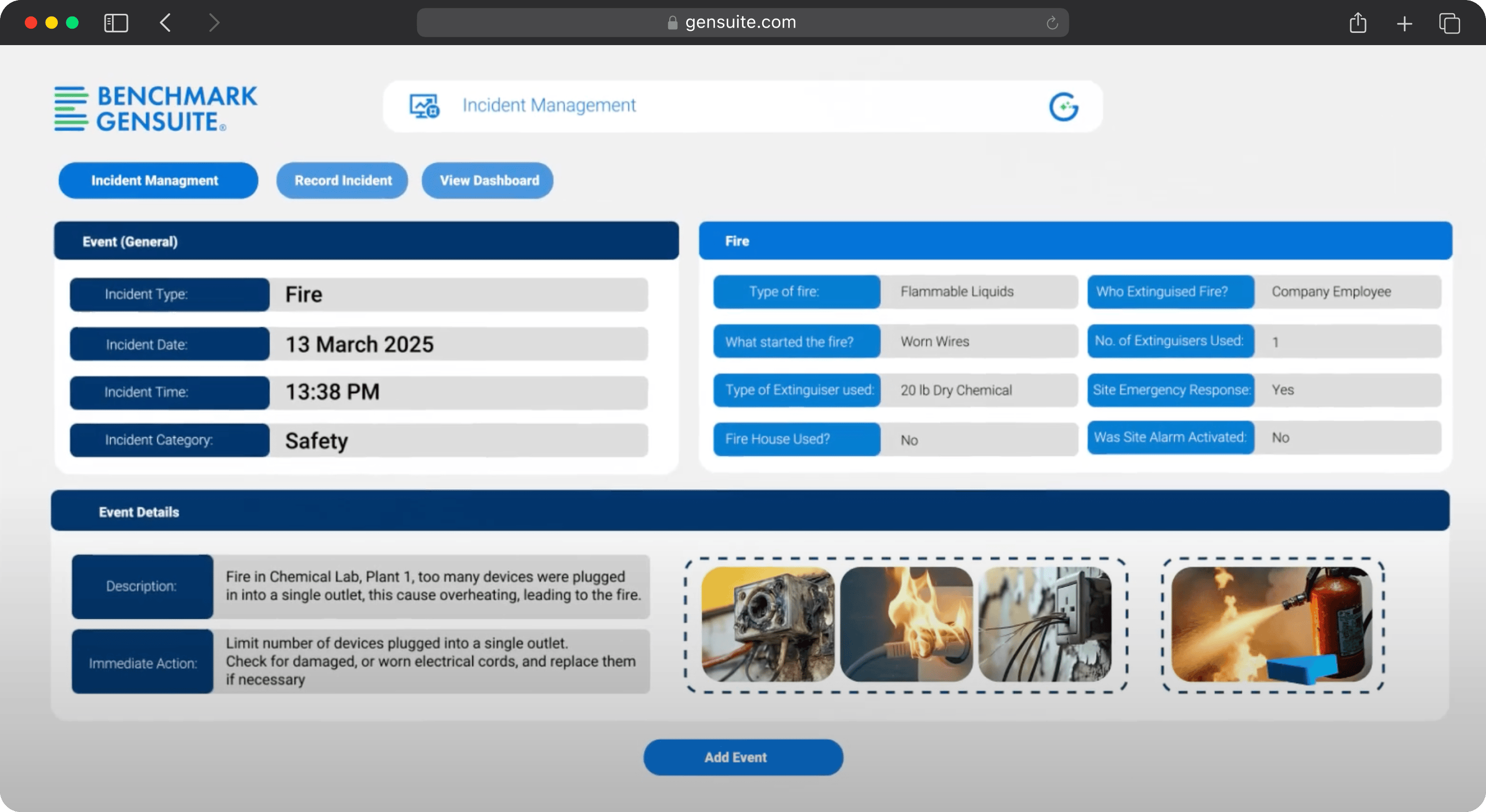
Benchmark Gensuite serves over 3 million users worldwide with a broad EHS and ESG platform. For enterprise teams where near miss reporting is part of a larger safety programme including training, audits, incident management, and sustainability reporting, Gensuite provides a comprehensive connected system.
In 2026, Benchmark Gensuite launched Genny AI — recognised by Occupational Health and Safety magazine as New Product of the Year in the EHS Software category. Genny AI assists EHS teams with data collection, predictive insights, and proactive risk mitigation — turning near miss report patterns into forward-looking safety intelligence.
The honest limitation: the platform has a steep learning curve and significant cost. Customisation can be slow. For teams that need near miss reporting without enterprise EHS overhead, a more focused tool is a better fit.
Key features
- Near miss and concern reporting with customisable forms
- Pre-built safety hazards and controls — or fully customised
- Genny AI — predictive insights from near miss and safety data
- Job safety analysis with offline capability
- Corrective action management and cross-site lesson sharing
- SDS management — 70M+ SDS library
- ESG tracking aligned to CDP, GRI, TCFD, CSRD
- Power BI integration and custom dashboards
Pricing
Quote-based pricing.
Ratings
4.5 — Capterra · 4.4 — G2
How to Choose the Right Near Miss Reporting Software for You
Selecting any tool for field operations requires balancing desired outcomes with the realities of frontline work.
Of course, you’ll also have to consider things like budget, the number of users, and how easily the software scales with your team’s needs. But most importantly your end users (who will be actually using the tool most often) should be happy about it.
Here’s how to make the right choice:
- Start with Your Frontline Reality: Do you have the needed number of mobile devices to report from the field? Are your field teams tech-savvy? Have you ever used any software before? If the answer is mainly “no,” think of how you’ll be onboarding everyone.
- Access Your Form Library: If you have all your forms in paper, you’ll need time to convert them into digital templates. It’s nice to consider tools that support multiple formats. If you are still working from a paper form, start with our free Near Miss Report Template.
- Check the Connection Requirements: Does the software still work when Wi-Fi drops? Your teams shouldn’t wait for connectivity to document critical safety issues.
- Think About Scale: Can the solution handle multiple sites? Different languages? New safety protocols? Nobody wants to change platforms just as your teams get comfortable.
- Will You Be Supported? The best features mean nothing without solid support when you need it. Ask about ongoing support and whether you’ll have your dedicated account manager. Even if you’re an IT specialist, you’ll be needing help at times.
FAQ
- What is near miss reporting software?
Near miss reporting software is a digital platform that helps field teams capture, document, and act on near miss events — replacing paper forms with mobile workflows. A near miss is any unplanned event that did not result in injury or damage but had the potential to do so. Software ensures near misses are reported consistently, routed to the right person, and resolved with a documented corrective action.
2. Does near miss reporting software need to work offline?
For most field teams, yes. Near misses happen in locations where connectivity is unreliable — on construction sites, offshore platforms, and remote oil and gas facilities. Fluix captures near miss reports fully offline — including photos, GPS timestamps, and e-signatures — and syncs automatically when signal returns.
3. What is the difference between a near miss and an incident?
An incident results in injury, illness, or damage. A near miss is an unplanned event that did not cause harm but could have under slightly different circumstances. Both should be reported and investigated. Near miss reporting is often considered more valuable than incident reporting because it allows organisations to address hazards before they cause harm. Fluix handles both through a single incident and near miss reporting software — from field capture to corrective action to audit-ready record.
4. Can near miss reporting software integrate with existing safety systems?
Yes — most platforms on this list integrate with broader EHS, ERP, and data systems. Fluix integrates with Procore, Power BI, Salesforce, and through its MCP connector with Claude, Copilot, and ChatGPT. Intelex and VelocityEHS integrate with SAP and enterprise ERP systems.
5. How long does it take to implement near miss reporting software?
Fluix deploys most teams in approximately four weeks including template setup, integrations, and training. Mitti can be live the same day using its template library. Enterprise platforms like Intelex and VelocityEHS typically require longer configuration — budget for dedicated admin time.