JSA software’s main task is to move the analysis to the device in a technician’s pocket, remove the paper from the process, and create a documented, timestamped safety audits that hold up when regulators ask for it.
This guide is for operations managers, HSE leads, and safety supervisors in construction, energy, oil and gas, and manufacturing who need JSA tools that work in real field conditions — offline, on mobile, and with enough flexibility to match how their crews work.
I reviewed more than 20 platforms and narrowed the list to seven. Here is what I found.
Contents:
How I Picked This List
- Market analysis. I mapped who consistently appears across analyst shortlists, G2 and Capterra category pages, and the procurement conversations I have with field operations teams at Fluix.
- Hands-on testing. I tested every tool that offers a free trial — completing a JSA from scratch, testing offline mode by putting the app in airplane mode, and checking whether the completed analysis routes correctly to a supervisor for sign-off.
- G2 and Capterra review patterns. I read the review text, not just the scores. Recurring complaints after 12 months of use tell you more than the sales demo. I looked specifically for what breaks down in the field — sync failures, form flexibility limits, pricing surprises at renewal.
- My own experience as Product Lead at Fluix. I have spent years working on inspection and safety management software for field teams. I know what crews struggle with during rollout and what breaks down six months in.
Top 7 Job Safety Analysis Software
1. Fluix – Best for Field Teams in Regulated Industries
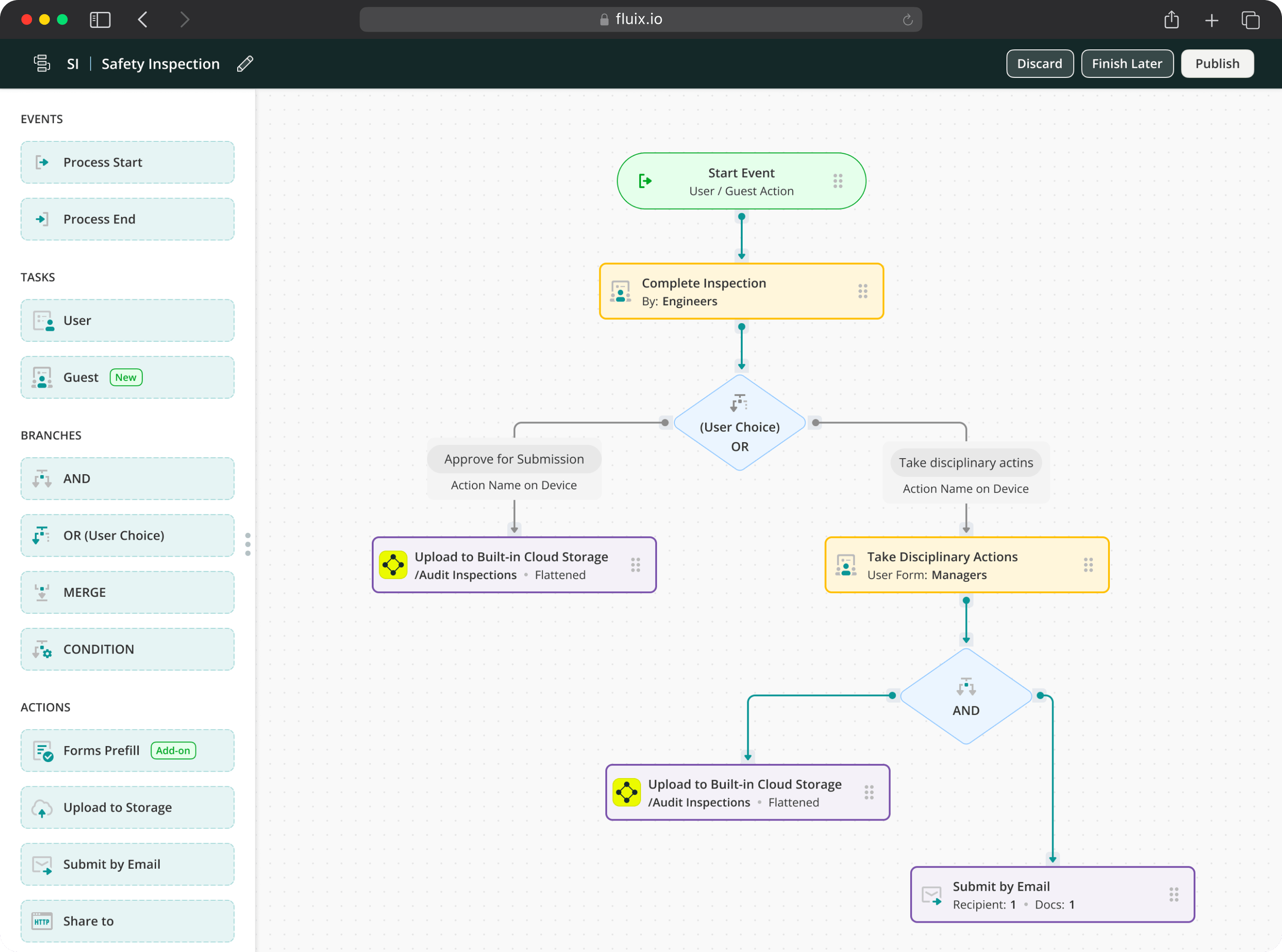
Fluix is inspection management software field teams use to run inspections, JSAs, permits to work, and compliance documentation.
A JSA in Fluix is part of the full inspection and corrective action workflow. A technician completes the JSA on mobile before the task begins, including photos of the worksite, a risk assessment, and a hazard control log. The completed analysis routes automatically to a supervisor for sign-off. If a hazard is flagged, a corrective action is assigned to a named person with a due date.
This matters most in the environments where JSAs actually need to happen. A crew working on a remote construction site, offshore platform, or at height without connectivity cannot wait for signal to complete a pre-task safety analysis. Fluix’s full offline mode captures JSA forms, photos, GPS timestamps, and e-signatures without signal and syncs automatically when connectivity returns.
For construction inspection software specifically, Fluix handles the full safety documentation cycle — JSAs before work begins, equipment inspections during, and incident reports when something goes wrong — all in one platform.
“In our industry, safety is paramount; regulations are very strict, and audits are frequent. We use Fluix to create audit checklists and safety documents because it allows us to do immediate sign-offs onsite.” Leanne Lawrence, Administration Manager, Dyna Crane, saving $286,650 annually and reclaiming 3,185 labour hours
Key Features
- Mobile JSA, JHA, and AHA forms — offline-first, iOS and Android
- Full offline mode — forms, photo capture, GPS timestamps, and e-signatures work without signal
- Automated routing to supervisor for sign-off before work begins
- Multi-step approvals with push-back capability
- Task scheduling and permit to work management
- Field Intelligence MCP connector — query live JSA and safety data through Claude, Copilot, or ChatGPT
- ISO 27001, SOC 2 Type II, HIPAA, GDPR certified
Pricing
- Crews: $29 per user/month, 5+ users
- Operations: $49 per user/month, 15+ users
- Enterprize: Quote request, 25+ users
Ratings
Ratings: 4.8 — Capterra · 4.8 — G2
Improve Your JSA Operations with Fluix Today
2. Mitti (Formerly SafetyCulture) – Best for Broad Safety Coverage
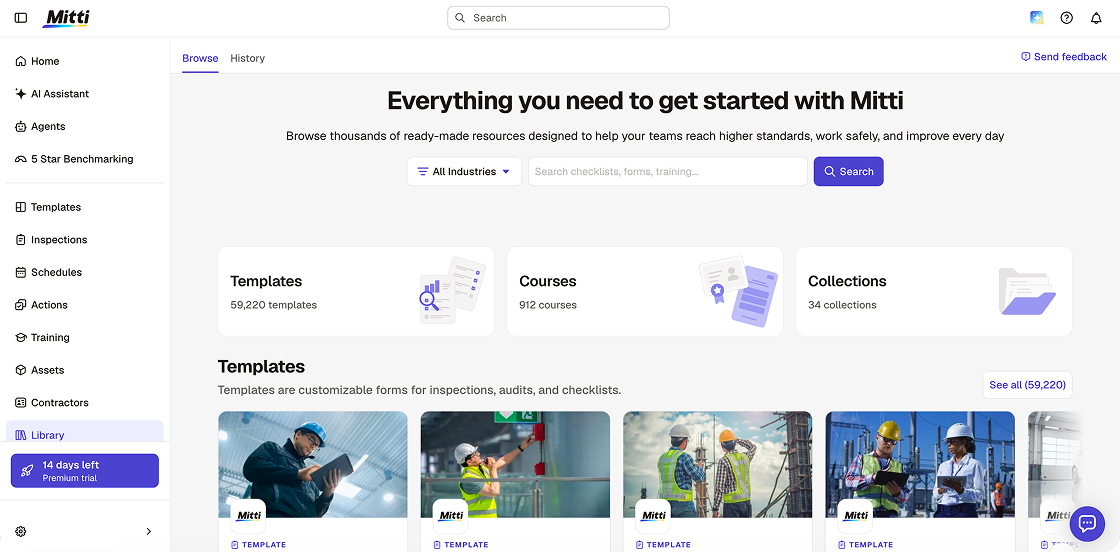
Mitti (formerly SafetyCulture, originally iAuditor) is the platform most field teams try first when they are moving from paper JSAs. The template library now exceeds 59,000 customisable options. Most teams find a ready-made JSA or JHA template for their industry and are completing their first analysis the same day they sign up. The mobile app is genuinely excellent for non-technical crews.
Alongside the 2026 rebrand from SafetyCulture, Mitti launched AI Agents that monitor site activity and run routine tasks automatically, an AI Assistant that surfaces patterns and creates action plans, and 5-Star Benchmarking that scores each site in a portfolio.
The honest limitation for teams in regulated industries: Mitti’s task management is one-directional. Once a worker marks a JSA as complete, it is complete. There is no native mechanism for a senior reviewer to push it back with notes before it counts as approved. For industries where multi-stage sign-off is a compliance requirement before work can begin, this is a real gap.
Key Features
- 59,000+ customisable JSA, JHA, and safety templates with AI template generation
- Mobile-first capture with offline support
- Corrective action tracking and basic task management
- AI Agents — background monitoring and automated routine tasks
- 5-Star Benchmarking — portfolio-level site performance scoring
- Training module — 1,000+ courses
- Real-time safety dashboards and analytics
Pricing
- Free: $0, up to 10 users — 5 active templates, basic JSA capability
- Lite Seat: $5/user/month — approximately 12 submissions per year, view-only access
- Premium: $24/user/month (annual) / $29/user/month (monthly) — unlimited templates, AI features, advanced analytics
- Enterprise: Custom — 24/7 priority support, 99.9% uptime SLA
Ratings
4.6 — Capterra · 4.6 — G2
Want to explore more platforms with similar capability? See our SafetyCulture alternatives.
3. VelocityEHS – Best for Complex Compliance Programs
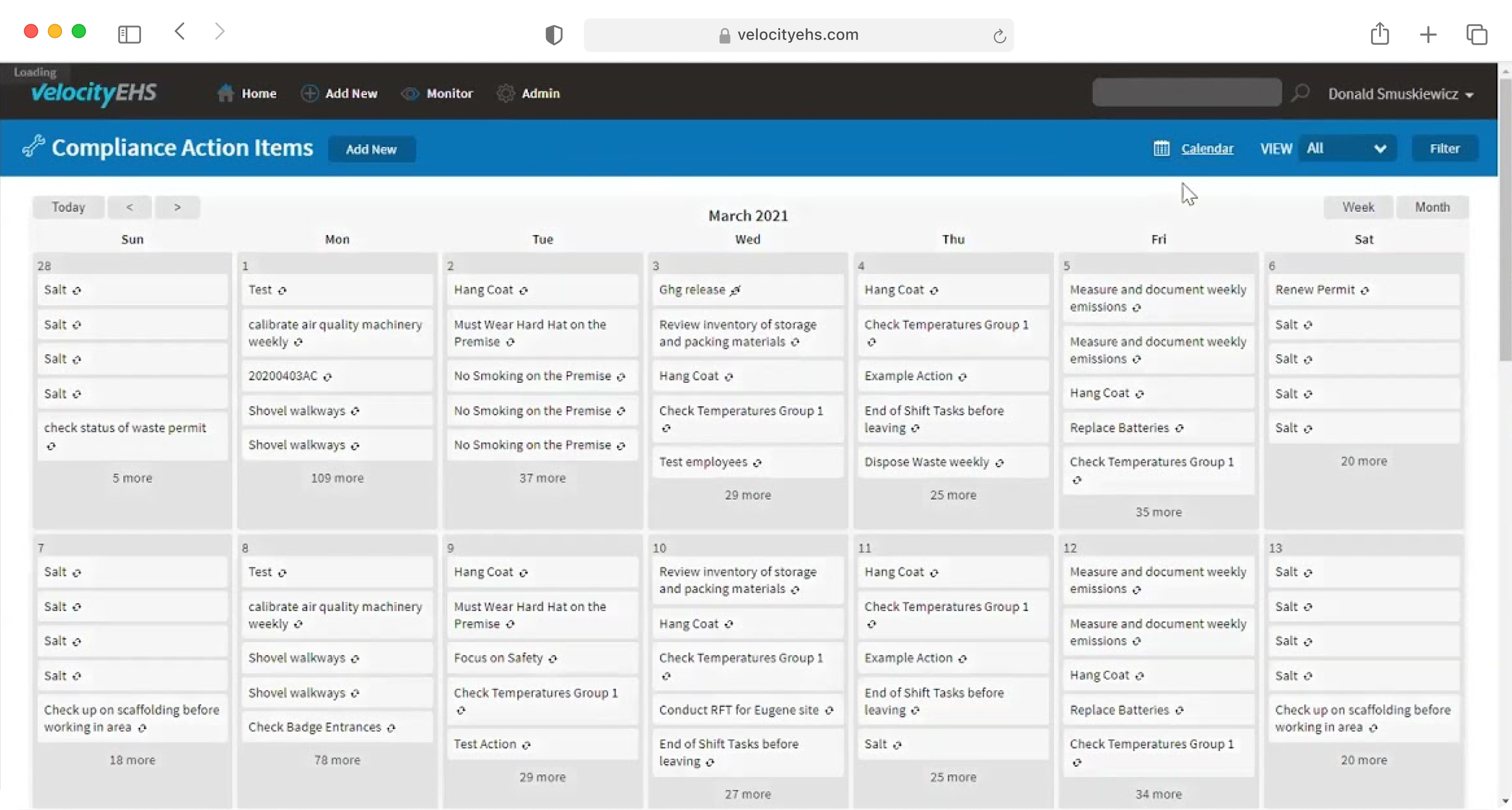
VelocityEHS is trusted by one-third of the Fortune Global 1000. For large enterprises where JSA is one part of a broader EHS programme covering chemical management, industrial hygiene, incident management, and ESG reporting, VelocityEHS provides a comprehensive connected system.
In 2026, VelocityEHS gained FedRAMP authorization — relevant for government sector buyers and federal contractors. The platform also expanded its SAP integrations to 60+ connections including SAP BTP and SAP BW/4HANA, making it a stronger fit for organisations already running SAP for operations.
Where VelocityEHS is not the right fit: field-first teams that need a fast, mobile-focused JSA app without the overhead of an enterprise EHS platform. The scope and cost reflect the enterprise it is built for.
Think of it as an extra set of eyes, giving you an enterprise-level view of risk. With this EHS platform, you can pinpoint and evaluate all kinds of safety hazards, implement and verify risk controls, and unify your risk management activities.
Key Features
- JSA and job hazard analysis workflows
- Conduct, schedule, and track safety inspections
- Submit electronic OSHA reports and manage SDSs
- Audits and safety observation management
- Mobile access from any device
- FedRAMP-authorized security
- 60+ SAP integrations
- ESG tracking aligned to CDP, GRI, TCFD, CSRD
Pricing
Quote-based.
Ratings
4.4 — Capterra · 4.4 — G2
4. HCSS – Best for Construction-Specific JSA Documentation
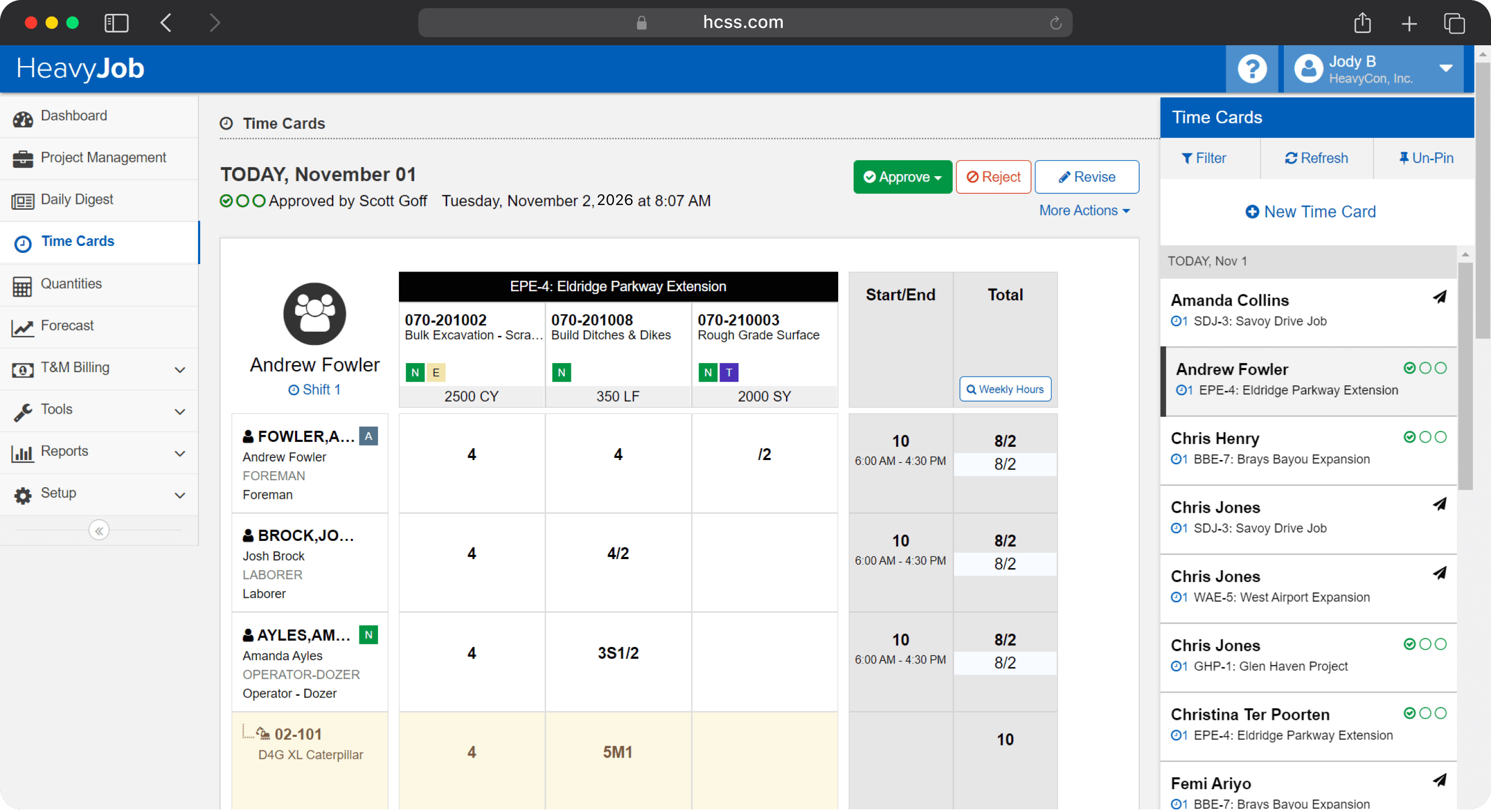
HCSS Safety’s JSA tools are designed specifically for the safety challenges construction managers face on active job sites. Construction-specific templates, mobile-first documentation, and integration with HCSS’s broader construction management suite — HeavyBid, HeavyJob, Equipment360 — make it a natural fit for civil contractors who are already in the HCSS ecosystem.
For teams outside construction or outside the HCSS ecosystem, the construction-specific focus is a limitation rather than a feature. The platform does not extend naturally to energy, aviation, or utilities workflows.
Key Features
- Construction-specific JSA and JHA templates
- Mobile-first documentation — phone and tablet access, including remote locations
- Automatic safety meeting triggers after form submissions
- PPE, tools, and equipment tracking with photo documentation
- Safety trend monitoring to prevent repeat incidents
- Integration with HCSS HeavyJob and Equipment360
Pricing
Quote-based.
Ratings
4.4 — Capterra
5. JSA Builder – Best for Affordable JSA Worksheet Documentation
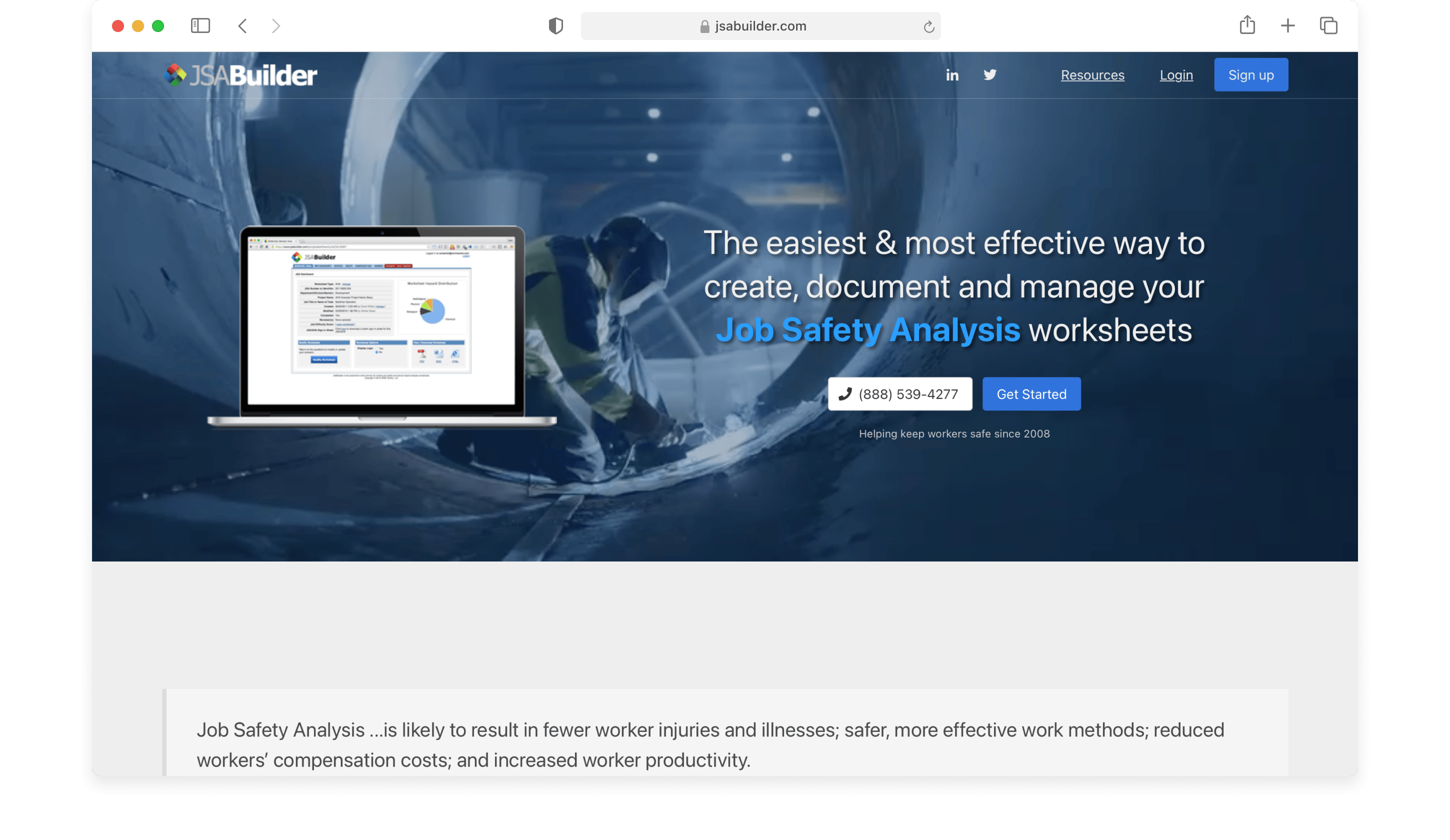
JSA Builder focuses on one thing: helping safety teams build and manage JSA worksheets that meet OSHA and USACE regulatory requirements, without the complexity or cost of a broader EHS platform.
It is a web-based tool — no native mobile app — which means it is best suited to teams that complete JSAs at a desk or in a site office before work begins, not from a phone in the field. The pre-loaded hazard library and risk scoring matrix cover the most common construction and industrial scenarios, and every subscription includes the full feature set with no tiers to navigate.
The pricing model is worth noting for larger teams: the per-user cost drops significantly with volume — from $67 for the first user to $49 for users 2–50, $30 for 51–100, and as low as $5 for teams over 1,000. One plan, everything included, no feature tiers, with a 30-day free trial and no credit card required.
Key Features
- Hazard probability and severity scoring with risk matrices
- Pre-loaded hazard and control library — customisable
- Share worksheets instantly with your team
- OSHA and USACE compliant documentation output
- PDF and AHA format output
- Photo uploads for visual context
- Cloud-based company JSA library — clone and modify for repeat tasks
Pricing
- $67/year for first user
- $49/user/year for users 2–50
- $30/user/year for users 51–100
- $20/user/year for users 101–500
- $5/user/year for users 1,001+
- One plan — everything included, no feature tiers
Ratings
4.5 — Capterra
6. SafetyReports – Best for Pre-Built hazard and Control Libraries
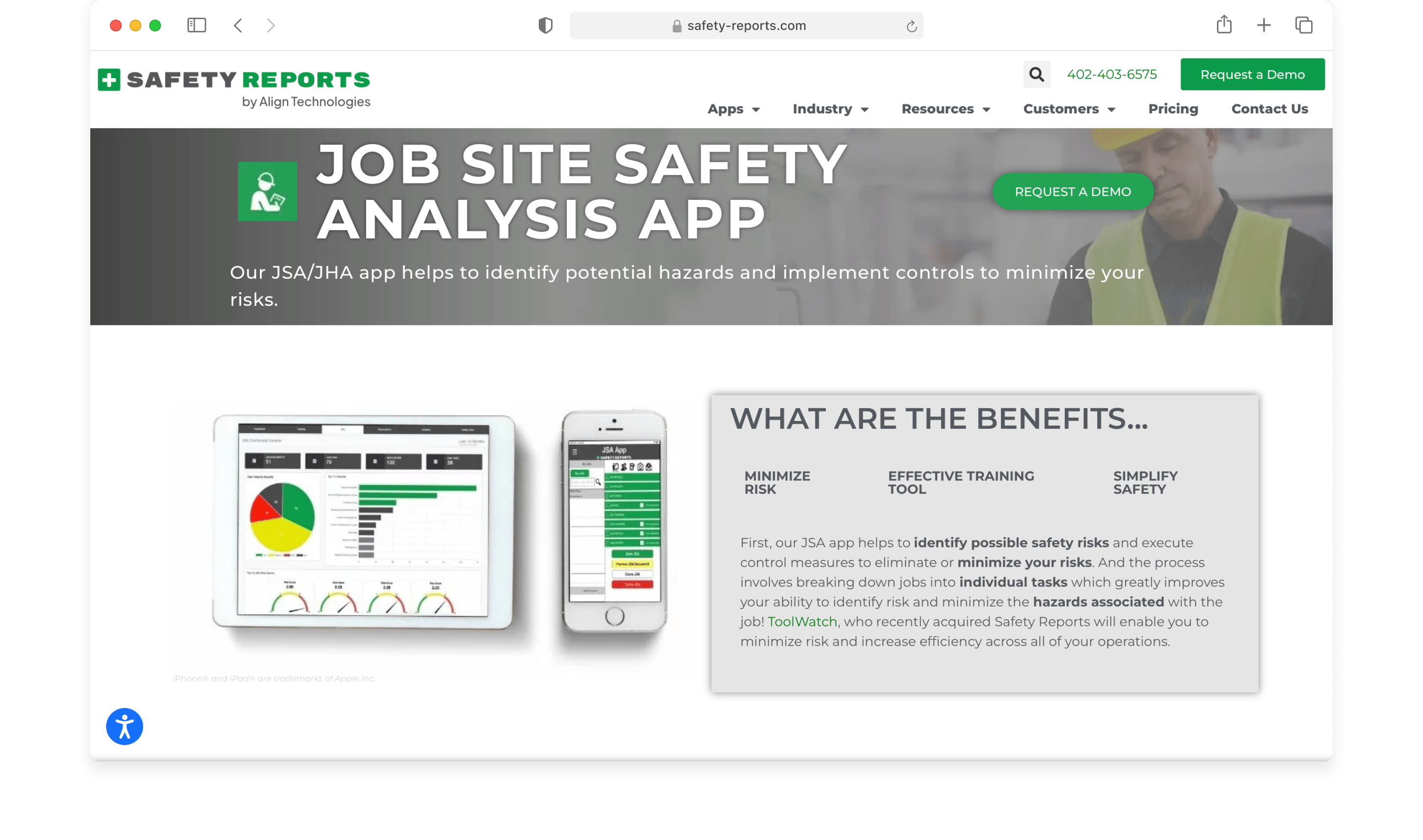
SafetyReports’ SafetyReports is a mobile JSA tool built around speed of completion. The pre-built library of hazards and controls covers the most common scenarios across construction, manufacturing, and utilities — a technician selects the task, selects the relevant hazards, applies controls, takes a photo, captures a signature, and the JSA is done. Fast enough to actually be completed before work starts.
The app works offline, which matters for teams on remote sites. Completed JSAs are emailed to the team once connectivity returns. The workflow is straightforward and designed for field crews who are not technology-savvy.
The honest limitation: SafetyReports is a field documentation tool, not an inspection management platform. It does not support multi-step approval chains, automated corrective action routing, or integration with broader safety and EHS systems. For teams that need JSA documentation only, it is well-priced and practical. For teams that need JSA as part of a connected inspection workflow, a more capable platform is needed.
Key Features
- Comprehensive pre-built library of hazards and controls — fully customisable
- Photo capture for visual context
- Digital signatures from the field
- Full offline functionality — complete JSAs without Wi-Fi or cellular
- Email completed JSAs to the team automatically on sync
- Professional PDF output
- Create, deliver, and share JSAs electronically
Pricing
Subscription-based.
Ratings
4.6 — Capterra
7. Sitemate – Best for Compliance-Focused JSA
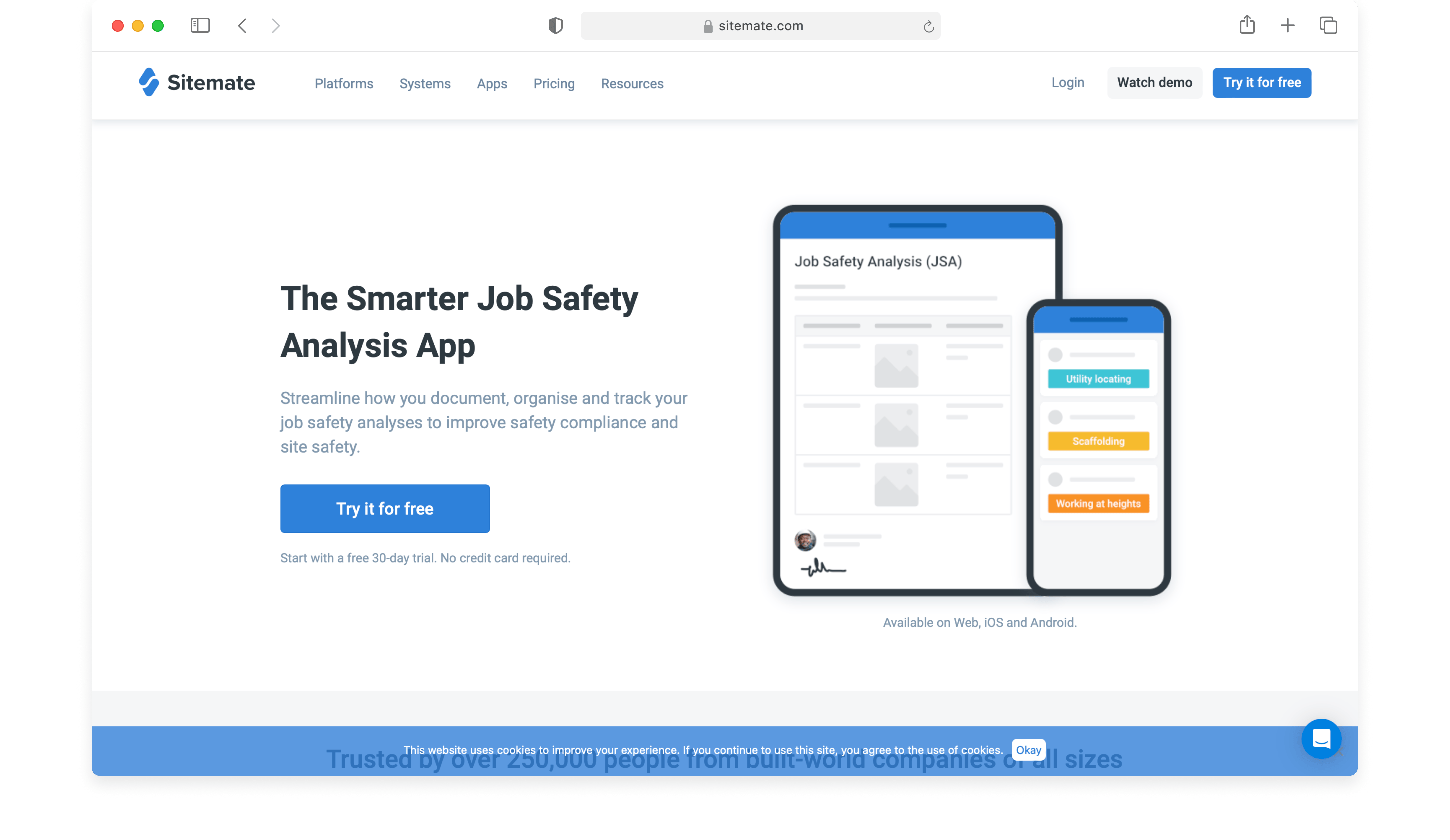
Sitemate Sitemate simplifies JSA creation and management for construction and infrastructure teams that need a clean digital process from analysis to sign-off. The platform supports digital ID card signatures — workers sign off using a verified digital identity, not just an on-screen tap — which is a meaningful differentiator for teams where the identity of the approver matters for compliance.
JSAs can be built from custom templates or from a pre-loaded library, and the platform works offline for field completion. Instant notifications, approvals, and escalations keep the process moving without manual chasing.
Key Features
- Build and manage JSAs in digital format — custom or pre-loaded templates
- Digital ID card sign-off for verified approvals
- Offline JSA completion with full sync on reconnect
- Instant notifications, approvals, and escalation rules
- Real-time safety indicator tracking
- Dashboard visibility across all active JSAs and approvals
Pricing
Subscription-based.
Ratings
4.6 — Capterra
FAQ
- What is job safety analysis (JSA) software?
Job safety analysis software (also called JHA (Job Hazard Analysis) or AHA (Activity Hazard Analysis) software) ss a digital tool that helps field teams identify hazards for a specific task, assess the risk level, define controls, and document who reviewed and approved the analysis before work begins. It replaces paper JSA forms with mobile workflows that work in the field, generate timestamped records, and route completed analyses to supervisors for sign-off automatically.
The best JSA tools connect the analysis directly to hazard management software and corrective action workflows, so a flagged hazard gets assigned and resolved.
2. What is the difference between a JSA, JHA, and AHA?
All three describe the same process — systematically analysing a task before it begins to identify hazards, assess risk, and define controls. The terminology varies by industry and regulatory framework. JSA (Job Safety Analysis) is most common in construction and utilities. JHA (Job Hazard Analysis) is the OSHA-preferred term. AHA (Activity Hazard Analysis) is commonly used in government and military construction contracts, particularly USACE projects. Most software supports all three formats — the underlying workflow is identical.
3. Does JSA software work offline?
For most field teams, offline capability is essential. JSAs need to happen at the worksite before work begins — not in the office with Wi-Fi. Fluix captures JSA forms, photos, GPS timestamps, and supervisor sign-offs without signal, syncing automatically when connectivity returns. SafetyReports and Sitemate also offer offline functionality. JSA Builder is web-based and does not have a native offline mobile app — it is better suited to teams completing analyses at a desk before heading to site.
4. What should a JSA include?
A complete JSA should include: the task name and location, the job steps in sequence, the hazards associated with each step, the risk level for each hazard (probability and severity), the controls that will be applied to reduce the risk, the PPE required, who reviewed and approved the analysis, and the date and signatures of the workers who were briefed on it. OSHA’s Job Hazard Analysis guidance (OSHA 3071) provides the standard structure most regulatory frameworks expect.
5. What are the benefits of JSA software over paper forms?
Paper JSAs get lost, arrive too late, or never reach the supervisor who needs to sign off. JSA software solves this in four ways: analyses are completed on mobile at the worksite before work begins; the completed JSA routes automatically to the right supervisor for sign-off without anyone manually forwarding it; the record is timestamped, GPS-tagged, and stored with an audit trail that holds up under regulatory review; and patterns across multiple analyses can be identified — which hazard types recur most, which sites flag the most risks, which task types need updated controls. That last point is not possible with paper at any practical scale.
6. How do I choose the right JSA software for my team?
Five questions narrow the field quickly. First: does it work offline in the conditions your crews work in — remote sites, poor connectivity, at height? Second: does the completed JSA route to a supervisor for sign-off automatically, or does someone need to manually chase approval? Third: what is the cost at your current team size and at double — some platforms look affordable at 10 users and expensive at 50? Fourth: does it connect to your broader construction inspection software or safety management system, or does it sit in isolation? Fifth: how long does onboarding take — a platform your crew cannot use in the field within a week is a platform they will not use at all.
7. Is JSA software the same as safety inspection software?
Not exactly — though the best platforms handle both. A JSA happens before work begins: it analyses the task, identifies hazards, and defines controls. A safety inspection happens during or after work: it checks whether standards are being met, documents what was found, and triggers corrective actions for anything that falls short. In Fluix, both workflows run on the same platform — a JSA completed before a task begins connects directly to the inspection that verifies it was followed and the corrective action that closes any findings. For teams that need both, a connected platform is more efficient than two separate tools.
8. Can JSA software help with OSHA compliance?
Yes. JSA software creates the documented, timestamped evidence that OSHA requires before high-hazard work begins. It records who conducted the analysis, what hazards were identified, what controls were applied, and who was briefed before work started. When OSHA inspects, that record is available immediately — not reconstructed from memory or paper files. Some platforms also support direct OSHA form output and electronic OSHA log management.