
If you run safety meetings, you know a good safety quote gets attention and sets the topic.
This list is for supervisors, foremen, and safety leads who need a quote for a toolbox talk, a weekly safety email, or a site noticeboard. You’ll find short one-liners sorted by topic, quotes from people who work in the field, and the classics, plus a simple way to turn any quote into a 10-minute talk.
Need a topic to pair with your quote? Pick one from our 100 toolbox talk topics.
Contents:
Short Safety Quotes for Work (by Topic)
Safety Quotes from Field Practitioners
Safety Quotes About Education
Safety Quotes About Culture and Theory
Safety Strategies
Impact of Work Injuries
How to Use a Safety Quote in a Toolbox Talk
FAQ
Running Toolbox Talks with Fluix
Short Safety Quotes for Work (by Topic)
These one-liners are common workplace safety sayings. They have no single author, and they’re short enough for a whiteboard, a sticker, or the top of a sign-in sheet.
General
- “Safety doesn’t happen by accident.”
- “Think safe, work safe, home safe.”
- “Safety is a habit, not a poster.”
PPE
- “PPE only works if you wear it.”
- “Your eyes don’t come with spares.”
Hazards and near misses
- “A near miss is a free lesson.”
- “If you see it, report it.”
Use these two with a talk on spotting common safety hazards before they turn into incidents.
Inspections and housekeeping
- “A clean site is a safe site.”
- “Inspect what you expect.”
Working at height
- “Tie off before you climb.”
- “Three points of contact, every time.”
Rushing and stop-work
- “Better to lose a minute than a life.”
- “If it’s not safe, stop. Everyone has stop-work authority.”
Quote of the week
- “Someone is waiting for you to come home tonight.”
Safety Quotes from Field Practitioners
We’ll start with a classic, then hear from people who do the work.
“A culture of safety is not a concept. It is a way of life.”
It belongs to James David Power III, the founder of the data analytics firm J.D. Power and Associates, and we agree with every word.
Having served safety-critical industries like construction, energy, and aviation for a decade, we can confidently say that safety policies that exist only on paper don’t work. How you execute them is what matters.
The quotes below come from guests on Field Intelligence, Fluix’s series of conversations with people who run inspections, maintenance, and safety in the field.
“Before you sign the permit — touch it.” Liam Hook for Field Intelligence #1. Can be a good opener for a talk on permits.
“Add one rule, remove two.” Joe Gilliland for Field Intelligence #4. Can be a good reminder on that rules shouldn’t get overcomplicated.
Safety Quotes About Education
The first set of employee safety quotes are sayings about the critical role of education in workplace safety.
“You don’t need to know the whole alphabet of safety. The A, B, C of it will save you if you follow it: Always Be Careful.”
Attributed to the Colorado School of Mines Magazine, this quote emphasizes keeping safety simple while staying vigilant. You can use it as a quick-reference reminder for your team.
“The future of the safety movement is not so much dependent upon the invention of safety devices as on the improvement of methods of educating people to the ideal of caution and safety.”
Walter Dill Scott, president of Northwestern University, predicted the ongoing importance of safety education in this quote from 1921.
Safety Quotes About Culture and Theory
These quotations highlight the need for a strong safety culture and offer insight into early workplace safety ideas that still hold true today.
Keep these safety messages in mind the next time you talk to your teams about prevention.
“Safety applies with equal force to the individual, to the family, to the employer, to the state, the nation and to international affairs. Safety, in its widest sense, concerns the happiness, contentment and freedom of mankind.”
William M. Jeffers, former president of Union Pacific Railroad Co., described the responsibility we share to protect one another, as individuals and as institutions, in this 1946 quote.
“The safety of the people should be the highest law.”
Marcus Tullius Cicero was a statesman and lawyer in ancient Rome. His quote shows how fundamental safety has always been to society.
“Safety work is today recognized as an economic necessity. It is the study of the right way to do things.”
Robert W. Campbell, the first president of the National Safety Council, recognized the importance of doing things the right way to keep everyone safe. To understand what works and what doesn’t in your workplace, you need to gather safety data, document incidents, and keep track of your safety metrics.
“Tomorrow — your reward for working safely today.”
This line is from Robert Pelton, author of “The World’s Most Dangerous Places.” As a journalist, Pelton has spent time with ground forces in more than 40 conflicts worldwide, including in Afghanistan, Chechnya, and Liberia.
“No job is so important and no service so urgent we cannot take time to perform our work safely.”
This safety quote comes from the 1939 AT&T Bell Safety System Creed, and it’s still relevant today.
“There’s no better policy in society than pursuing the health and safety of its people.”
Before Ralph Nader ran for president, he was a well-known consumer safety advocate and the author of books such as “Unsafe at Any Speed,” about the auto industry.
“Concern for man himself and his fate must always form the chief interest of all technical endeavors.”
Albert Einstein said this to students at Caltech in 1931. He wasn’t talking about workplace safety specifically, but the point holds: whatever you build, the people using it come first.
“A culture of safety is a journey, not a destination, it requires our continuing diligence.”
This safety quote comes from Terry J. Moulton, chief of military and veteran service at TriWest Healthcare Alliance and a long-time advocate for workplace safety in hospitals and healthcare.
Safety Strategies
The following workplace safety quotes offer practical advice you can put to work on your own job site.
“Ask the people who work in the warehouse to start thinking about safety, and on a regular, periodic basis, review and discuss how they might work better. I encourage people to put a meeting on a calendar, once a month, at least to come together for an hour or 90 minutes to discuss ideas for improvement.”
This recommendation comes from Joseph Flahiff, author of “Being Agile in a Waterfall World: A practical guide for complex organizations.”
“An ounce of prevention is worth a pound of cure.”
This lesson from Benjamin Franklin, one of America’s founding fathers, still applies in the modern workplace. Franklin was actually writing about fire safety: his 1735 letter urged Philadelphians to prevent house fires rather than fight them.
“…We need to stay vigilant. It’s how we prepare for threats and how we direct our resources that will ensure the safety of our people.”
This advice comes from Larry Delfiner, a business resiliency director who focuses on the impact of safety.
“I’ve personally met up with quite a few legless, armless and other badly messed-up folks. There’s a whole lot of mighty serious accident contemplation going on in our hospitals. My observations have taught me that it is much better to think about accidents before they happen than to brood on them afterward. … Personally, I’d rather be late for dinner tonight here than to be on time for breakfast in the next world in the morning. Haste makes waste of a lot of good human material.”
Irvin S. Cobb was an author and journalist who wrote for Pulitzer’s New York World in the early 1900s, when he was the highest-paid staff writer in the U.S. His quote is about the importance of slowing down to stay safe.
“Orientation is a place where employees should learn about their stop-work authority. Any worker should be able to stop work if they feel there is a danger to continuing operations.”
Sean Lucas, a risk control safety professional with Travelers Insurance, explains why new-employee training should emphasize the company’s safety culture.
Impact of Work Injuries
These quotes about safe work environments touch on the often devastating effects of job site accidents.
“Work injuries and illnesses can affect every aspect of life for workers and their families.”
This quote from the Maine Department of Labor highlights how far the effects of workplace injuries reach.
“The economic waste resulting from carelessness is appalling, but anyone who stops for a moment to consider the sorrow and desolation which is brought into thousands of lives each year by utter thoughtlessness must feel a new resolve to make a habit of ‘Safety First.'”
W. C. Durant, the president of General Motors, addressed the human cost of carelessness in this 1930 quote.
“How employees manage health and safety in the workplace or how labor rights are respected are issues important for employees and investors alike. Companies can, and should, do good right alongside doing well.”
Tim Smith, an expert in occupational safety across industries and founder of Leading Indicators, Inc., discusses how safety metrics influence investor relations.
“If you put good people in bad systems, you get bad results. You have to water the flowers you want to grow.”
This line is widely attributed to Stephen Covey, author of “The 7 Habits of Highly Effective People.” Its first half echoes W. Edwards Deming’s “A bad system will beat a good person every time.” Either way, it’s a useful reminder that a safe work environment depends on systems, not just individual care.
“Technology is moving at a much faster clip than our laws can keep up with.”
Deborah Hersman, former president and CEO of the National Safety Council, urged caution with new technology in a 2015 interview. She was talking about the lack of laws on drivers using smartphones behind the wheel, but the advice also applies to how quickly we introduce new tech at work.
How to Use a Safety Quote in a Toolbox Talk
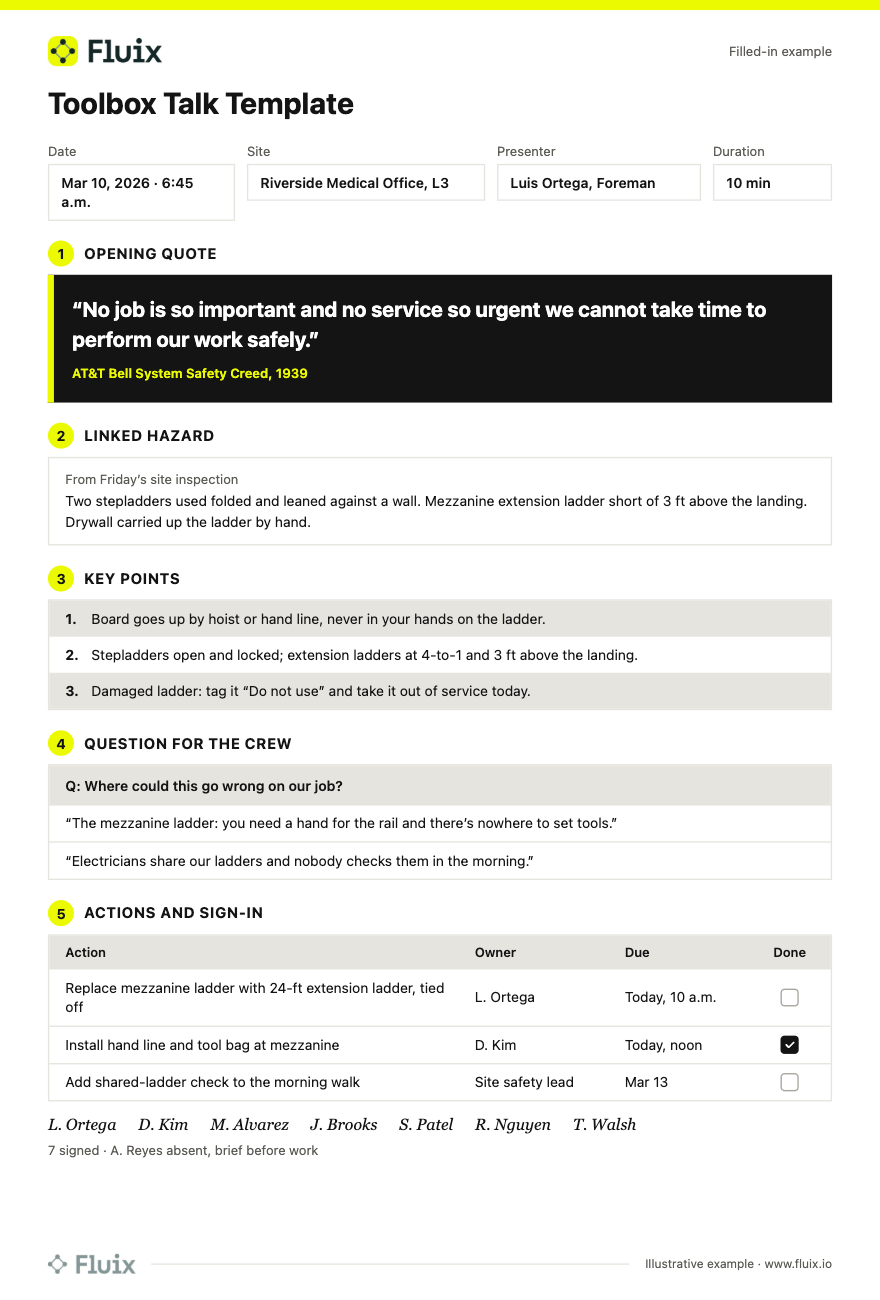
A quote works best as the opening line of a short talk, not as decoration. Here’s a 10-minute format:
- Open with the quote. Read it out and ask the crew what it means on this site, today.
- Connect it to one real hazard. Use something from last week’s inspection or a recent near miss, not a generic example.
- Give two or three key points: what to do differently, starting this shift.
- Ask one question, such as “Where could this go wrong on our job?” Write down what you hear.
- Record it. Note the topic, hazards, questions, and actions, and collect signatures on a toolbox talk template.
For a safety quote of the week, rotate through the topics above so PPE, housekeeping, near misses, and working at height each get a turn every month.
FAQ
- What is a good short safety quote for work?
“Safety doesn’t happen by accident” and “A near miss is a free lesson” are two of the most widely used. Short quotes work best when they point to one action, such as reporting a near miss or wearing PPE, rather than a general idea of being careful.
2. How do you use a safety quote of the week?
Pick one quote every Monday, read it at the start of the first toolbox talk, connect it to a hazard on site, and post it where crews will see it all week. Rotate topics so the same message doesn’t repeat for months.
3. Do safety slogans actually improve safety?
On their own, rarely. A slogan on a wall changes little. A quote used to open a discussion about a real hazard, followed by actions with owners and dates, becomes part of a working safety routine. The quote gets attention; the follow-up changes behavior.
4. Where can I find toolbox talk topics to pair with a quote?
Start with hazards from your own inspections and near-miss reports, since they’re specific to your site. For more ideas, use our list of toolbox talk topics, grouped by risk area.
Running Toolbox Talks with Fluix
A quote starts the conversation, and the record of the talk is what proves it happened.
With toolbox talk software in Fluix, supervisors run talks from a phone or tablet. Crews sign on one device, photos of the hazard go into the record, and every talk is saved automatically, even offline. Concerns raised in the talk become tasks with owners and due dates, so you can see attendance across crews and check that actions get closed.