


If your team works around conveyors, saws, presses, mixers or packaging lines, use this checklist to walk one machine at a time, record what you find, and turn every “No” into a dated corrective action.
What Is a Machine Guarding Checklist?
A machine guarding checklist is an inspection form used to verify that every hazardous part of a machine is guarded and that the guards work. It covers the point of operation, ingoing nip points, rotating parts and flying chips and sparks, as OSHA 29 CFR 1910.212 requires. It also records defects and the corrective actions taken.
What’s Included in the Machine Guarding Checklist Template
1. Machine and inspection details
- Machine name, asset ID, location and line
- Inspector, date, shift and inspection type (pre-use, periodic, after maintenance)
2. General guard requirements
- Guards prevent hands, arms and other body parts from contacting moving parts
- Guards are affixed to the machine (or secured elsewhere) and can’t be removed without tools
- Guards create no new hazard: no sharp edges, no new pinch points
- Objects can’t fall into moving parts; lubrication is possible without removing guards
3. Point of operation
- A guard or safeguarding device is in place where the work is done
- No evidence of tampering, removal or bypassing
- Hand tools (push sticks, feeding tools) are available where required, and are not used as a substitute for a guard
4. Power transmission and rotating parts
- Belts, pulleys, gears, sprockets, chains, shafts and couplings 7 ft or less above the floor are enclosed
- Ingoing nip points (belt-to-pulley, roller-to-roller, chain-to-sprocket) are guarded
- Shields protect against flying chips, sparks and coolant
5. Safeguarding devices and controls
- Interlocked guards stop the machine when opened (function-tested, not just looked at)
- Presence-sensing devices and two-hand controls work as designed
- Emergency stops and pull-cords are reachable, red and tested
- Start/stop controls are within the operator’s reach and protected against accidental activation
6. Maintenance, adjustments and lockout/tagout
- A machine-specific LOTO procedure is posted or accessible
- Jam clearing, cleaning and adjustments are done under LOTO, or under an approved alternative method
- Guards are reinstalled and verified before restart
7. Training, PPE and signage
- Operators are trained on this machine’s guards and on the hazards of removing them
- Warning signs and labels are legible
- No loose clothing, jewelry or untied long hair near moving parts
8. Findings, corrective actions and sign-off
- Pass / Fail / N/A per item, with comments and photo reference
- Corrective action, owner, due date and verification date
- Inspector and supervisor signatures
Filled-In Machine Guarding Checklist Sample
This is an example of how your completed checklist may look like. Your values will be different.
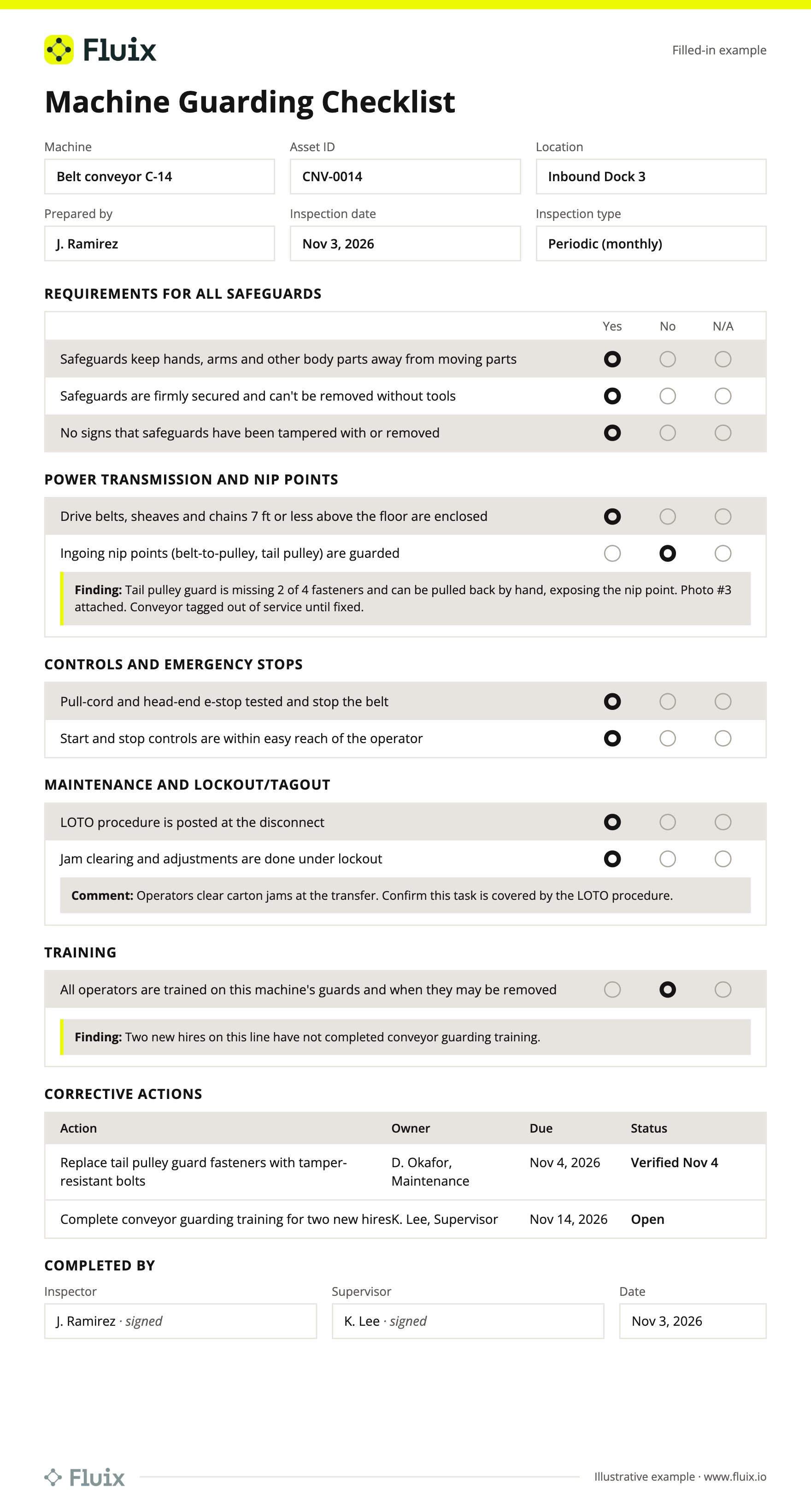
How to Fill In the Checklist
- Pick one machine per form. Write the asset ID and location so the record can be traced to the exact unit.
- Inspect with the machine stopped, then test with it running. Check guard condition and fasteners under lockout. Function-test interlocks, e-stops and pull-cords only under controlled conditions, by an authorized person.
- Mark every item Pass, Fail or N/A. A blank isn’t an answer. Use N/A only when the feature doesn’t exist on the machine.
- Add evidence to every Fail. Note the exact location (“tail pulley, operator side”) and take a photo.
- Assign the fix before you leave the machine. Record the owner, the due date and whether the machine stays in service.
- Re-inspect and sign off. Closing the action means someone checked the guard again.
What OSHA Requires
29 CFR 1910.212, General requirements for all machines
- (a)(1): “One or more methods of machine guarding shall be provided to protect the operator and other employees in the machine area from hazards such as those created by point of operation, ingoing nip points, rotating parts, flying chips and sparks.”
- (a)(2): Guards must be affixed to the machine where possible, and “the guard shall be such that it does not offer an accident hazard in itself.”
- (a)(3)(ii): “The point of operation of machines whose operation exposes an employee to injury, shall be guarded,” and the guarding device “shall be so designed and constructed as to prevent the operator from having any part of his body in the danger zone during the operating cycle.”
- (a)(5): Fan blades less than 7 ft above the floor need guards with openings no larger than ½ inch.
- (b): Machines designed for a fixed location must be anchored to prevent walking or moving.
Machine-specific standards that apply instead of, or on top of, 1910.212
- 1910.213, woodworking machinery: table saws, band saws, jointers, radial arm saws.
- 1910.217, mechanical power presses: point-of-operation safeguarding. Under 1910.217(e)(1)(ii)(A), you must also “inspect and test each press on a regular basis at least once a week to determine the condition of the clutch/brake mechanism, antirepeat feature, and single-stroke mechanism.” These weekly checks are exempt from certification records, which are required only for maintenance tasks and general-component inspections.
- 1910.219, mechanical power-transmission apparatus: flywheels, shafting, pulleys, belts, gears, sprockets and chains 7 ft or less above the floor or platform must be guarded.
- Construction crews working with saws, grinders and other powered tools fall under 1926.300 instead.
How often this gets cited: Machine guarding has held the #10 spot on OSHA’s most-cited list. In the FY2025 final data (released April 2026), it drew 1,498 violations. The FY2026 preliminary list (Oct. 1, 2025–Aug. 31, 2026, announced September 2026) shows 1,072 so far. Each serious violation can cost up to $16,550, and a willful or repeated one up to $165,514.
Outside the US: In Great Britain, Regulation 11 of PUWER 1998 sets a strict order of measures. First, “fixed guards enclosing every dangerous part” where practicable. Then other guards or protection devices. Then jigs, holders and push-sticks. All of these come with information, instruction, training and supervision. HSE’s L22 Approved Code of Practice explains how to comply.
How to Verify Guarding Through Inspections
A checklist only protects people if failed items get fixed and stay fixed. Run guarding checks on a schedule that matches the risk. Inspect presses weekly. Check conveyors and power-transmission equipment at least every 60 days, the interval 1910.219 sets for power-transmission equipment. After any maintenance that removed a guard, check the machine before it restarts. Paper still works for small sites, but using safety inspection software will help you effectively manage multiple sites and machinery pieces.
Treat each “Fail” as a finding with an owner, a due date and an out-of-service decision. Then track your findings by machine and by item. If the same tail pulley guard fails three months running, the problem is the guard design or the jam-clearing method, not the inspector. Raise it in your next toolbox talk and add it to your list of recurring safety hazards.
Use the Template in Fluix
Fluix is inspection management software for field teams. Load this checklist into Fluix and every guarding inspection runs the same way on every shift and site.
- Photos per item: attach a photo to any Fail, so maintenance sees exactly which guard and which fastener.
- Required fields: inspectors can’t submit with blank items or a Fail without a comment.
- Offline mode: complete inspections in basements, cold rooms and remote plants, and they sync when a connection returns.
- Routing: failed items route to maintenance and the supervisor automatically for corrective action.
- Scheduling: set weekly, monthly or post-maintenance inspections per machine.
- Corrective actions: track each fix to closure and re-inspection, with a full audit trail.
FAQ
- What are OSHA’s requirements for machine guarding?
OSHA 29 CFR 1910.212 requires one or more guarding methods to protect operators and nearby employees from the point of operation, ingoing nip points, rotating parts, flying chips and sparks. Guards must be attached to the machine where possible and must not create a hazard themselves. Machines designed for a fixed location must be anchored.
2. What are the four types of machine guards?
The four types are fixed, interlocked, adjustable and self-adjusting. Fixed guards are permanent barriers. Interlocked guards shut the machine off when opened. Adjustable guards are set to fit the stock. Self-adjusting guards move with the material. OSHA’s Safeguarding Equipment and Protecting Employees from Amputations explains when each works best.
3. What is the 7-foot rule for machine guarding?
Under OSHA 1910.219, power-transmission parts located 7 feet or less above the floor or working platform must be guarded. These parts include flywheels, shafting, pulleys, belts, gears, sprockets and chains. Under 1910.212(a)(5), fan blades less than 7 feet up need guards with openings no larger than one-half inch. Parts higher up may be considered guarded by location.
4. How often should machine guards be inspected?
Check guards before each shift as part of the operator’s pre-use check, and after any maintenance that removed a guard. Run fuller inspections on a fixed schedule. OSHA requires weekly clutch/brake checks on mechanical power presses, and power-transmission equipment must be inspected at least every 60 days. Plan your schedule with Fluix safety compliance guidance.
5. Is machine guarding still one of OSHA’s most-cited standards?
Yes. Machine guarding (1910.212) ranked #10 in OSHA’s FY2025 final data, with 1,498 violations, and #10 again in the FY2026 preliminary list, with 1,072 violations through August 31, 2026. Serious violations can cost up to $16,550 each, and willful or repeated violations up to $165,514.
6. What is the difference between a machine guarding checklist and a machine guarding assessment?
A checklist verifies that existing guards are present, intact and working on a given day. An assessment, sometimes called a guarding survey or risk assessment, decides which hazards a machine has and which guarding it needs. Run an assessment for new or modified machines, then use the checklist routinely. See OSHA’s sample self-inspection checklist.
7. Can I use this checklist outside the US?
Yes. The checks also map to UK PUWER 1998 Regulation 11, which requires fixed guards first, then other guards or protection devices, then jigs and push-sticks, all supported by training and supervision. Check local regulations in other countries, and add any national standards your site follows as extra items in the PDF.
8. Can I fill in this machine guarding checklist on a tablet?
Yes. Download the PDF for paper use, or load it into Fluix to complete it on iPad, Android or the web, including offline. You can attach photos to failed items, require comments, and route corrective actions to maintenance automatically. See how it works in the lockout and safety workflows on essential safety documents.