


Use this free incident report template to document workplace injuries, property damage, environmental spills, vehicle incidents, and security events the same day, in the same format, on every site.
It’s built for supervisors, safety leads, and HR or operations managers in construction, manufacturing, energy and utilities (including wind and solar), oil and gas, facilities, aviation ground operations, logistics, and HVAC or field service.
What Is an Incident Report Template?
An incident report template is a ready-made form for recording workplace incidents the same way every time. It sets out the fields to complete, from incident details, people involved, and injuries to witnesses, root cause, corrective actions, and sign-offs, so no report is missing information a regulator, insurer, or investigator will ask for
What’s Inside the Template
Incident details
- Report number, date and time of the incident, and when it was reported
- Site, exact location, and asset or equipment ID
- Task being performed, shift, and conditions (weather, lighting, surface)
- Incident type: injury, illness, near miss, property damage, environmental release, vehicle, security
People involved
- Name, job title, and department
- Employee, contractor, or visitor, and their employer
- Supervisor and contact details
Injury or illness details
- Body part affected, including left or right
- Nature of the injury and the object or substance that caused it
- Treatment: none, first aid, medical treatment, emergency room, or inpatient hospitalization
- Return to work: full duties, restricted duties, or off work
Witnesses
- Names, roles, and contact details
- Short statements in the witness’s own words
Description
- What the person was doing just before the incident
- What happened, in sequence
- Equipment, materials, and conditions involved
- A space for a sketch of the scene
Immediate actions
- First aid given and by whom
- Area made safe, equipment isolated, spill contained
- Who was notified and when
Root cause
- A 5 Whys ladder
- Contributing factors: people, equipment, procedure, environment, supervision, training
Corrective actions
- Each action with an owner, due date, and status
- Verification that the fix worked, with name and date
Classification
- Severity: minor, moderate, serious, or critical
- OSHA recordable: yes or no
- Severe injury reportable to OSHA: yes or no, with date reported
- RIDDOR reportable (UK): yes or no, with category and date reported
Photos and attachments
- Scene, equipment, and damage photos
- Witness statements, permits, and job safety analyses
Sign-offs
- Reported by, supervisor review, safety review, and manager approval
Filled-In Incident Report Sample
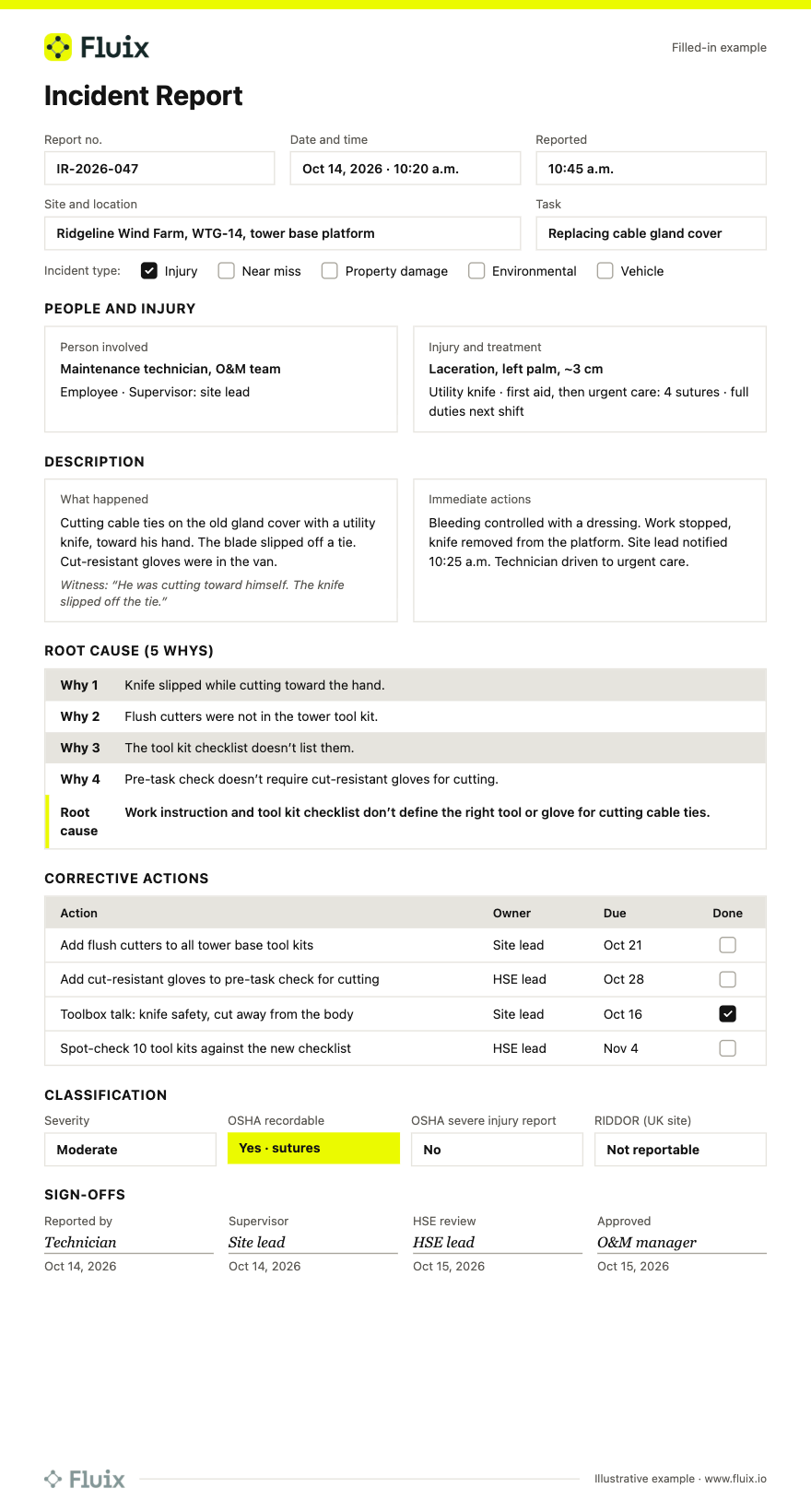
Here’s a completed report for one realistic incident: a hand injury of the kind wind, solar, and utility crews deal with every year. It’s compressed to the fields that matter.
For a longer walkthrough with timeline examples, see how to write an incident report.
Use This Template in Fluix
Upload this PDF or rebuild it as a form in Fluix’s incident reporting software, and your crews can:
- Report incidents and near misses on a phone or tablet, even offline; data syncs when they’re back in signal.
- Add time-stamped, geotagged photos with annotations and e-signatures.
- Route each report to the right supervisor automatically, with multi-step approvals before it closes (available on selected plans).
- Assign corrective actions with owners, due dates, and notifications, and require evidence before an action can be closed.
- Let contractors report through Guest User access with a QR code or link, without a Fluix account (available on selected plans).
- Track incident metrics on dashboards, export data to Power BI, and query records through Fluix’s AI connectors for Claude, ChatGPT, and Copilot.
FAQ
1. Can I edit this incident report template?
Yes. Add your logo, rename fields, remove sections you don’t need, or add site-specific ones such as permit numbers or vehicle details. Keep the core fields (incident details, people, injuries, description, corrective actions, and sign-offs) so every report captures the same information across sites.
2. Is an incident report the same as OSHA Form 301?
Not exactly. OSHA Form 301 is the regulated incident report for recordable cases in the US, and you can use an equivalent form if it captures the same information. This template covers those fields and adds root cause and corrective actions. Recordable cases also go on the OSHA 300 log; see our guide to the OSHA 300, 300A, and 301 forms.
3. Should near misses be reported?
Yes. A near miss is an event where nobody was hurt and nothing was damaged, but the same causes could injure someone next time. OSHA and RIDDOR don’t require near miss reports, but ISO 45001 treats near misses as incidents to investigate.
4. Do I need to report an incident under RIDDOR?
In Great Britain, report deaths, specified injuries, over-seven-day incapacitation, certain occupational diseases, and dangerous occurrences to HSE. Over-seven-day injuries must be reported within 15 days of the accident. Injuries that keep someone off normal duties for more than three days are recorded, not reported. Check HSE’s RIDDOR guidance for the full lists.
5. Who should fill out an incident report?
The person closest to the event, usually the crew lead or the injured worker’s supervisor, starts the report with input from the injured person and witnesses. A safety lead or site manager completes the root cause and corrective actions. On multi-employer sites, the contractor’s supervisor reports and the host’s safety team reviews and signs off.
6. Can I use this incident report template in Fluix?
Yes. Upload the PDF or rebuild it as a form in Fluix, then complete it on a phone or tablet, even offline. Add geotagged photos and signatures, route the report to a supervisor automatically, and assign corrective actions with due dates. See how it fits a complete incident investigation process from report to closure.
7. What is the standard incident report format?
A standard incident report follows the order an investigator reads it: incident details, people involved, injury or damage, witness statements, a factual description, immediate actions, root cause, corrective actions with owners, classification, attachments, and sign-offs. Write the description in chronological order and in the past tense, and keep opinions about fault out.