


Lockout/tagout is OSHA’s third most-cited standard in the preliminary FY2026 data, with 1,863 violations, and it shows up wherever maintenance teams service equipment: in manufacturing plants, warehouses, facilities, energy sites, and treatment plants.
What Is a Lockout/Tagout Procedure?
A lockout/tagout (LOTO) procedure is a written, machine-specific set of steps for shutting down equipment, isolating every energy source, locking and tagging the isolation points, releasing stored energy, and verifying zero energy before anyone services or maintains it.
“Lockout” means a physical lock holds an energy-isolating device, such as a disconnect or valve, in the safe position. “Tagout” means a warning tag is attached to that device. OSHA requires lockout wherever the device can accept a lock, unless the employer can show that tagout gives equivalent protection.
What’s Inside the Lockout/Tagout Procedure Template
Procedure details
- Procedure number, machine name, and asset ID
- Location, department, and revision date
- Statement of intended use (e.g., die change, belt replacement, jam clearing)
People involved
- Authorized employees who apply and remove locks
- Affected employees who need to be notified
- Who is responsible for notifying them
Energy source table
- Energy type and magnitude
- Isolation device and its location
- Lockout device used
- How stored energy is released or blocked
- Verification method for each source
Shutdown and isolation
- Normal stop sequence
- Order in which energy sources are isolated
- Blocking and bleeding steps
Lock placement and removal
- Who applies locks
- How keys are controlled
- Removal sequence
Zero-energy verification
- Try-start method
- Meter or gauge readings
- Who witnessed the test
Group lockout, shift changes, and contractors
- Lockbox or multi-lock hasp setup
- Primary authorized employee
- Shift change handover steps
- Procedure exchange with outside contractors
Restoring to service
- Tools removed
- Guards back in place
- Employees clear
- Devices removed
- Affected employees notified
Periodic inspection certification
- Machine and date
- Employees included and inspector
- Deviations found and corrective action taken
Photos
- Isolation point photos, numbered to match the energy source table
How to Fill In the Lockout/Tagout Procedure Template
- Walk the machine before you write. Trace every energy source to its isolation point, including secondary feeds, air drops, and accumulators. Photograph and number each point. Our guide to safety hazards covers the electrical, mechanical, and stored-energy hazards to look for.
- Complete the energy source table. One row per source, with magnitude, isolation device, device location, lockout device, and how stored energy is released or blocked.
- Write the shutdown sequence. Start with the normal stop, then isolate in a set order. Push buttons and selector switches are not energy-isolating devices, so don’t list them as isolation.
- Define device placement and removal. State that each authorized employee applies their own lock, how group lockout works, and what happens at shift change.
- Write a test for each energy source. Give a try-start, meter reading, or gauge reading for each row, and return controls to off or neutral after the try-start.
- Write the restoring-to-service steps. Remove tools, refit guards, confirm everyone is clear, remove devices in sequence, and notify affected employees.
- Approve the procedure and schedule its first periodic inspection. Set a due date within 12 months and post a printed copy at the machine or in the maintenance binder.
What OSHA 1910.147 Requires
The standard requires an energy control program with three parts: written procedures, training, and periodic inspections. Procedures must state their intended use and the steps for shutdown, isolation, blocking, securing, device placement, removal and transfer, and testing. Periodic inspections must happen at least annually, by an authorized employee who isn’t using the procedure being inspected, and they must be certified.
The standard covers servicing and maintenance in general industry. Construction, agriculture, and electric utility generation, transmission, and distribution are excluded; utility work falls under 1910.269. You can skip a written procedure for a machine only when all eight conditions in the 1910.147(c)(4)(i) exception are met, for example a single, readily identified energy source with no stored energy.
The cost of getting it wrong: OSHA’s maximum penalty is $16,550 per serious violation and $165,514 per willful or repeated violation. These amounts stay unchanged for 2026. In the final FY2025 data, lockout/tagout was the fourth most-cited standard, with 2,562 violations.
If your binder has a generic program and checklists but no machine-specific procedures, you’re missing the document OSHA asks for first. For how lockout fits with other high-risk work, see our guides to safety protocols and permit to work.
LOTO Procedure Template Sample
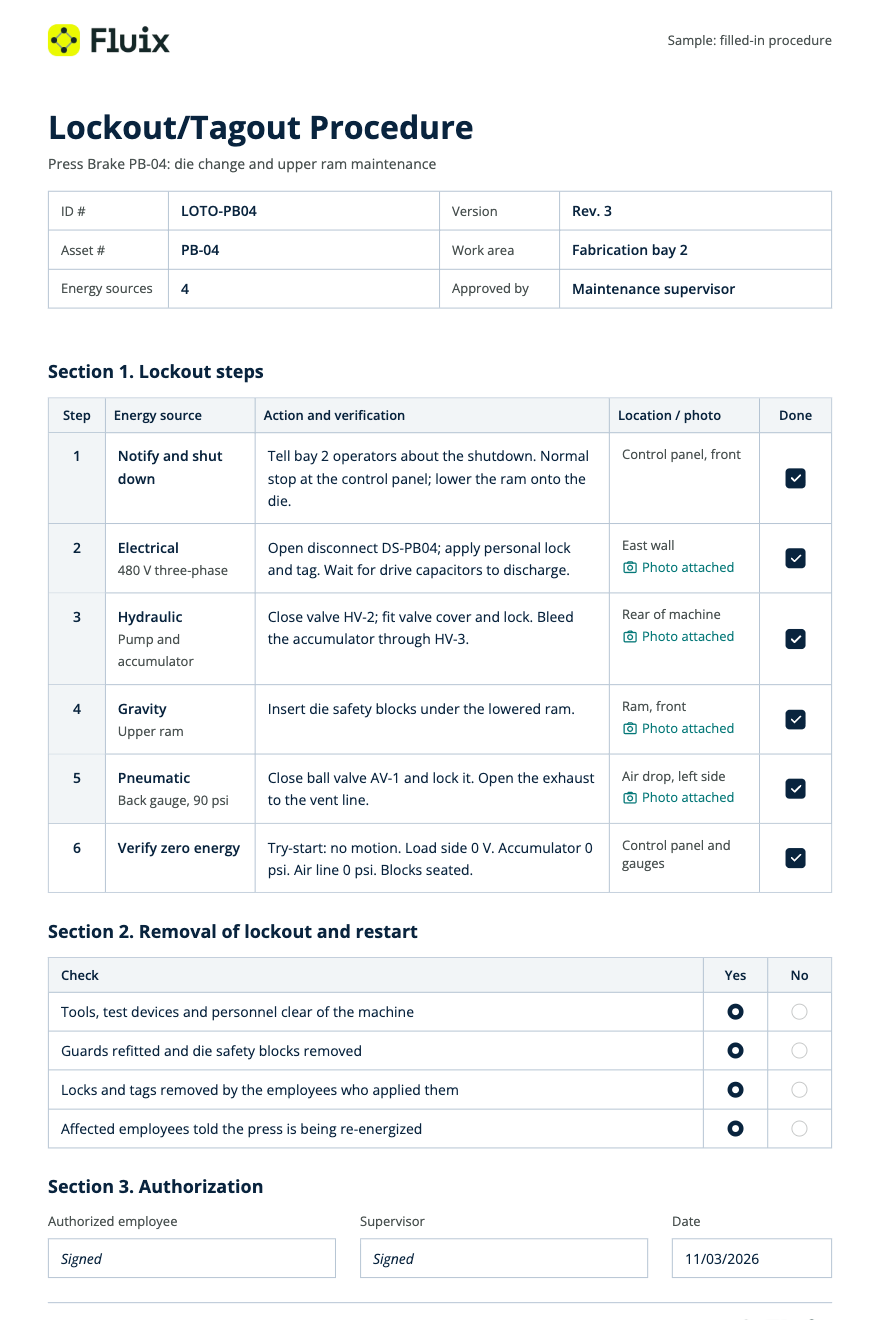
This is a compressed illustrative example of how one machine’s energy table should read. Your values will be different.
Use the Lockout/Tagout Template in Fluix
Fluix is inspection management software for field teams. In Fluix, the digital version of this template turns the procedure and the annual inspection into tasks your team completes on a phone or tablet:
- Photos of isolation points. Technicians attach a photo to each energy source row, so the next person finds valve HV-3 without guessing.
- Required fields. The verification reading for each energy source can’t be skipped before the form is submitted.
- Offline completion. Fill in the procedure or inspection in a plant basement or a turbine nacelle; it syncs when you reconnect.
- Sign-off routing. Completed lockout records and periodic inspections go to a supervisor for approval, with timestamps.
- Annual inspection scheduling. Set the periodic inspection once per procedure, and Fluix sends reminders before it’s due.
- Corrective actions. Deviations found during an inspection become tracked tasks with owners and due dates.
Frequently Asked Questions
- What is a lockout/tagout procedure?
A lockout/tagout procedure is a written, machine-specific set of steps for shutting down equipment, isolating every energy source, applying locks and tags, releasing stored energy, and verifying zero energy before servicing or maintenance. OSHA 29 CFR 1910.147 requires employers to document these procedures as part of an energy control program.
2. Is this lockout/tagout template free?
Yes. The template is a free printable PDF with no email required. Download it, fill it in for each machine, and post it at the machine or in your maintenance binder. To complete it digitally with photos and sign-offs, use the same template in Fluix.
3. What must a lockout/tagout procedure include under OSHA?
29 CFR 1910.147(c)(4)(ii) requires a statement of intended use, steps for shutting down, isolating, blocking, and securing the machine, steps for placing, removing, and transferring lockout or tagout devices, and requirements for testing to verify that the energy controls work. Procedures should be machine-specific.
4. Do I need a separate lockout/tagout procedure for every machine?
Usually, yes. OSHA expects documented procedures for each machine unless all eight conditions of the 1910.147(c)(4)(i) exception apply, such as a single, readily identified energy source, no stored energy, and one lock achieving full isolation. Machines with the same energy sources and isolation points can share one procedure.
5. How often do lockout/tagout procedures need to be inspected?
At least annually, under 1910.147(c)(6). OSHA interprets this to mean each energy control procedure is inspected separately. The inspector must be an authorized employee who isn’t using that procedure, and the inspection must be certified with the machine, date, employees included, and inspector. See how to conduct a safety inspection for the wider process.
6. What are the steps of a lockout/tagout procedure?
Prepare for shutdown, notify affected employees, shut down the machine, isolate every energy source, apply personal locks and tags, release or block stored energy, and verify zero energy before work starts. To restore, remove tools, replace guards, clear employees, remove devices, and notify everyone affected.
7. What’s the difference between lockout and tagout?
A lockout device physically holds an energy-isolating device in the safe position. A tag only warns. OSHA requires lockout wherever the isolating device can accept a lock, unless the employer can show that tagout gives equivalent protection. Tagout programs need extra training and more rigorous periodic inspection.
8. Can I fill in the lockout/tagout template on a phone or tablet?
Yes, with Fluix. Technicians complete the procedure or periodic inspection in the Fluix app, attach photos of each isolation point, and capture signatures, including offline. Records sync when the device reconnects and route to a supervisor for approval.