Fluix provides integrations that help streamline your business processes by connecting Fluix to various third-party systems. These integrations enable seamless document management, cloud storage, and automation across platforms, ensuring your data flows smoothly between systems.
Fluix Integrations allow your teams to connect to external systems such as cloud storage services, document management systems, and other tools vital for your business processes. Whether you’re storing documents or integrating with CRMs and ERPs, Fluix’s integration options provide flexibility and efficiency in automating workflows.
Available Integrations
Cloud Storage Solutions supported in Fluix Tasks
Fluix integrates with the following cloud storage providers:
Select the required storage as a destination for the documents submitted through workflows. Additionally, you can use it to store fillable PDF files that can be added to Tasks as template forms.
We encourage you to consider and evaluate Fluix Built-in File Storage as your primary document repository. It can be connected as a network drive to your Windows or Mac workstations and easily manipulated like any other folder.
Business Intelligence platforms that can be connected to Fluix Tasks
Fluix Smartsheet Integration Smartsheet is a platform for aggregating and acting on data collected in forms in the Fluix app.
Fluix SeaTable Integration SeaTable is an online database software for managing data in a spreadsheet/database view. It allows you to store and process different types of data captured in the Fluix app.
CRM (Customer Relationship Management) systems that can be connected to Fluix Tasks
Fluix Pipedrive Integration Pipedrive is a CRM cloud-based system where the contracts and other documents can be uploaded once completed and signed in the Fluix app.
Salesforce Integration Salesforce is a cloud-based software system that provides CRM (Сustomer relationship management) service. This service allows you to track and analyze customer data, including contact and account information.
Project Management tools that can be connected in Fluix Tasks
Fluix Monday.com Integration Monday.com is a project management platform that provides dashboards to delegate tasks and track their progress. It can also be used as a CRM tool, allowing you to create leads based on the data retrieved from the completed forms in Fluix.
Fluix Asana Integration Asana is a web and mobile-based project management tool. With this integration, tasks are automatically created on the Asana dashboard, and the attached documents are completed in the Fluix app.
Fluix Procore Integration Procore is a construction management platform. With this integration, you may automatically upload documents completed in the Fluix app to the required project in Procore.
Work Collaboration software that can be connected in Fluix Tasks
Fluix Slack Integration Slack is business communication software. You can submit the completed document in the Fluix app, and a notification message with the attached document will be automatically sent to the predefined recipient or group in Slack.
In the next article, we will examine more precisely how to connect different integrations for your business processes.
Feel free to contact us at support@fluix.io if you have any questions.
Was this article helpful?
Thanks for your feedback!
Oops, something went wrong. Please, try again later.
Thank you!
What details or examples would have made this article more helpful for you? We appreciate your insights!
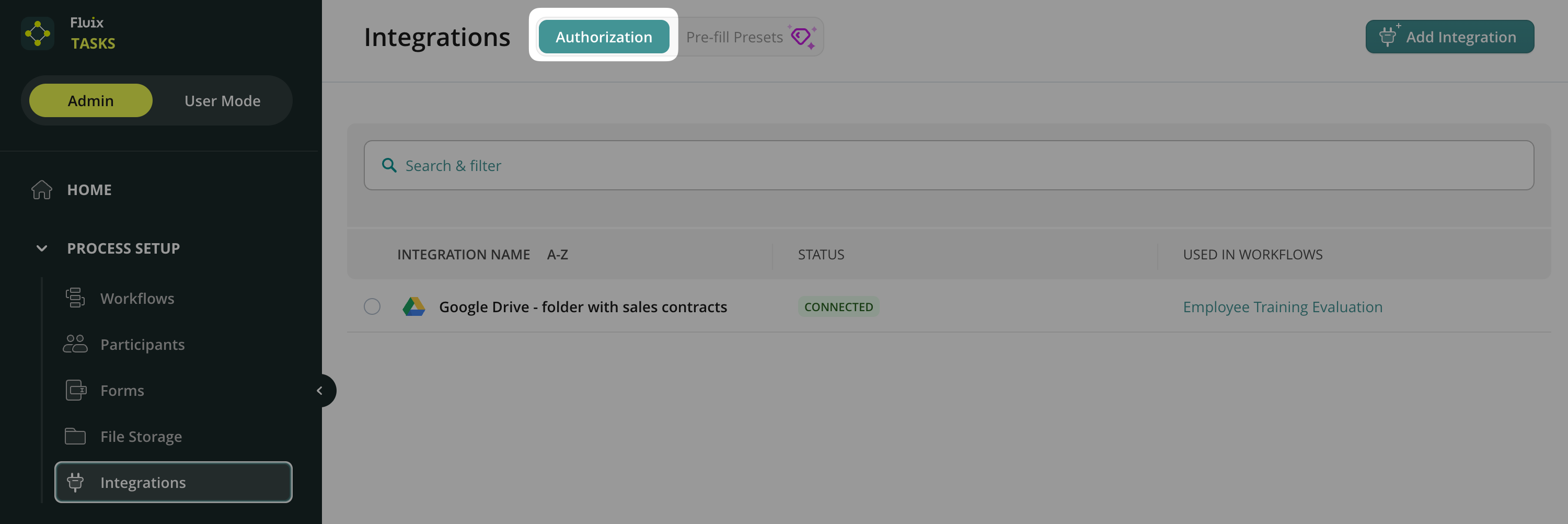
To connect your company storage to Fluix, please navigate to the Admin tab -> Process Setup -> Integrations section. Locate the storage that you would like to connect to Fluix and follow the instructions on the screen to authorize it.
Upon choosing storage, you will be redirected to the storage’s authorization page to confirm that you are granting access to Fluix. Upon authorizing it, the connected storage will be displayed in the Integrations section. It may have different statuses:
Connected status means the storage was connected successfully.
Disconnected status means the storage got disconnected from Fluix, and there are some problems with the connection between your storage and Fluix. To reauthorize, please select the storage and click on Reconnect.
The Authorization tab of the Integrations section contains a list of already connected storages, the names of all the Taskstreams where they are being utilized, and their current statuses.
When connecting OneDrive or SharePoint as a storage integration in Fluix, Microsoft will prompt you to grant Fluix a set of permissions. These permissions allow Fluix to access and manage your files on your behalf.
Delegated permissions are used when a signed-in user is present. This means Fluix acts on behalf of the user who authorized the connection, and the app can only do what that user is allowed to do. These permissions can be granted by the user themselves or by an administrator, depending on the permission level.
Application permissions are used for background operations that run without an active signed-in user. These permissions require administrator consent and allow Fluix to continue working with your storage even when no user session is active.
Below is a breakdown of each permission Fluix requests and why it is needed.
Files.ReadWrite.All — Allows Fluix to read, create, update, and delete files you have access to in OneDrive. This is required for Fluix to work with the OneDrive API on your behalf.
Sites.ReadWrite.All — Allows Fluix to edit and delete documents and list items across SharePoint site collections on your behalf. This is required for Fluix to work with the SharePoint API.
offline_access — Allows Fluix to access and update your data even when you are not actively using the app. This ensures the integration continues to function in the background without requiring you to re-authenticate each time. This permission does not grant any additional access beyond what has already been authorized.
Files.ReadWrite.All — Allows Fluix to read, create, update, and delete files across all site collections without a signed-in user. This is required for background operations within the OneDrive integration.
Sites.ReadWrite.All — Allows Fluix to create, read, update, and delete documents and list items across all SharePoint site collections without a signed-in user. This is required for background operations within the SharePoint integration.
Organization.Read.All — Allows Fluix to read your organization’s information, such as the tenant name, without a signed-in user. This is used so that once your tenant is recognized, it can be selected when setting up a new storage connection without requiring you to grant access to Fluix again.
Note: Application permissions can only be granted by a Microsoft administrator. If you are not an admin, please contact your IT team to complete the authorization.
In case you have any questions or difficulties with setup, contact our support at support@fluix.io, and we’ll be happy to help you.
Was this article helpful?
Thanks for your feedback!
Oops, something went wrong. Please, try again later.
Thank you!
What details or examples would have made this article more helpful for you? We appreciate your insights!
Sign Up to Our Product Newsletter
The latest updates from our Product team, straight to your inbox