
Most inspection tools look great in a demo. Then a technician takes one up a wind turbine, loses signal at 80 meters, and the form won’t save. That’s why field teams when looking for software, should look for whether it’s built for their conditions in the first place.
I evaluated the seven best inspection management software platforms the way crews actually use them: offline, in PPE, in remote conditions, and under deadline. My goal is to give you a comparison you can actually act on.
This guide is for operations, HSE, quality, and field-service leaders who run distributed inspections across job sites. You’ll get verified 2026 pricing, an honest “not ideal for” note on every tool, and a quick comparison table you can shortlist from today.
Already managing inspections in the field?
See how Fluix connects inspection findings to corrective actions and audit-ready reports
How I Evaluated These Tools
Where free versions were available, I tested those directly — keep in mind they come with limitations that paid plans remove, so I’ve noted where a free-tier experience differs meaningfully from what a paying team would get. I also cross-referenced user feedback on G2, Capterra, and Reddit, and spoke with teams at Fluix who came from several of the tools on this list. Their firsthand experience of what broke down in practice — not just in a demo — shaped how I framed the honest limitations for each tool.
I judged each platform on the criteria that decide whether an inspection gets done right in the field:
- Mobile usability — Can a technician complete a checklist quickly on a phone or tablet, in gloves and sunlight?
- Offline reliability — Does data capture keep working when connectivity drops, then sync cleanly later?
- Compliance support — Are there audit trails, timestamps, and recordkeeping that hold up in a regulatory review?
- Multi-step approvals — Can an inspection move through a defined chain of sign-offs before it closes, with the ability to push findings back for correction?
- Integration depth — Does inspection data flow into the systems your team already runs, without custom development to make it work?
- Implementation speed — How fast can you roll it out without a long IT project or bespoke configuration?
That field-first lens shapes every pick below.
Quick Comparison: The 7 Best Inspection Management Tools
| Tool | Best For | Starting Price | Free / Trial |
| Fluix | Field inspections in regulated industries | $29/user/mo | Demo |
| Mitti (SafetyCulture) | Broad safety inspections | $24/user/mo | Free ≤10 users |
| Fulcrum | Geospatial data-based inspections | $43/user/mo | Free trial |
| GoAudits | Multi-site retail, hospitality, and facilities audits | $12/user/mo | 14-day trial |
| TrueContext | Enterprise field-service workflows | $4,800/year | Contact sales |
| Field Eagle | Industrial and equipment inspections | Quote-based | Free demo |
| ComplianceQuest | QMS for life sciences and manufacturing | Quote-based | Contact sales |
Top Inspection Management Software
1. Fluix — Best for Field Inspections in Regulated Industries
Fluix is inspection management software built for wind and energy, oil and gas, aviation, construction, and utilities, and used to manage inspections, safety, and compliance from the field. What I think separates Fluix from the rest of this list is the post-inspection step. While most tools get data off paper, Fluix moves the inspection loop – you can flag, route, track, and resolve action without leaving the platform.
In the field, technicians run inspections on any device with or without signal. Every failed item, photo, GPS tag, and signature is captured at the point of work. Back in the platform, findings are assigned to the right person, with a deadline, through whatever approval chain the inspection requires. A senior engineer can push a finding back to the technician for correction before it closes.
Once inspections are complete, the data rolls up into dashboards – which sites are generating the most findings, which equipment fails on a pattern, where compliance gaps are building. You have the end-to-end inspection management from data collection to storage and analytics.
Key features:
- Mobile inspections with AI form generation
- Full offline support — inspections, photos, GPS, and e-signatures all work without signal
- Rich data capture — photos, annotations, GPS timestamps, barcodes
- Multi-step approvals with push-back capability
- Task scheduling and automated notifications
- Issue reporting and incident reporting
- Centralised dashboards and analytics
- Field Intelligence and MCP integration
- Guest access for external contractors and vendors
- Certified security: ISO 27001, SOC 2 Type II, HIPAA, GDPR
Best for: Operations, HSE, and quality leaders managing distributed field teams in compliance-heavy environments who need fast deployment without a heavy IT project.
Not ideal for: Teams that only need a handful of simple one-off forms and don’t run recurring inspection programmes.
Pricing:
- Crews: $29/user/month (5+ users)
- Operations: $49/user/month (15+ users)
- Enterprise: Custom (25+ users)
All plans include unlimited forms and templates, plus full offline mode.
What customers say:
“What used to take hours now can be accomplished in minutes.” Bob Hoelzen, FCF Operations Manager, Alaska Airlines “With Fluix, we decreased wind farm inspection time by 43%, that enabled us to cut project costs.” — Paul Wilson, Project Manager, CPP Australia
2. Mitti (by SafetyCulture) — Best for Broad Safety Inspections
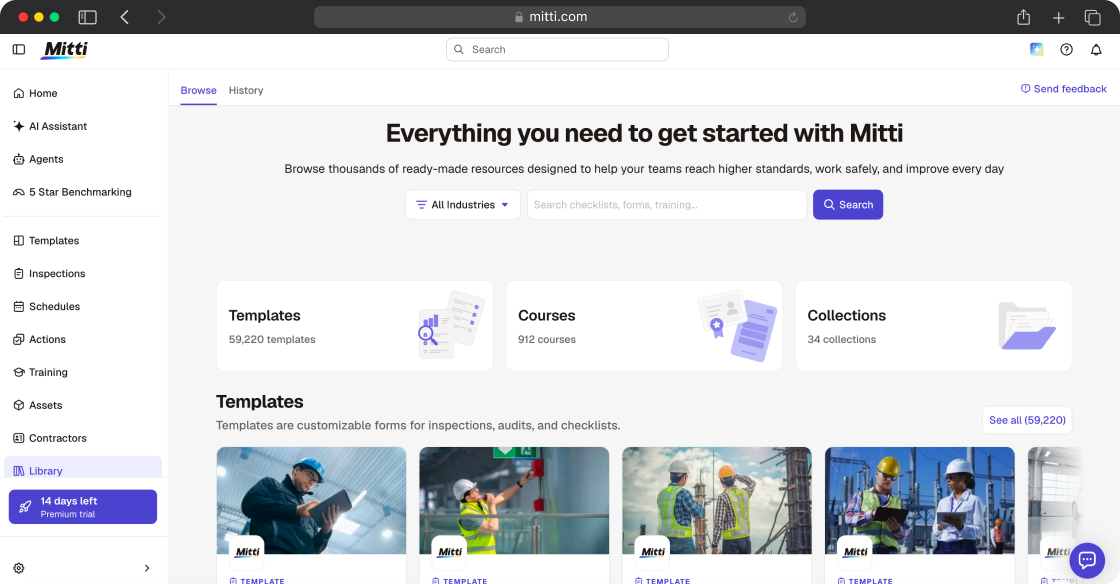
SafetyCulture rebranded to Mitti in August, 2026. The platform has also launched a significant AI capability suite alongside the rebrand: AI Agents that monitor what is happening on site and run routine tasks in the background, an AI Assistant that surfaces patterns, compares performance against regulations, and creates action plans, and “5-Star Benchmarking” that turns operational history into one clear score across multi-site operations. AI Issue Creation turns photos, videos, and voice into structured issues automatically.
Strategically, Mitti is expanding well beyond safety inspections. The platform now covers quality, maintenance, training, assets, and insurance — with Mitti Insurance now licensed across the United States. For teams who want a focused inspection management tool, that expanding scope is worth factoring into an evaluation.
If I had to hand one tool to a non-technical workforce that needs to start inspecting fast, Mitti is still one of the strongest options on this list. The template library exceeds 100,000 customisable options, and I have seen teams go from zero to running inspections on the same day they signed up.
Key features:
- Customisable inspection templates with AI template generation
- Mobile-first capture with offline support
- Conditional logic in template builder
- Scheduling with bulk site management
- Analytics heatmaps and 5-Star Benchmarking
- AI Agents and AI Assistant
- AI Issue Creation from photos, videos, and voice
- Training module with AI course creation
- IoT sensor monitoring and telematics integration
Best for: Non-technical teams rolling out standardised safety inspections at scale, especially where the template library does most of the heavy lifting.
Not ideal for: Teams that need multi-stage approval chains, highly customised report layouts, or automatic filing to external storage — these are where Mitti shows its limits.
Pricing:
- Free: Up to 10 users
- Premium: $24/user/month (annual) / $29/user/month (monthly)
- Lite Seat: $5/user/month
- Enterprise: Custom
What customers say:
“Our team is motivated to use SafetyCulture because it’s easy, and they’re seeing the benefits of doing so.” Graham Berry, Group General Manager HSEQ Assurance, Thermosash Group
Related: SafetyCulture review by a Fluix PM: hands-on testing of the 2026 version →
3. Fulcrum — Best for Geospatial Data-Based Inspections
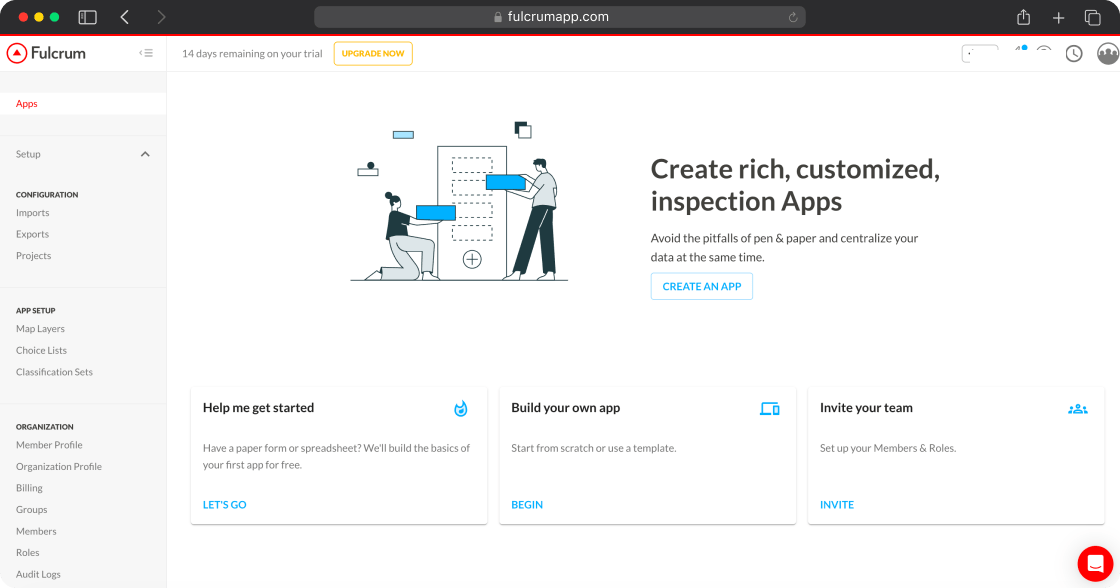
Fulcrum is my pick when location is the organising principle of the entire inspection. It’s a field data collection and process management platform built around GIS, and it does that better than anything else on this list.
What makes Fulcrum stand out is how it handles location at every stage of the workflow. Inspection records connect to geospatial points, lines, and polygons. Field teams can interact with live ArcGIS feature service layers in the field, even offline, using customisable basemaps. When they reconnect, data flows into GIS-ready formats without manual conversion. For utilities, environmental monitoring, and infrastructure teams managing assets across wide areas, that is genuinely valuable.
My honest note: Fulcrum is powerful, but the geospatial depth adds a learning curve. Teams that don’t need spatial analysis won’t use what makes Fulcrum distinctive, and the entry price reflects the platform’s depth rather than its simplicity. I’d also check the corrective action workflow depth — Fulcrum excels at capture and location intelligence, but closing the defect-to-repair loop requires more configuration than in Fluix or Mitti.
Key features:
- GIS and geospatial data capture with live ArcGIS layer connectivity
- Offline maps and offline
- AI capability
- FastFill AI — form population from photos, voice, and text
- Object recognition and face blurring
- Fulcrum Insights — plain-language data queries returning charts and maps
- Audio capture and conditional logic
- Geostamped audit trails
- Export to shapefiles, KML, GeoJSON for direct GIS use
- Integrations: ArcGIS, Power BI, Google Sheets, Microsoft Teams
Best for: Utilities, environmental monitoring, and infrastructure teams where geospatial context is central.
Not ideal for: Teams that just need straightforward checklists without GIS overhead — the platform’s power becomes complexity if location intelligence isn’t central to your programme.
Pricing:
- Professional: $43/user/month
- Elite: $55/user/month
- Enterprise: Custom
What customers say:
“GIS integration and data organisation is the best aspect of Fulcrum. It has been a tremendous process improvement and has allowed us to be so much more efficient with our time.” — Scott M., G2
4. GoAudits — Best for Multi-Site Scored Audits
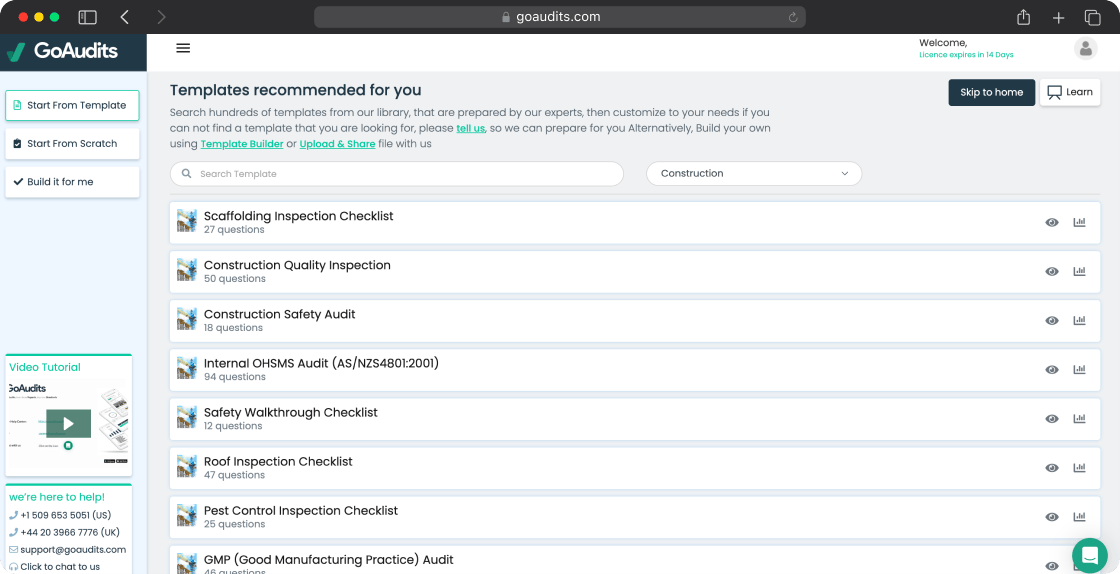
GoAudits is built for operations where the same audit runs across many locations and the score is what management actually cares about. Retail, hospitality, food and beverage, facilities management — if your job is holding standards across a portfolio of sites, this is the tool I’d reach for first.
The thing I find most practical about GoAudits is the workflow that happens between the audit and the action. During an inspection, you assign corrective actions directly to the right person — internally or externally — with a priority and due date. External assignees don’t need a paid licence; they receive a link by email. That’s genuinely useful for multi-site operations with contractors or area managers who only need to close out tasks, not run audits themselves.
The instant branded PDF reports are also worth noting. After each inspection, a professional-looking report generates automatically and distributes to whoever needs it. GoAudits claims customers report up to 5x faster inspections, which tracks with how much time usually disappears into manual report preparation.
My honest note: GoAudits is built for consumer-facing operations, and that shapes what the platform does well. Teams in oil and gas, mining, or heavy industrial environments will find fewer industry-specific templates and a less developed compliance reporting layer than they’d get from Fluix or Field Eagle. And the Starter plan’s limit of 10 templates and 25 locations is a real constraint for larger portfolios.
Key features:
- Mobile audits with offline and online capture, on any device
- Automatic branded PDF report generation after every inspection
- Scoring with trend analytics and site-to-site performance comparison
- Corrective action assignment with due dates, priorities, and external user access
- Scheduled audits with automated reminders and escalation rules
- Custom workflows for report distribution and approvals
- ISO 27001 certified
- 14-day free trial, 60-day money-back guarantee
Best for: Multi-site operators in retail, hospitality, food and beverage, and facilities who need fast, repeatable scored audits with clear visibility across locations.
Not ideal for: Heavy industrial and regulated-environment inspections — the platform is optimised for consumer-facing operations and the compliance depth reflects that.
Pricing:
- Starter: $12/user/month (annual)
- Enterprise: $30/user/month (annual)
- Custom enterprise plans available for advanced integrations and reporting
What customers say:
“GoAudits has assisted us to move dramatically through our quality control scores, internal and external. Any recommendation or request we made was immediately actioned upon.” — Remus Palimaru, Rosewood London
5. TrueContext (Formerly ProntoForms) — Best for Enterprise Field-Service Workflows
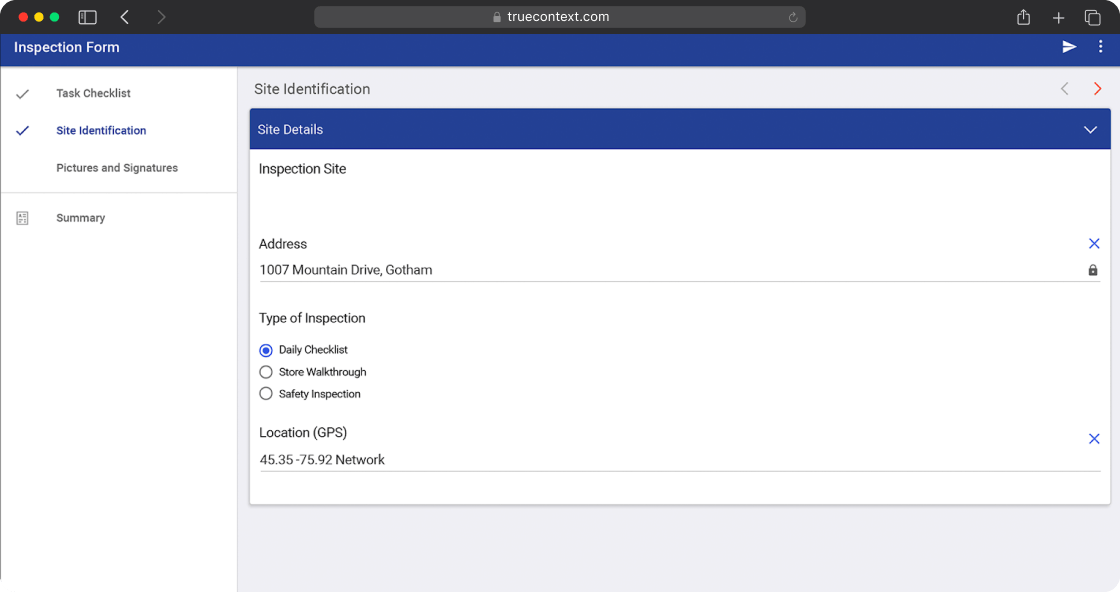
TrueContext targets enterprise field-service workflows in high-complexity, low-connectivity environments. It supports very large deployments — over 100,000 users across its customer base — and its depth in conditional logic, workflow routing, and enterprise integrations is the strongest on this list for organisations that need that level of configurability.
In 2026, TrueContext has been building out its AI direction under a “context layers” framework. Core Context pre-populates workflows with job, asset, and customer details before the technician arrives on site. Expand Context gives technicians access to Work History — launched February 2026 — so they can see what has been done on an asset previously without leaving the workflow. Extend Context allows technicians to tap into external systems mid-workflow, including AI services and computer vision tools, with responses feeding directly back into the form. The platform now uses Anthropic Claude as its LLM provider for opted-in AI features.
A consistent note from G2 reviewers: the UX feels somewhat dated and more AI features should be integrated into the core product — particularly for conditional logic and low-code customisation. This is an honest limitation for teams used to more modern interfaces.
Key features:
- Advanced conditional logic and multi-step workflow routing
- Offline operation across all plans
- Deep enterprise integrations — Salesforce, SAP, Oracle, ServiceNow
- AI-guided workflows (Intelligent and Elite tiers)
- Cross-platform: iOS, Android, Windows, macOS
Best for: Large enterprises with complex field-service processes, demanding connectivity conditions, and dedicated admin resources to configure the platform.
Not ideal for: Small teams or organisations with tight budgets — the enterprise pricing and configuration depth assumes dedicated resources.
Pricing:
- Digital: From $4,800/year (entire team, billed annually)
- Intelligent: Custom
- Elite: Custom
What customers say: 4.5 — G2, 4.6 — Capterra. Reliability in low-connectivity environments and deep enterprise integrations are the most consistent strengths cited.
6. Field Eagle — Best for Industrial and Equipment Inspections
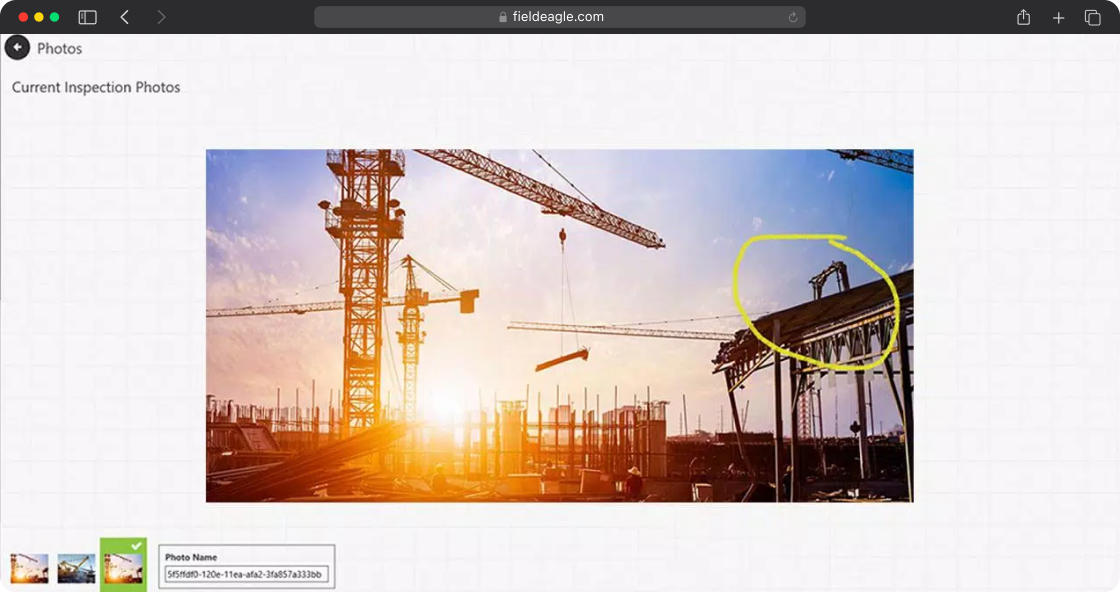
Field Eagle focuses on industrial and equipment inspections, linking findings to specific asset components. That structure fits energy and manufacturing teams inspecting complex machinery where a defect needs to be tied to a specific part — not just noted in a form.
Key features:
- Findings tied to specific asset components
- Full offline capability
- Equipment and asset-focused templates
- Detailed inspection recordkeeping
- AI preventative maintenance features
- Corrective actions workflow
- NASPO-certified compliance
Best for: Industrial teams in energy and manufacturing who need component-level inspection detail and NASPO-certified compliance.
Not ideal for: Non-technical users or teams that need self-serve workflow configuration — Field Eagle assumes a more technical implementation and often requires vendor involvement for workflow changes.
Pricing: Quote-based — no published tiers. Request a demo to get numbers.
What customers say: Users value its offline strength and the asset-component structure for equipment-heavy inspections. The most common switch reason: onboarding complexity for non-technical crews and quote-only pricing that adds procurement friction.
Also read: 5 best Field Eagle alternatives in 2026 →
7. ComplianceQuest — Best for Life Sciences and Manufacturing QMS
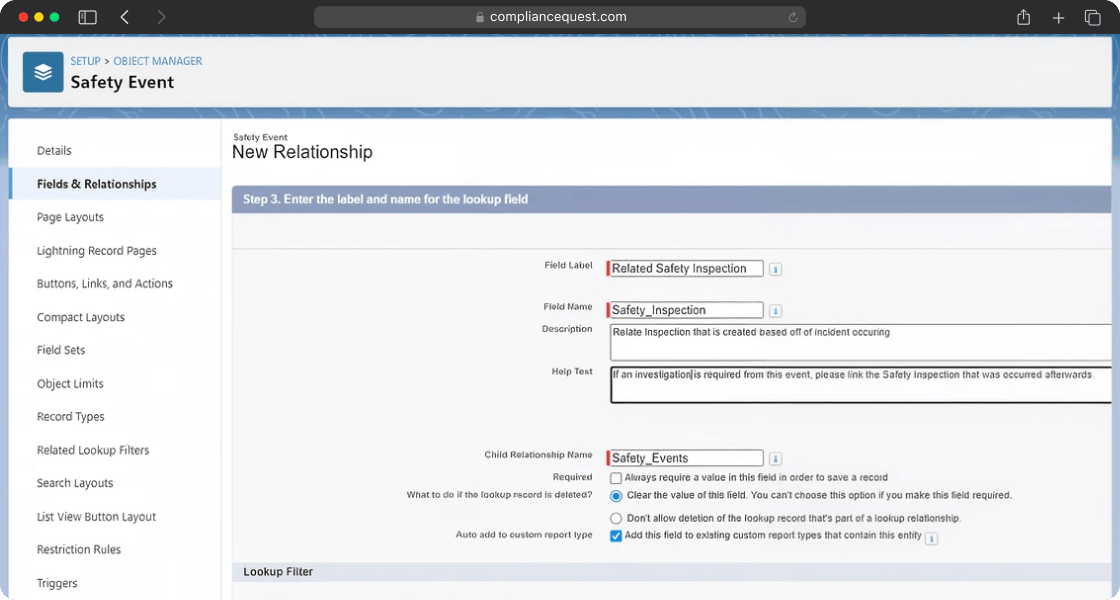
ComplianceQuest is an AI-powered quality management system built on Salesforce, aimed at life sciences, manufacturing, and automotive organisations.
It is a broad QMS rather than a field-first inspection tool, and that distinction matters: it is built for quality departments managing document control, CAPA, and regulatory submissions, not for field crews running daily safety checks.
Key features:
- AI-powered QMS on the Salesforce platform
- Quality, compliance, and document control
- CAPA and corrective action management
- Workflow automation across quality processes
- Enterprise reporting and analytics
- Regulatory submission management
Best for: Life sciences, pharmaceutical, and manufacturing organisations that need an enterprise QMS and are already invested in the Salesforce ecosystem.
Not ideal for: Field-first crews — ComplianceQuest typically requires IT or consultants to implement, and its mobile experience is functional but not optimised for on-site inspections in demanding conditions.
Pricing: Quote-based. Starting price information from third-party sources suggests enterprise-level investment.
What customers say: Capterra ~4.3. Users cite strong quality management depth; implementation complexity and Salesforce dependency are the consistent friction points.
Related: 6 best ComplianceQuest alternatives in 2026 →
What Is Inspection Management Software?
Inspection management software is a digital platform that helps operations and safety teams plan, conduct, document, and track inspections — replacing paper checklists and manual reporting with mobile workflows. Fluix is used by 12,000 field service teams in construction, energy, and utilities to manage their inspections, safety, and compliance from the field.
It’s easy to confuse it with adjacent categories. Audit software focuses on scheduled compliance reviews. A QMSmanages broad quality processes across an organisation. Inspection management software sits closest to the daily field work: safety walkthroughs, equipment checks, vehicle inspections, and facility audits that your crews run every week.
Why it matters: consistent inspections catch defects and hazards before they cause downtime or injury, and a clean digital record keeps you audit-ready when regulators show up.
What to Look For in an Inspection Management Tool
A few features matter for almost every field team:
- Offline mode — capture that keeps working without signal and syncs cleanly when you’re back online
- Mobile capture — a fast app usable in gloves and glare, with photo and annotation support
- Conditional logic — checklists that adapt based on what a technician actually finds
- Audit trails — timestamps and traceable records that hold up in a regulatory review
- Integrations — inspection data flowing into the ERPs, CMMS platforms, and cloud storage you already run
- Fast implementation — a rollout measured in weeks, not quarters
How to Choose the Right Tool
Start with your team’s actual conditions and narrow from there.
Field-heavy, regulated industries — energy, aviation, construction, utilities: prioritise offline reliability, compliance depth, and post-inspection workflow automation. Fluix, Fulcrum, and Field Eagle fit here, for different reasons.
Multi-site retail, hospitality, and food service: prioritise fast, scored, repeatable audits across locations. GoAudits is the most focused tool on this list for that specific use case.
Enterprise field-service with complex workflows: TrueContext handles high-complexity, low-connectivity deployments at large scale — but it needs dedicated admin resources to configure properly.
Life sciences and manufacturing QMS: ComplianceQuest covers the Salesforce-native quality management use case. Be clear about whether you need a QMS or an inspection tool — they’re different problems.
If your inspections happen in the harshest conditions and a failed sync is a real risk, weight offline mode and audit trail depth above everything else. A tool that captures offline but loses data on reconnect isn’t offline-ready.
Frequently Asked Questions
What is the best free inspection management software?
Mitti by SafetyCulture’s free plan is the most capable no-cost starting point — up to 10 users with core inspection features. MaintainX has a free tier for maintenance-led teams. Fluix, GoAudits, and Field Eagle all offer demos or trials so you can test in your own environment before committing.
Does inspection management software work offline?
Yes — offline mode is essential for field teams, and most tools here support it. Fluix includes full offline mode on every plan, including photo sync, so capture continues when connectivity drops and uploads automatically when you’re back online.
What’s the difference between inspection management, audit, and QMS software?
Inspection management software handles daily field checks — safety, equipment, vehicle, facility. Audit software focuses on scheduled compliance reviews. A QMS manages quality processes across an organisation. They overlap, but inspection tools sit closest to the daily field work itself.
Which is best for regulated, asset-intensive industries?
Look for offline reliability, audit trails, and recognised security certifications. Fluix is built for this, with named results in wind energy and aviation, and certifications including ISO 27001, SOC 2 Type II, HIPAA, and GDPR.
How fast can you implement inspection management software?
With Fluix, teams typically launch a first pilot in four weeks and scale from there without recreating processes. Mitti is faster for straightforward safety checklists. TrueContext and ComplianceQuest take longer — budget for dedicated configuration time.
What happened to SafetyCulture?
SafetyCulture rebranded to Mitti in August 2026. The product, pricing, features, and team are unchanged. The mobile app was renamed and the website moved to mitti.com. If you are currently evaluating SafetyCulture, the platform you are looking at is now called Mitti.