Since 1986, HCSS has helped civil contractors streamline estimating, fleet management, safety, and jobsite coordination. It was acquired by the Nemetschek Group, in 2026, joining Nemetschek’s Build & Construct segment alongside Bluebeam, GoCanvas, and SiteDocs. For teams evaluating HCSS, this acquisition means long-term product direction and roadmap decisions will be influenced by Nemetschek’s broader portfolio strategy.
HCSS modular solutions bring flexibility. But they can also slow crews down, requiring them to switch between systems, which increases manual errors. What’s more, the risk continues upstream, leaving safety managers struggling to maintain real-time visibility across sites.
For contractors managing tight schedules, dispersed teams, and growing compliance demands, centralizing these workflows is no longer optional.
Contents:
Why Look for HCSS Alternatives?
HCSS has earned its place in civil construction by helping contractors improve bidding speed and fleet performance. But as job site demands evolve, so does the need for a unified tool that supports fast-moving fieldwork, real-time updates, and streamlined safety oversight.
For example, with HCSS, logging a safety incident in one module may require switching to another to assign corrective actions, and a third to update compliance records.
The alternatives to HCSS featured here consolidate these tasks into a single, streamlined platform. They’re built for civil contractors managing fast-paced projects, dispersed teams, and zero margin for delay in 2026.
How I Chose the Top HCSS Alternatives
I looked for EHS platforms that deliver what HCSS often requires extra setup or IT support to achieve. Specifically, I focused on tools that address the core operational challenges faced by civil contractors on active infrastructure projects.
And so, each solution needed to meet four key criteria:
- Built for dynamic job sites: Designed to flex with evolving site conditions (without IT intervention)
- Connectivity where it counts: Reliable offline functionality across bridge decks, tunneling sites, and rural pipeline spans
- One platform for safety & compliance: Combines inspections, permits, and reporting in one mobile-ready platform accessible to supers, safety officers, and crews
- Workflows that fit how you build: Enables mobile data capture, real-time jobsite coordination, and risk-based safety automation
Top Alternatives to HCSS in 2026
1. Fluix
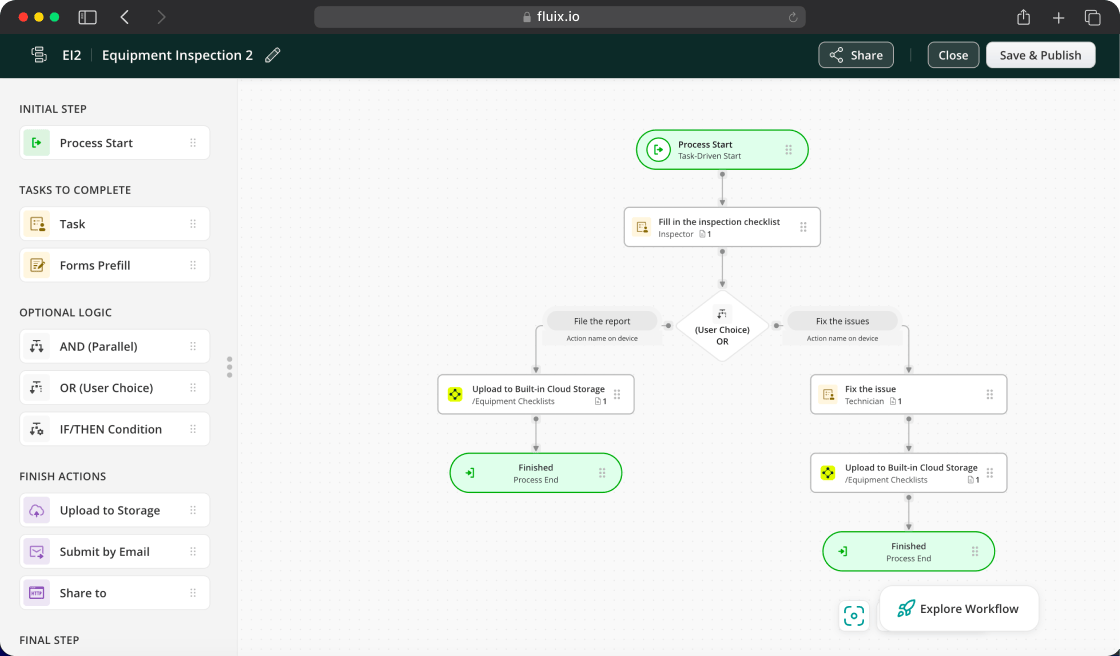
Fluix is inspection management software field teams use to run safety inspections, equipment checks, permit-to-work workflows, and compliance documentation from the field.
The distinction from HCSS is fundamental. HCSS is a civil construction operations suite — estimating, fleet management, telematics, scheduling. Its safety module (HCSS Safety) is one component in a larger system, requiring teams to switch between modules for inspection, corrective action, and compliance record-keeping. Fluix is purpose-built for the safety inspection itself: one system, one mobile app, one connected workflow from checklist to corrective action to audit-ready record.
On a real civil project: a foreman on a remote road job logs a JHA offline. Once connected, it syncs instantly. A safety officer captures a near-miss with photos, triggering an automated workflow that routes the report to the right reviewer without anyone creating a task manually. The superintendent tracks inspection completion and open corrective actions across all crews in real time.
In 2026, Fluix launched Field Intelligence — including an MCP connector that lets operations managers query live inspection data through Claude, Microsoft Copilot, or ChatGPT in plain language. Ask “which sites have open corrective actions older than 14 days?” or “show inspection completion rates by crew for Q2” and get the answer directly in the AI interface, without building a report or opening a dashboard.
Key Features
- Mobile checklists and AI form generation
- Full offline mode
- Multi-step approvals with push-back capability
- Automated corrective action routing
- Permit-to-work management with conditional logic and required sign-offs
- Task scheduling with visual calendar
- Equipment safety inspections via mobile forms
- MCP connector for Claude, ChatGPT and Microsoft Copilot
- Guest access for external contractors
- API and integrations
Pricing
- Crews: $29 per user/month, 5+ users
- Operations: $49 per user/month, 15+ users
- Enterprize: Quote request, 25+ users
WHAT IF SAFETY MANAGEMENT SAVED YOU $300K THIS YEAR?
Talk to Fluix team and find out your potential savings
2. Procore
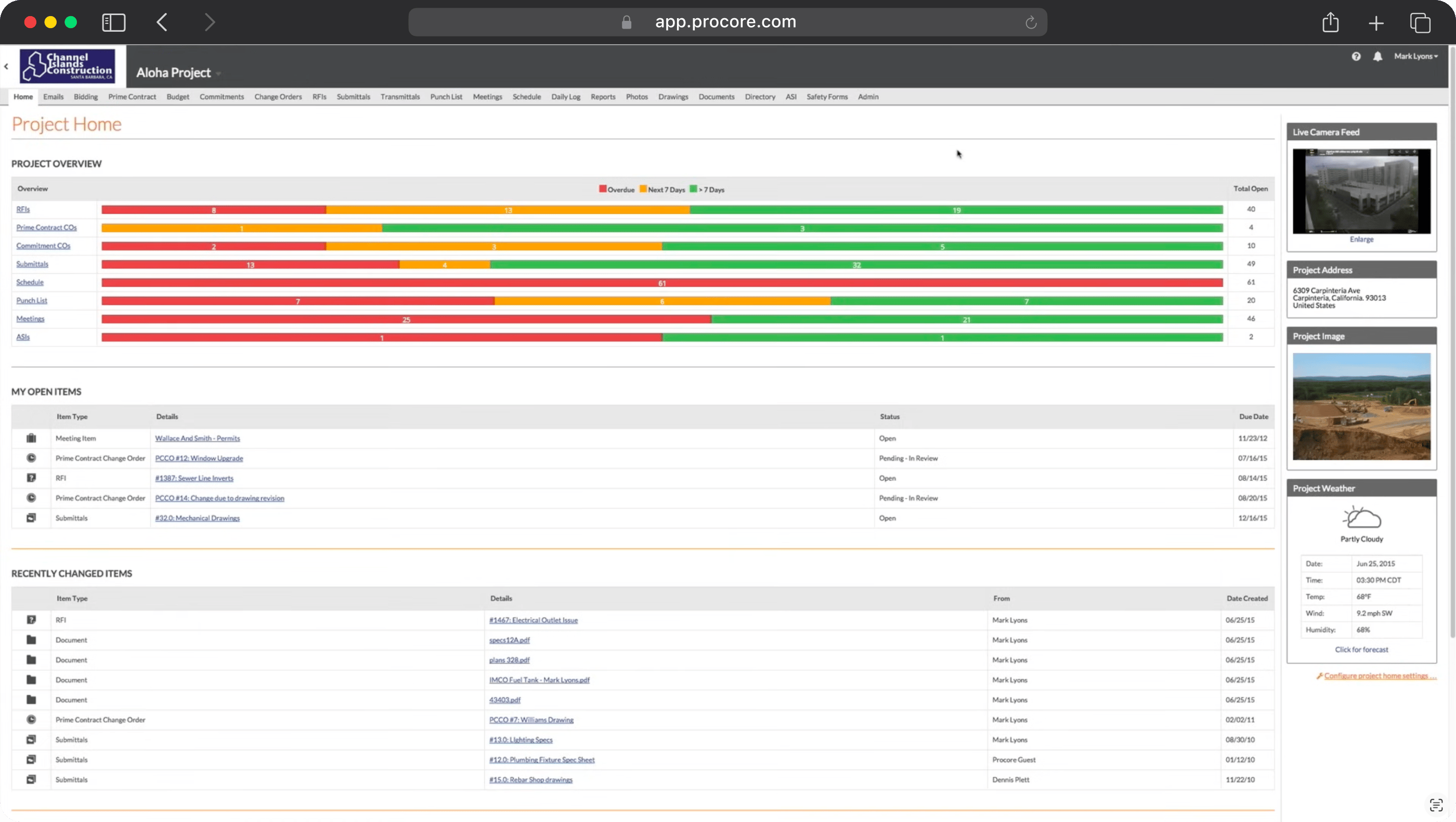
If you’re managing complex infrastructure projects from pre-construction to closeout and need to unite safety, schedules, and site activity in one place, consider Procore.
With HCSS, safety is managed in a separate module. By contrast, Procore directly ties incidents and inspections to project tasks, simplifying audits and claim reviews. It’s a strong option for general contractors and project managers looking to manage safety within a broader construction platform.
In 2026, Procore launched its Safety Hub — an AI-powered layer that analyses observations, inspections, and incidents to surface leading safety indicators across projects. This is a meaningful addition for GCs managing safety programme performance at scale, though it requires additional configuration and does not replace a dedicated inspection management workflow.
Key Features
- Inspection and observation logs integrated with project records
- Incident tracking with attachments and team notifications
- Mobile app access for field safety updates
- Safety reporting is tied to overall project performance
- Centralized documentation for audits and compliance reference
- Safety Hub — AI-powered leading indicator analysis
Pricing
Procore uses an Annual Construction Volume (ACV) model — pricing is based on total construction volume, not per user, meaning unlimited users within your plan tier. No pricing is published publicly.
3. Mitti (Formerly SafetyCulture)
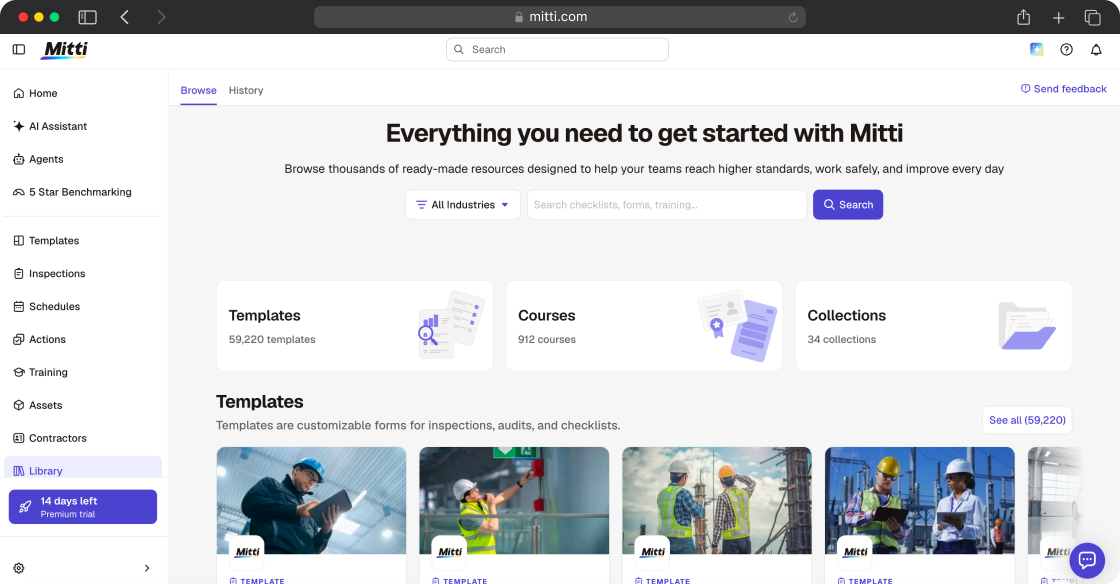
Mitti (formerly SafetyCulture, originally iAuditor) is a mobile-first platform well-suited for civil contractors that need to standardise site inspections and improve daily reporting quickly. The template library now exceeds 59,000 customisable options — most teams find a ready-made inspection template for their use case and are running the same day they sign up.
Where HCSS captures static safety logs only, Mitti lets supervisors assign inspection tasks, collect photo evidence, and trigger follow-ups from any device in real time — even with limited connectivity. If you need to boost field reporting across multiple crews without major IT overhead, Mitti is a fast and practical option.
Alongside the August 2026 rebrand from SafetyCulture, Mitti launched AI Agents that monitor site activity and run routine tasks in the background, an AI Assistant that surfaces patterns and creates action plans, and 5-Star Benchmarking that scores each site in a portfolio — useful for contractors managing multiple active project sites simultaneously.
If your projects demand full EHS integration, multi-step approval workflows, or cross-site analytics for large-scale civil infrastructure, Mitti’s one-directional task management may require pairing with other tools to close the gaps.
Key Features
- Customisable inspection templates with AI template generation
- Mobile-first capture with offline support
- Real-time issue reporting with status tracking
- AI Agents and AI Assistant
- 5-Star Benchmarking — site performance scoring across portfolio
- Digital training and certification tracking
- Team dashboards and exportable reports
Pricing
- Free: $0, up to 10 users
- Lite Seat: $5/user/month
- Premium: $24/user/month (annual billing) / $29/user/month (monthly)
- Enterprise: Custom
4. Fieldwire
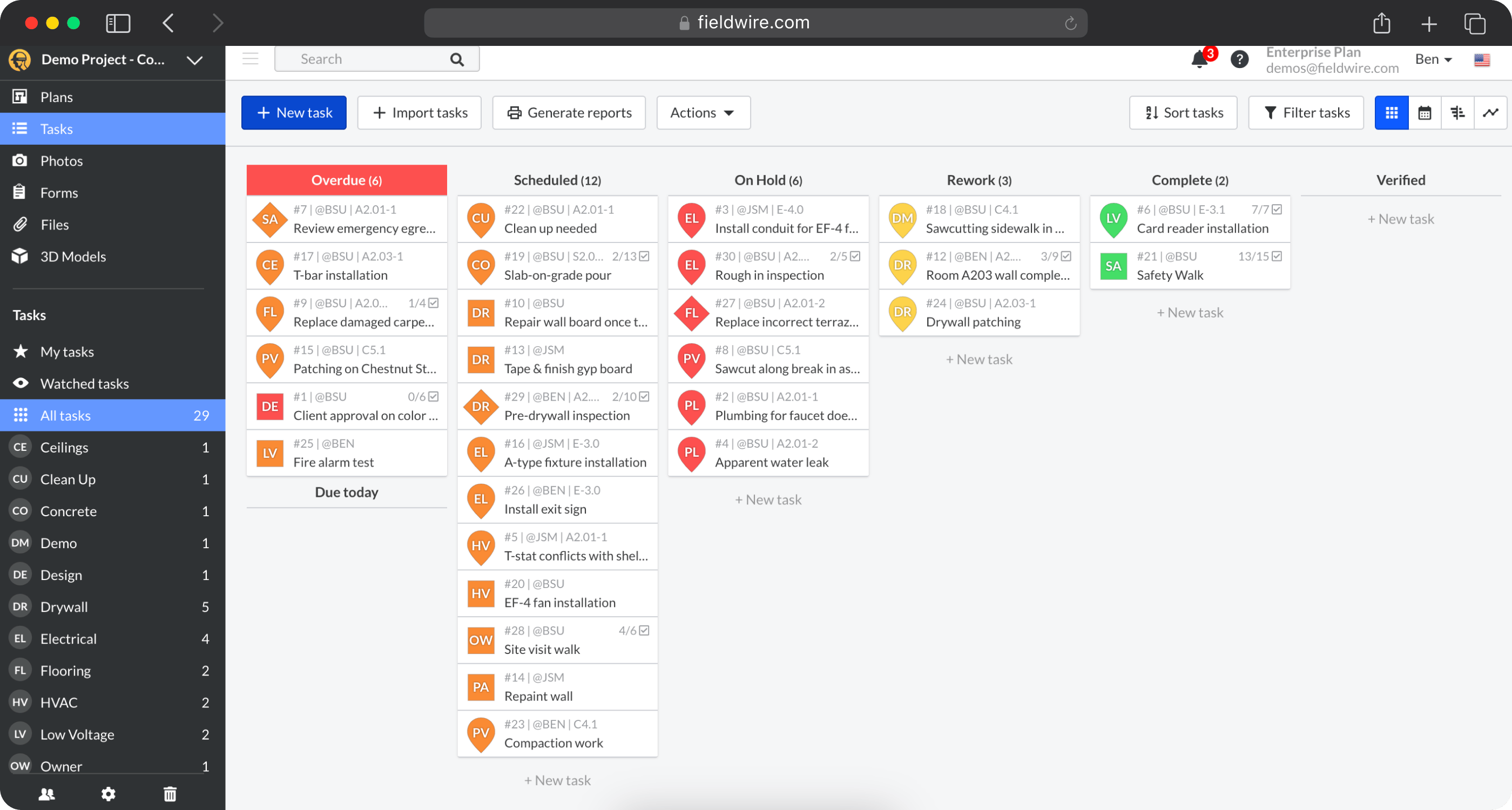
Fieldwire is a jobsite coordination tool that incorporates embedded EHS functionality into its task and plan management features. For infrastructure projects such as rail trenching, supers and field engineers can flag safety concerns directly on digital plans, assign corrective actions to responsible crews, and track the progress of resolution.
It’s ideal for small to mid-sized civil contractors who need fast, crew-friendly safety coordination without the full system overhead. Compared to HCSS Safety, which operates in silos with limited field interactivity, Fieldwire integrates safety into daily construction workflows.
In 2026, it shipped voice-to-task AI — technicians can create and complete tasks or forms using voice input with real-time translation — and expanded plan syncing between GC and subcontractor projects. These additions reinforce Fieldwire’s position as a construction coordination tool but do not address the EHS workflow gaps noted above.
Key Features
- Plan-based issue tagging
- Real-time task coordination
- Photo and video documentation
- Mobile field forms
- Offline access
- Basic reporting
- Role-based permissions
Pricing
- Basic: Free
- Pro: $39/user/month
- Business: $64/user/month
- Business Plus: $89/user/month
Which HCSS Alternative Is Best for You?
Whether you’re moving on from HCSS Safety or exploring more integrated HSE solutions, the right tool for heavy civil work needs to match the pace and pressure of your crews on the ground.
If your jobsite safety systems still rely on paper trails, siloed modules, or offline workarounds, Fluix is the most field-ready upgrade for heavy civil contractors seeking to modernize their risk, reporting, and compliance management across active infrastructure projects.