
Wind turbine inspection software covers three functionally different categories – drone and AI blade inspection, operations and maintenance management, and field inspection management. And most buying mistakes happen when operators treat them as interchangeable. And in my experience, the field execution layer is where most operators underinvest.
The six tools below are the best in their respective categories in 2026. I’ve included one tool from each of the three layers, plus the strongest alternatives in each.
New to this category? How to choose wind turbine inspection software covers the three-layer framework before you evaluate any product.
Contents:
How I Picked This List
I work with wind energy operators across Europe and North America on inspection management and field workflows. Every tool on this list has been selected based on three criteria.
- Documented capability in wind energy specifically. Every tool here has named wind energy deployments and capabilities built around the operational realities of turbine inspection: narrow weather windows, offshore connectivity gaps, OEM-specific SCADA systems, and regulatory audit requirements.
- The right tool for the right layer. I’ve organised this list by functional category rather than by overall score, because scoring tools from different layers against each other produces meaningless rankings. vHive and Fluix both appear on this list. They solve different problems. Comparing them on the same scorecard would be like comparing a diagnostic MRI to a surgeon — both are necessary, one does not replace the other.
- Honest limitations. Every section includes what the tool doesn’t do. If you’re reading this list hoping to find one platform that covers everything — drone inspection, condition monitoring, field management, CMMS, and compliance records — it doesn’t exist yet.
I’ve direct experience with Fluix deployments across wind energy customers — RWE Renewables, Siemens Gamesa, ZITON, CPP Australia. For the other tools, I’ve drawn on published capability documentation, named customer references, and conversations with operators who use them.
Best Tools for Wind Turbine Inspections
1. Fluix: Best for Wind Turbine Field Inspection
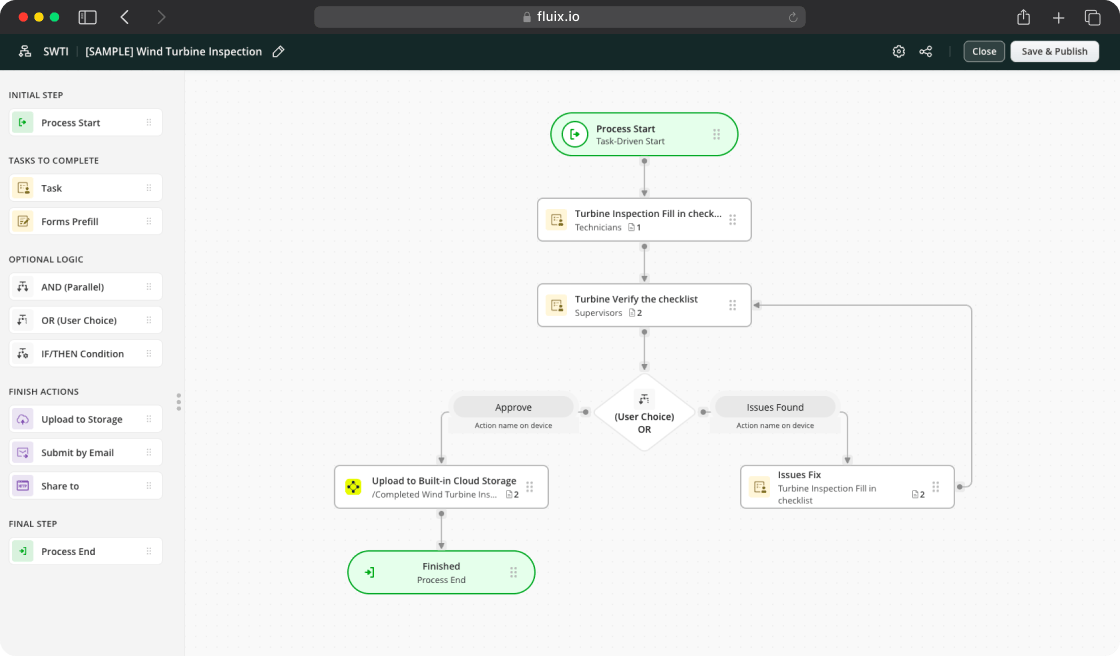
Fluix’s wind turbine inspection software runs the human inspection process — checklists, permit to work, LOTO, corrective actions, and compliance records — for onshore and offshore teams. It manages inspections, safety, and compliance across wind, construction, aviation, and utilities.
Key features
- Offline mode — full form filling, photo capture, and submission with no connectivity; syncs automatically on reconnect
- Permit to Work and LOTO checklists with step-by-step digital sign-off and named authorisation at each stage
- Automated corrective action creation from failed checks — routed to a named person, with a deadline, requiring verified closure
- Photo documentation linked to specific findings at point of capture, with GPS tag and timestamp
- Pre-filled fields — turbine ID, site name, inspector name, and asset codes populate automatically
- AI form creation — generate inspection forms from a text prompt or uploaded PDF in seconds
- Automated file naming — every completed record saves with a consistent, searchable name from form data
- Dashboards — real-time completion rates, open corrective actions, and KPIs across sites
- Integrations — Power BI, SharePoint, Google Drive, Salesforce, Procore, SCADA systems, and API access
- MCP – Ask your AI assistant anything about your inspection data
Best for: Wind energy field teams who need audit-ready inspection records from every turbine visit — nacelle, tower, foundation, electrical, and safety checks — with corrective actions tracked to verified closure.
Limitations: Fluix is the field management layer. It does not fly drones or classify blade imagery from aerial inspection campaigns.
Wind energy results
- RWE Renewables — 45% reduction in daily form completion time
- ZITON — preventive maintenance reporting 3.5× faster
- Siemens Gamesa — 2,000 man-hours saved annually across 26 countries
- CPP Australia — inspection time cut from 22 to 12.5 minutes per visit
Security: ISO 27001 and SOC 2 Type II certifications.
Pricing
From $29/user/month. Enterprise plans and custom workflows available on request.
2. vHive: Best for Autonomous Blade Inspection
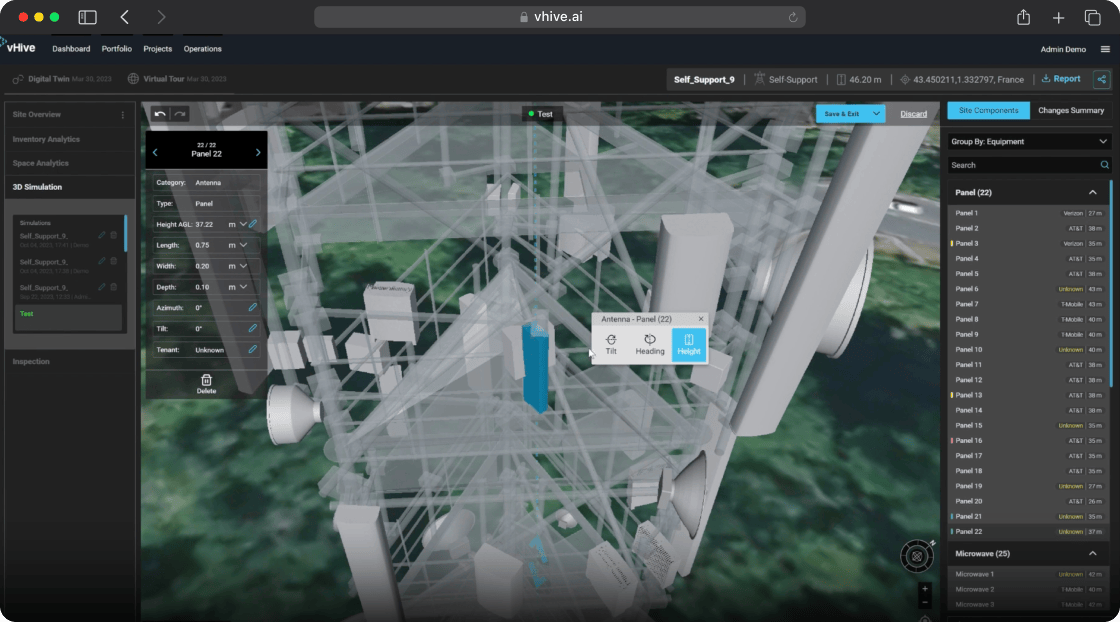
vHive is an end-to-end autonomous blade inspection platform combining pre-programmed drone flights, AI defect classification, and cloud-based reporting. It is the platform I hear cited most consistently by operators running large-scale blade inspection campaigns.
One thing to know before you evaluate it: Cristina Fernandez Alonso, a product service engineer at GE Vernova who manages offshore blade inspection programmes, puts the rope-access follow-up rate at 12–20% of drone-surfaced findings: “Maybe around 12% of the defects or up to 20% of the defects are unknowns — we need to send rope technicians to do more or a deeper exploratory investigation.”
That is not a vHive limitation specifically, it is an inherent limit of aerial classification. Plan your inspection programme accordingly.
Key features
- Autonomous flight path generation per turbine model — eliminates pilot variability
- AI defect detection and classification — erosion, cracks, lightning damage, coating failure
- Historical comparison — track defect severity change across inspection cycles
- Prioritised repair report — findings ranked by severity, not raw imagery
- Cloud-based reporting with integration to downstream corrective action workflows
- Hub, nacelle, and tower coverage alongside blade inspection
Best for: Operators running large or growing blade inspection programmes who need consistent, repeatable data capture at fleet scale with AI-assisted defect triage.
Limitations: vHive covers the drone and detection layer. The corrective action tracking, permit workflows, and compliance records that follow require a field inspection management tool alongside it.
Pricing
Contact vHive. Campaign-based and portfolio licensing available.
3. Shoreline Wind: Best for Wind Farm O&M Management
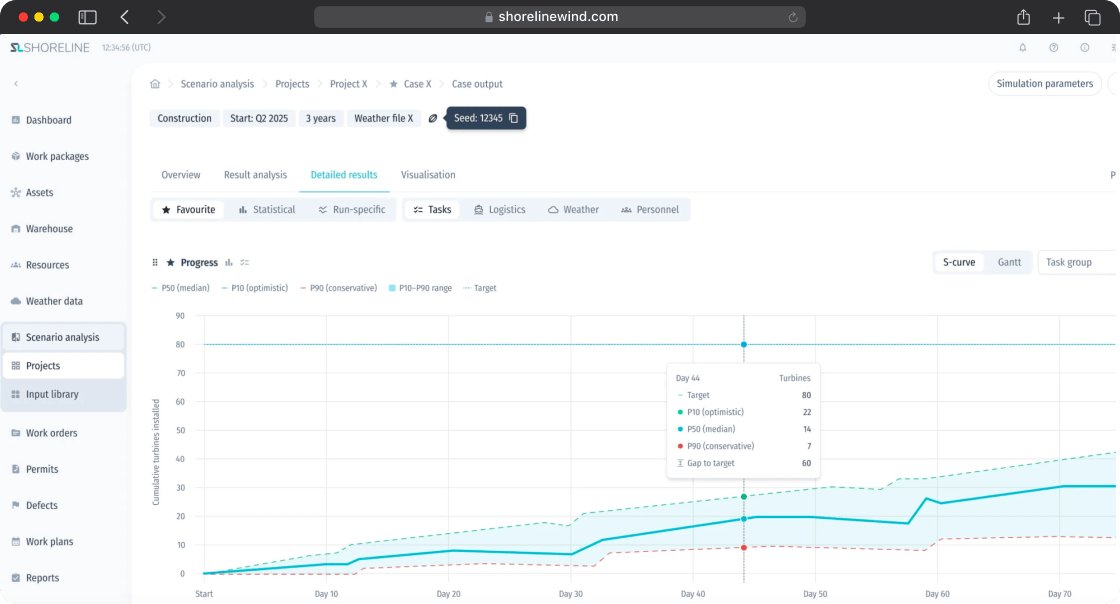
Shoreline Wind is a Norwegian AI-powered platform for wind farm logistics, installation, and O&M management. It entered the onshore wind market in June 2025, having previously focused on offshore operations. Ørsted uses it to simulate long-term operational logistics; Ocean Winds selected it in 2025 to scale offshore operations; RENOVA uses it for onshore wind challenges in Japan and the Philippines.
Key features
- AI-powered CMMS — maintenance planning, work order generation, and personnel assignment
- O&M Design Simulation — model operational scenarios before committing to a maintenance strategy
- Field service scheduling — saves up to 10% OPEX through scheduling and deployment optimisation (Shoreline published data)
- Real-time progress reporting — KPIs across active operations
- Logistics and installation planning — full project lifecycle from construction through O&M
- Onshore and offshore coverage — expanded to onshore in 2025
- Integration with existing ERP and asset management systems
Best for: Offshore and onshore wind operators managing complex operational logistics who need AI-assisted O&M planning and CMMS, particularly where scheduling complexity and crew deployment are major cost drivers.
Limitations: Shoreline is an O&M management and simulation platform. It does not run field inspection checklists, issue PTW forms, or produce the compliance records needed for individual turbine audits.
Notable customers: Ørsted, Ocean Winds, RENOVA.
Pricing
Enterprise pricing — contact Shoreline directly.
4. SkySpecs: Best for Blade Defect Analytics and Historical Comparison
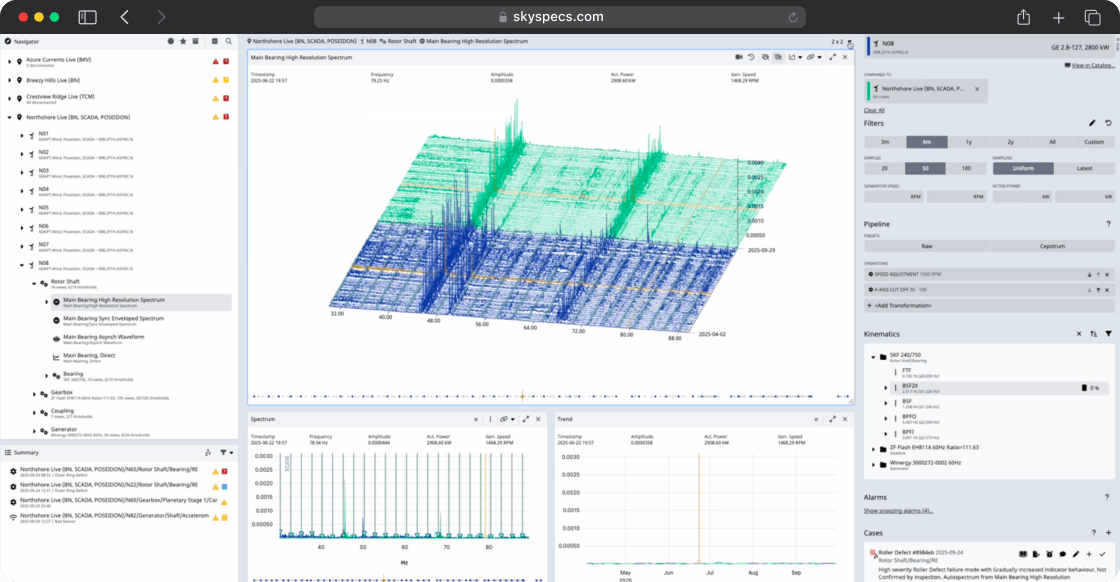
SkySpecs runs autonomous blade inspection at approximately 15 minutes per turbine and stores findings in its Horizon Analytics platform for historical comparison. The speed matters specifically in offshore contexts where weather windows are narrow; the historical comparison matters for repair prioritisation.
Key features
- Autonomous blade inspection — pre-programmed flight paths per turbine model
- Horizon Analytics platform — defect management, severity rating, and historical comparison across cycles
- Defect progression tracking — compare findings against previous inspection cycles
- Fleet-scale deployment capability
- Integration with maintenance planning systems
Best for: Operators who have completed at least two inspection cycles and want structured analytics to track defect progression and inform repair versus monitor decisions.
Limitations: SkySpecs covers the drone and analytics layer. Field inspection documentation — the human inspection process at and inside the turbine — requires a separate tool.
Pricing
Contact SkySpecs.
5. Onyx InSight: Best for Condition Monitoring with Field Inspection
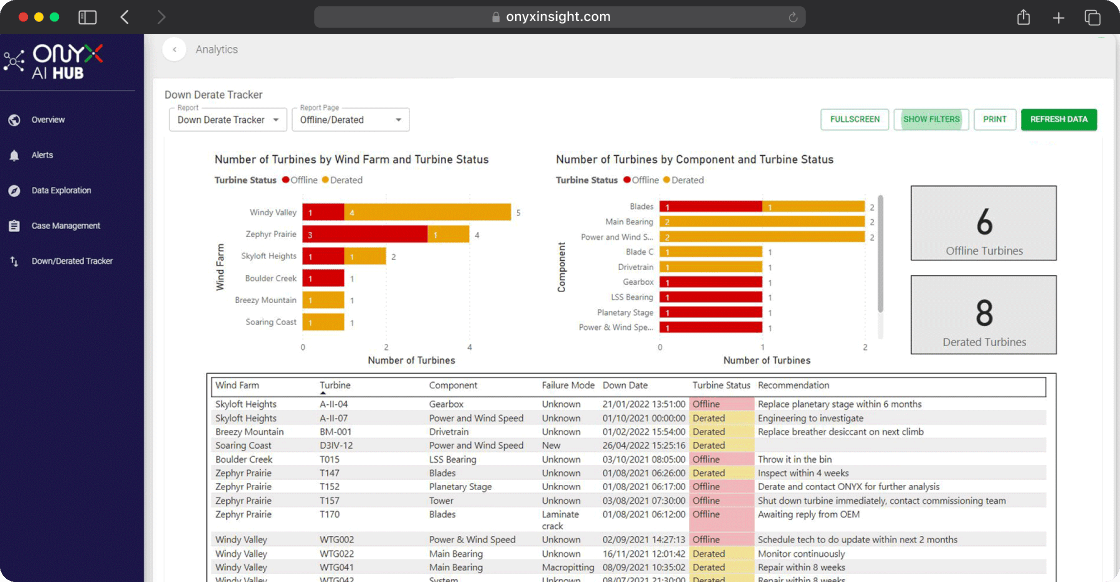
Onyx InSight monitors over 28,000 turbines across 35 countries through its fleetMONITOR platform, with predictive fault detection published at up to 24 months of lead time before major drivetrain failure. Its fieldPRO product extends into field inspection workflows, making it one of the few vendors that connects the monitoring and execution layers in a single relationship.
Key features
- fleetMONITOR — continuous condition monitoring with predictive analytics
- Predictive fault detection — up to 24 months lead time for major drivetrain faults (published capability)
- ecoCMS hardware sensors — direct turbine asset monitoring
- fieldPRO — field inspection management for wind technicians
- Connected workflow — monitoring alerts trigger inspection tasks in the same system
Best for: Operators who want condition monitoring and field inspection managed by a single vendor, reducing the integration overhead between the monitoring signal and the inspection response.
Limitations: Onyx’s condition monitoring is established and well-cited. fieldPRO is newer and less proven at scale than the monitoring product. Evaluate both independently before selecting Onyx on the basis of the combined pitch.
Pricing
Contact Onyx InSight.
6. Scopito: Best for Drone Inspection Data Management
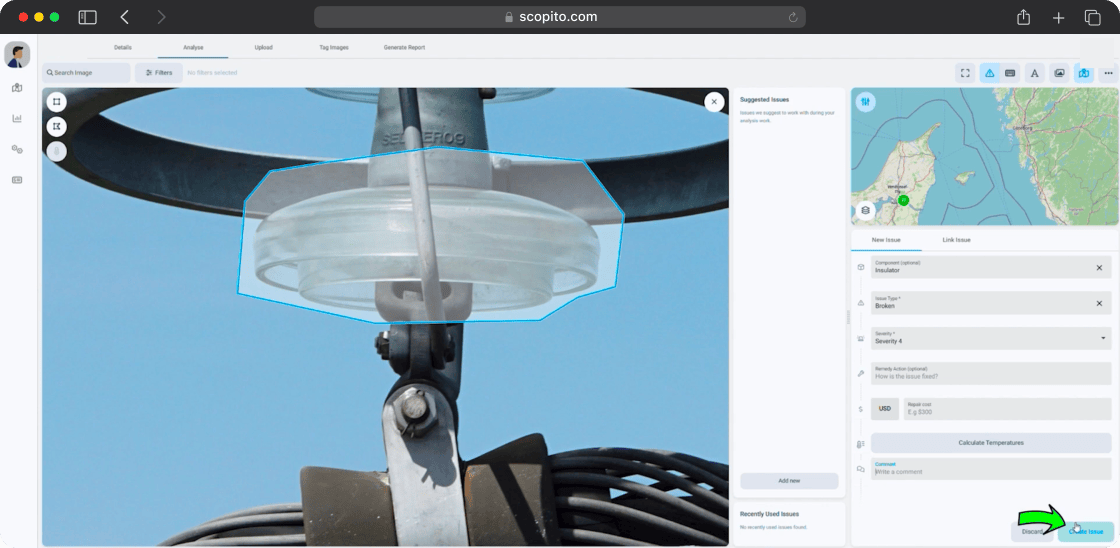
Scopito is a hardware-agnostic drone inspection data management platform. It accepts imagery from any drone source and provides annotation, defect classification, and reporting tools. Designed for operators or service providers who receive raw imagery from drone campaigns rather than processed defect reports.
Key features
- Multi-source image ingestion — accepts data from any drone hardware or service provider
- Defect annotation and classification — manual and AI-assisted tools
- Portfolio-level defect management — across multiple turbines and sites
- Historical comparison across inspection cycles
- Report generation from annotated findings
Best for: Inspection service providers handling imagery across multiple clients and drone platforms, or operators whose drone campaigns are run externally and who need a single platform to process findings.
Limitations: Scopito is not an autonomous inspection platform — it requires drone imagery as input. It does not manage the field inspection workflows that follow a blade finding.
Pricing
Contact Scopito.
Comparison Table
| Tool | Layer | Offline capable | Wind-specific | Corrective actions |
|---|---|---|---|---|
| Fluix | Field inspection management | ✓ True offline | ✓ | ✓ Automated, verified closure |
| vHive | Drone / AI blade inspection | N/A — cloud | ✓ | Via integration |
| Shoreline Wind | O&M and CMMS | Limited | ✓ | Via work orders |
| SkySpecs | Drone / AI blade inspection | N/A — cloud | ✓ | Via integration |
| Onyx InSight | Condition monitoring + field | Partial | ✓ | Via fieldPRO |
| Scopito | Drone data management | N/A — cloud | ✓ | No |
Frequently Asked Questions
- What is the best wind turbine inspection software?
The right answer depends on which layer of the inspection problem you’re solving. For field inspection management — checklists, corrective actions, PTW, LOTO, and compliance records — Fluix is the tool I recommend from direct experience with wind energy operators. For autonomous blade inspection, vHive and SkySpecs lead in 2026. For O&M planning and CMMS, Shoreline Wind is widely adopted by offshore operators including Ørsted.
2. Do I need drone inspection software and field inspection management software?
For a complete programme, yes. Drone software captures and classifies blade defects. Field inspection management software runs the human inspection process and tracks corrective actions to verified closure. Most operators who have one without the other discover the gap when an auditor asks for documentation the drone platform cannot produce.
3. What features should wind turbine inspection software include?
For the field management layer: true offline capability, photo documentation linked to specific findings, automated corrective action creation with verified closure, PTW and LOTO support, and audit-ready record retrieval. For blade inspection: autonomous flight standardisation, AI defect classification with a stated false-positive rate, and historical comparison across cycles.
4. Does wind turbine inspection software work offshore?
True offline capability is the critical requirement for offshore. Fluix allows inspectors to complete full forms, attach photos, and submit with no connectivity — records sync when connectivity returns. Cloud-based drone platforms require connectivity for data upload but not during the inspection campaign itself.
5. How much does wind turbine inspection software cost?
Fluix starts at $29/user/month. Enterprise plans are priced on request. vHive, Shoreline Wind, SkySpecs, and Onyx InSight are enterprise-priced with no published pricing — contact each vendor based on fleet size.