



Monday.com is a project management platform that provides dashboards to delegate tasks and track their progress. Besides that, monday.com can be used as a CRM tool that will allow you to manage leads or sales pipelines.
By integrating Fluix and monday.com, you will streamline the whole process: from collecting data by remote teams on mobile devices, to the automated creation of tasks, leads, or any other items on the monday.com dashboards, with the filled documents attached.
Note. Integration requires a Core account in Fluix and a Standard account in monday.com. To try the option, you can register for a free trial account in both tools.
Let’s look at how this integration works in case monday.com is used for managing the project.
Step 1 – Creating a Workspace and a Board in monday.com
Before building the integration with Fluix, you will need to have the Workspace and the Board created in monday.com. Upon each document’s submission in Fluix a task will be created on that Workspace and a Board with the respective document attached.
Workspace provides your account with a hierarchy of organization in order to better manage multiple departments, teams, and projects in one unified place. To proceed with the setup, join the relevant Workspace or create your own.
Each of the Workspaces consists of the Boards with tasks (or any other item terminology relevant to your board’s content). Add a Board to your Workspace and customize it in accordance with your business needs. Please find the example of the created Board below:

Step 2 – Creating a Fluix app in monday.com
During this step, you’ll need to create the Fluix App in monday.com that will be used for authentication and to specify how Fluix needs to access your monday.com account.
1. To register the Fluix App, please follow the link.
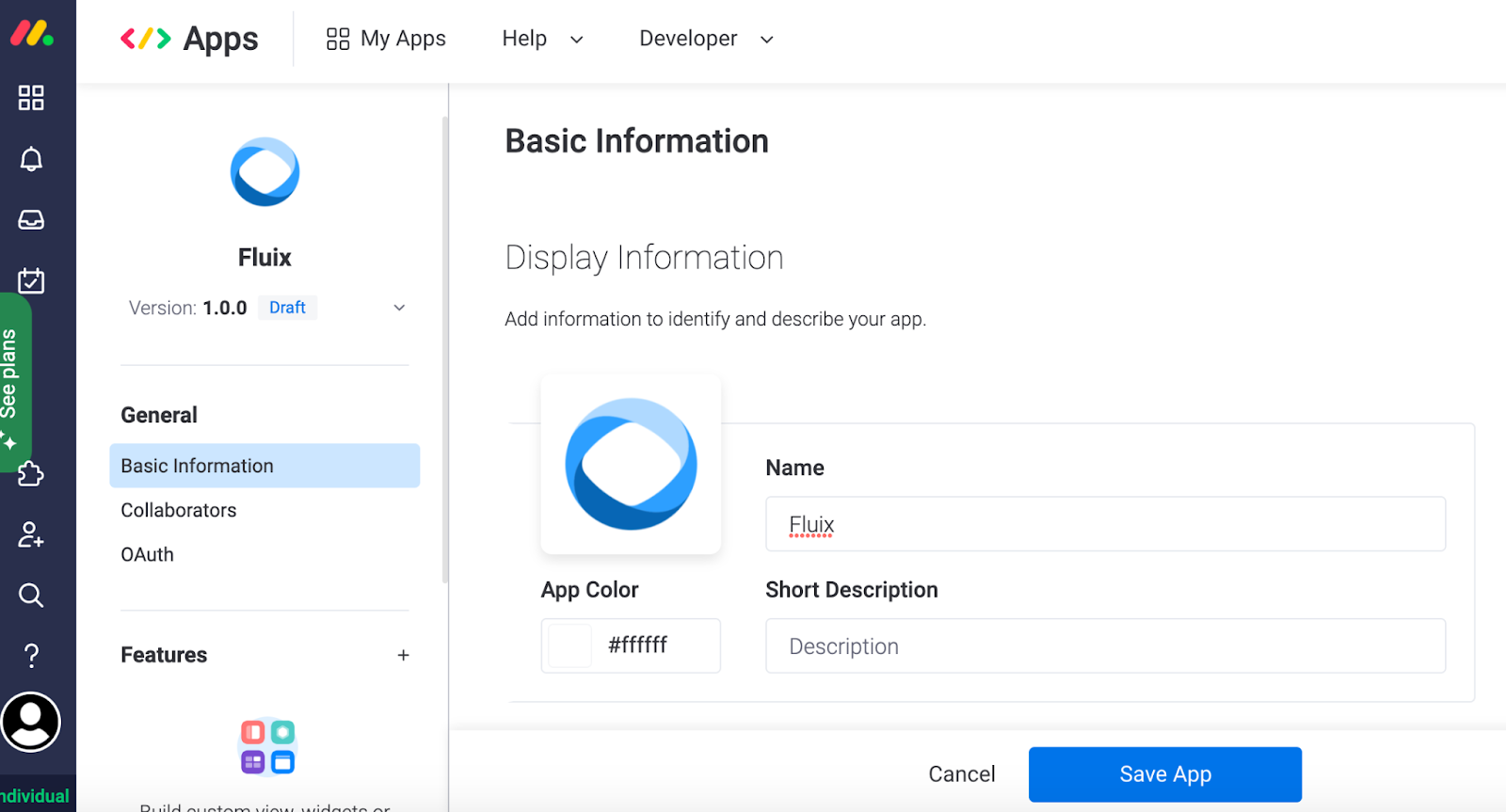
2. Click Create App, specify the name of the app, let’s say “Fluix App”, and click Save App.
3. Take note of the client ID and the client secret in the Authorization tab. These parameters will be used for authorization further.

4. Go to OAuth – Scope tab and specify the permissions that Fluix will have in monday.com. For this type of integration, you will need three of them:

5. Specify the Redirect URL depending on the domain you’re using in Fluix (you can check it upon login to your Fluix account). Select the one from the list:
https://admin.fluix.io/api/intg/oauth2/authorization-code
https://admin-eu.fluix.io/api/intg/oauth2/authorization-code
https://admin-eu2.fluix.io/api/intg/oauth2/authorization-code
https://admin-aus.fluix.io/api/intg/oauth2/authorization-code
https://admin-us-west.fluix.io/api/intg/oauth2/authorization-code
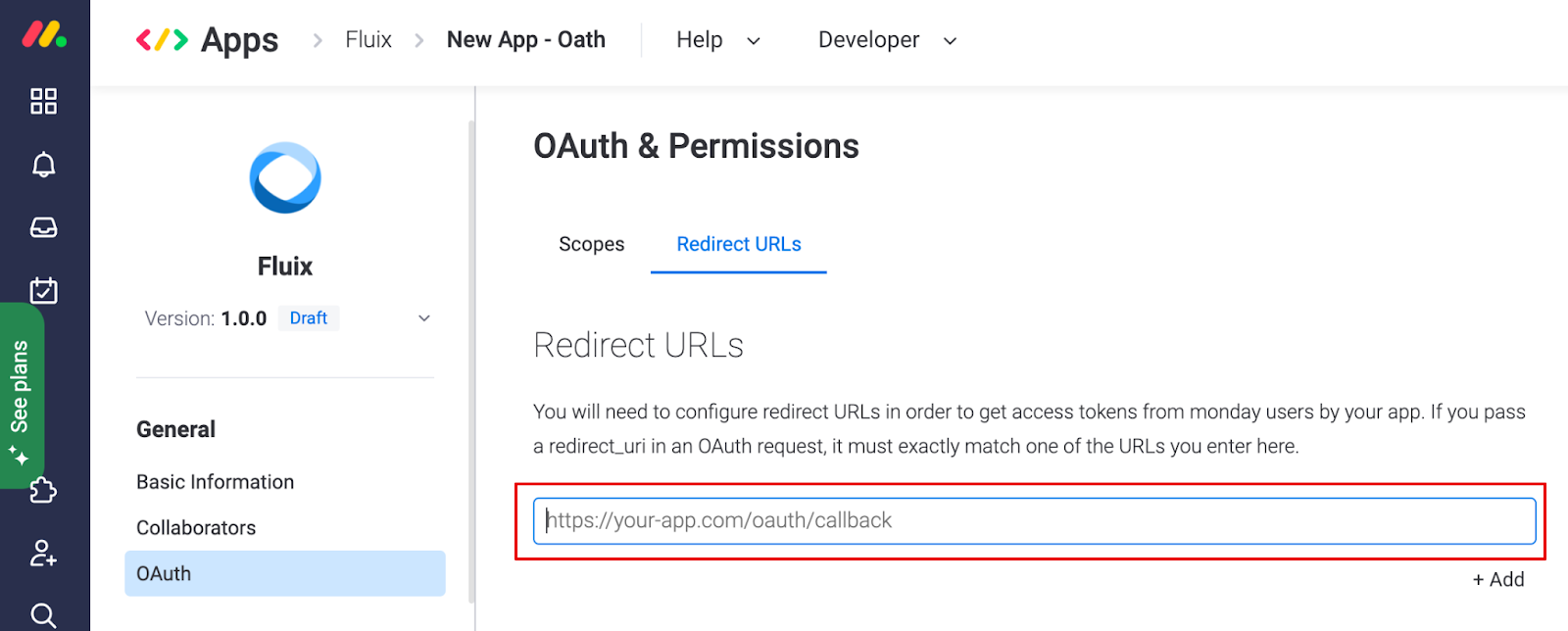
Once done, click Save Feature.
Step 3 – Configuring a Fluix Workflow
In your Fluix account, go to Configuration > Workflows. Select the workflow or create a new one for the documents that need to be filled out in the Fluix app and then appear as attachments on the dashboard in monday.com.
In the selected workflow, add a submit action called Upload to CRM/ERP. We will need to configure 2 requests for being able to create a task (or any other item terminology relevant to your business case and board’s content) and upload the file to it.
Process 3.1 – Configuring a request for creating a Task
1. Configure the request name, let’s say “Create a Task”, select POST as the data type, and add the following URL – https://api.monday.com/v2.
2. Go to the Header tab and enter the following:
- Header name – Authorization
- Header value – OAuth2
- Header name – Content-type
- Header value – application/json

Note: We recommend entering the value manually since it will allow adding already preset parameters from the dropdown list.
3. Go to the Body tab:
- Enter the following in the Text tab: {“query”: “mutation { create_item (board_id: %board_id%, group_id: \”topics\”, item_name: \”Document Name\”){id}}”}
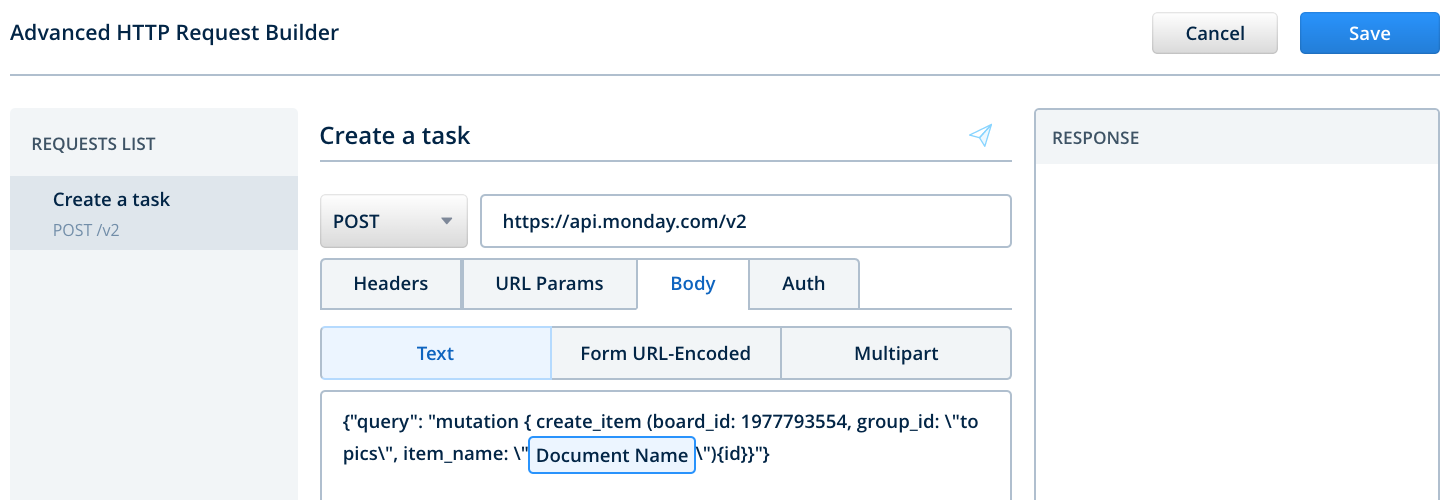
- Replace the %board_id% parameter with the ID of the board to which the task needs to be added. You may find it in the address bar when the monday.com board tab is opened:
- We recommend entering the value Document Name manually since it will allow adding already preset parameters from the dropdown list.

4. Go to the Auth tab and open the OAuth section:
- Select ‘Authorization code’ in the Grant type field
- Specify the client ID and the client secret in the relevant fields generated during step 2.
- Add the link https://auth.monday.com/oauth2/authorize to the Authorization URL field.
- Add the link https://auth.monday.com/oauth2/token to the Access token URL field.

5. Once done, click Get Access and you will be redirected to the page where you will be requested to provide permission to the Fluix app in monday.com. Click Allow to proceed. As an indicator that everything was set up successfully, you’ll see a green ‘Access Granted’ in the Auth tab.
Process 3.2 – Configuring a request for uploading a File
1. Configure the request name, let’s say “Upload a File”, select POST as the data type, and add the following URL – https://api.monday.com/v2/file.
2. Go to the Header tab and enter the following:
- Header name – Authorization
- Header value – OAuth2

Note: We recommend entering the value manually since it will allow adding already preset parameters from the dropdown list.
3. Go to the Body tab and select the Multipart tab:
- Part name – query
- Part value – mutation add_file($itemId: Int!, $column: String!, $file: File!) { add_file_to_column(item_id: $itemId, file: $file, column_id: $column) { id name file_size } }
- Part name – variables
- Part value – {“column”:”files”, “itemId”:Response Body}
- Configure the Response Body parameter by clicking on it, selecting the necessary request and adding the key path – data.create_item.id:

- Click Save to apply the changes.
- Part name – map
- Part value – {“document”:”variables.file”}
- Part name – document
- Part value – Document File
- Configure the Document File parameter by clicking on it, selecting the necessary document type.

4. Go to the Auth tab and open the OAuth section:
- Select ‘Authorization code’ in the Grant type field
- Specify the client ID and the client secret in the relevant fields generated during step 2.
- Add the link https://auth.monday.com/oauth2/authorize to the Authorization URL field.
- Add the link https://auth.monday.com/oauth2/token to the Access token URL field.
5. Once done, click Get Access. You’ll see a green indicator ‘Access Granted’ in the Auth tab.
6. After all the requests are configured, click Save in the top right corner of the Advanced HTTP Request Builder. To save changes in a workflow, click Save & Apply to apply the changes to the workflow and go to test the setup.
Step 3 – Testing the integration
Go to the Fluix app on the device or User App in the web browser version. Open a test form, fill it out and submit it through the workflow.
In monday.com, you will see a new Task created with an attached file in it.
In case you have any questions or difficulties with setup, contact our support at support@fluix.io and we’ll be happy to help you.
Check other business integrations here.